
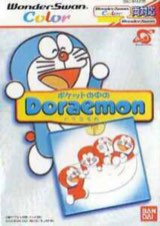
A Doraemon raising and conversation game for the WonderSwan Color in which the player looks after a small Minidora together with Doraemon.
Screenshots

Title screen 
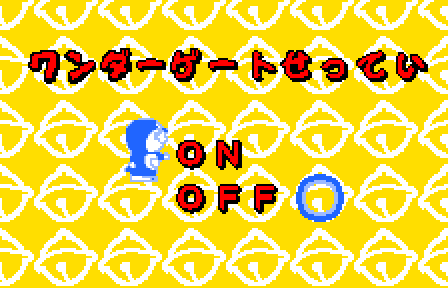
In play 





Pocket no Naka no Doraemon is a game based on Doraemon, the long-running manga and anime about a robot cat from the future. Bandai published it in Japan on 24 May 2001 as a raising and communication game. Instead of following the anime’s characters through an adventure, it casts the player as someone Doraemon meets by mistake.
The player looks after a Minidora, one of the tiny Doraemon-like robots from the series, with Doraemon at their side, and the little robot grows through the conversations the two of them have. The game was made with the WonderSwan Color in mind, but it works on both the colour console and the original black-and-white WonderSwan. It was priced at 4,500 yen.
The story
The game is set in the player’s own room rather than in Nobita’s house. Doraemon, the robot cat from the future, sets off for what he thinks is Nobita’s room but arrives in the player’s by mistake. The player takes part as themselves and not as one of the anime’s children.
Doraemon does not leave straight away. He senses that the player is on the same wavelength as Nobita and decides to stay with them for a while. As a token of the friendship that begins there, he hands over a Minidora, and from that point the player and Doraemon bring it up together.
The story is the time the three of them, the player, Doraemon and the Minidora, spend together. Doraemon’s stay is not permanent, and the days run on towards the day he has to say goodbye. What happens in those days shapes what kind of Minidora the player ends up with and decides which ending the game reaches. It is an everyday story of a friendship with Doraemon, told through conversation and small pastimes rather than an adventure.
How it plays
Pocket no Naka no Doraemon is a one-player game played with the console held horizontally. Bandai called it a raising and communication game. At the start the player picks one of four Minidora, each modelled on one of the familiar children and each with its own temperament: the Nobita type is always napping, the Suneo type is timid, the Shizuka type is well-mannered and the Gian type is a troublemaker. The choice sets the character of the robot the player then raises.
The heart of the game is conversation. The Minidora does not grow by being fed or trained directly but by watching the exchanges between the player and Doraemon, so how the player talks with Doraemon shapes the robot. Raising it well also means telling it off now and then, so that it grows up obedient.
Alongside the talking there are mini-games. One of them is a fishing game in which the player can try to land a big catch. The total number of mini-games is not certain.
The game runs over the days leading up to Doraemon’s farewell, and the way those days are spent decides the ending. Progress is kept in the cartridge’s 16-kilobit EEPROM, and the sound is in stereo. There are no link cable features. The game supports both the WonderSwan Color’s colour graphics and the original console’s black-and-white display.
Development and release
The cartridge was sold as SWJ-BANC0D for 4,500 yen before tax and keeps its save data in EEPROM. Its copyright line names Fujiko Productions, Shogakukan and TV Asahi as the holders of the Doraemon licence alongside Bandai; no separate development studio is named. As a purchase bonus, Bandai’s online shop e-Shopping! Toys gave buyers a limited number of Doraemon pouches decorated with original artwork and sized to hold a WonderSwan or WonderSwan Color.
Ports and other versions
Pocket no Naka no Doraemon was made for the WonderSwan and was never ported or re-released. It is the only Doraemon game on the WonderSwan, and it has no version for any other system. Other Doraemon games of the same year include Epoch’s pet-themed Doraemon: Kimi to Pet no Monogatari for the Game Boy Color, released two months earlier in 2001; this cartridge stands apart from them as a Bandai game built around raising a Minidora through conversations with Doraemon.