
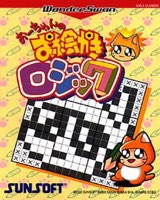
Sunsoft's picture logic puzzle game starring O-chan from the Hebereke series, with 300 puzzles sized for the wide screen and a timed story mode of nine-part pictures.
Screenshots
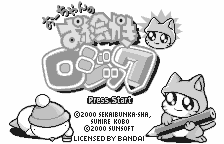
Title screen 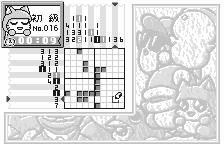
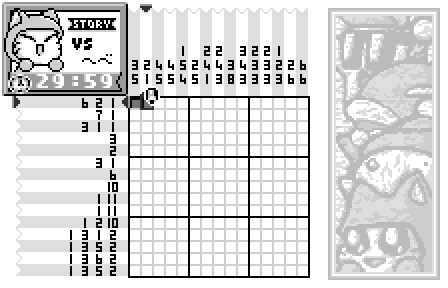
In play 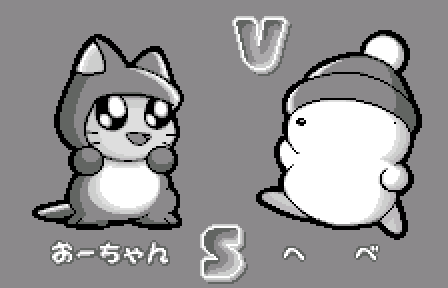
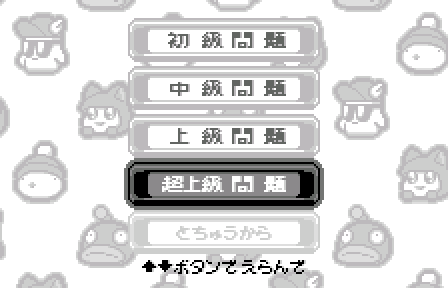

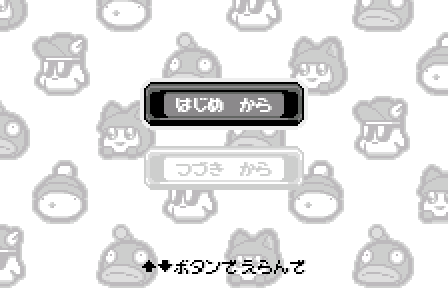
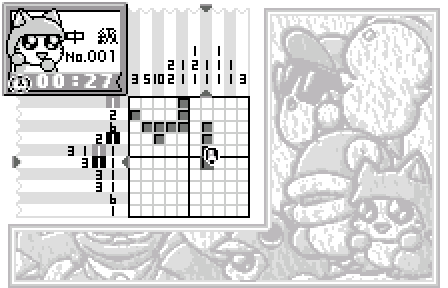
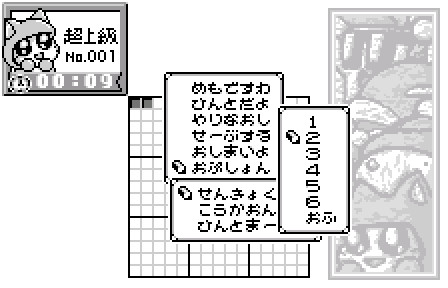
O-Chan no Oekaki Logic is a picture logic puzzle game published by Sunsoft for the WonderSwan on 6 January 2000. It continues a series that Sunsoft had started in 1995 on the PlayStation, the Saturn and the Super Famicom. Its star is O-chan, a haughty girl in a cat costume from Sunsoft’s Hebereke games, whose puzzle spin-offs went on to outnumber the games of the series she came from.
The puzzles follow the familiar oekaki logic rules, a form also known as nonograms. Numbers along the top and side of a grid say how many squares in each row and column are filled in, and working out where they go reveals a picture. The console is held sideways, and its wide screen allows grids of up to 25 by 15 squares. Bandai’s announcement before release spoke of 400 puzzles; the finished game has 300 in its main mode, sorted into four levels of difficulty, plus a timed story mode in which large pictures are put together from nine pieces. It is for one player and has no link cable play.
The story
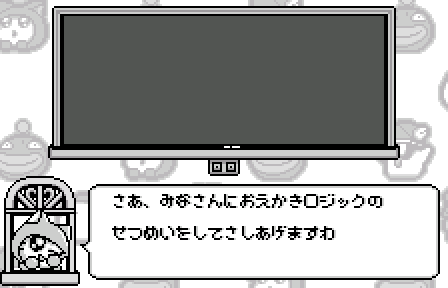
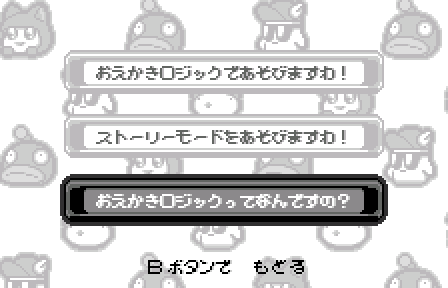
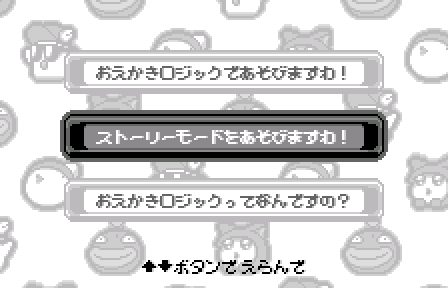
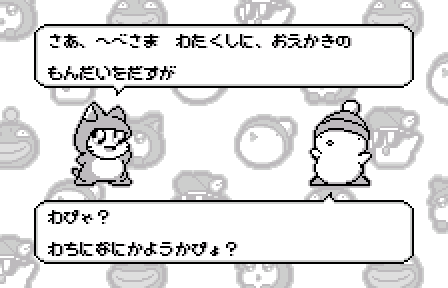
There is no plot in the usual sense. The game borrows the cast of Sunsoft’s Hebereke series, a band of odd creatures, and makes O-chan the host. She is a girl in a cat costume who looks sweet but is haughty, talks in the elaborate speech of a well-bred young lady and is given to loud laughter, and the whole game speaks in her voice: the menu entries end in her ladylike turns of phrase, so the main mode is announced as playing oekaki logic, desu wa style, and the tutorial asks what oekaki logic might be.
The story mode turns the puzzles into a string of contests. O-chan meets the Hebereke characters one at a time, and each sets her a picture to complete. They come in a fixed order: Hebe, the snowman-like hero of the series; Sukezaemon, a ghostly figure in sunglasses and a plumed hat who speaks like a polite samurai; Jennifer, a two-legged anglerfish with a foul mouth and a soft heart; Bobodori, a peculiar bird that keeps losing its egg; Pen-chan, a girl in a penguin costume; the alien Utsuzin; and Unyohn, the series’ emperor of evil. What happens after the last of them is best found out in play.
Most of the charm is in the presentation. O-chan stands in the top left corner of the screen and reacts to the player’s work, and in the story mode she grows flustered as time runs short and turns her back in dejection when it runs out. The space left beside the smaller grids is filled with drawings of the Hebereke cast. Each finished puzzle is shown as a whole picture, in shades of grey rather than plain black and white, since the console has no colour. The puzzles were made under the supervision of Sekai Bunka-sha, one of the companies named in the copyright line.
How it plays
The A button fills a square, B marks it with a cross as known to be empty, and the Y buttons, at the top left of the console as it is held, place a provisional mark. Pressing a button on a square that is already in that state turns the cursor into an eraser, and holding the button clears further squares as the cursor moves. Wrong fills carry no penalty and are not corrected automatically: a puzzle is solved when the grid matches the picture, and the game then records the best time.
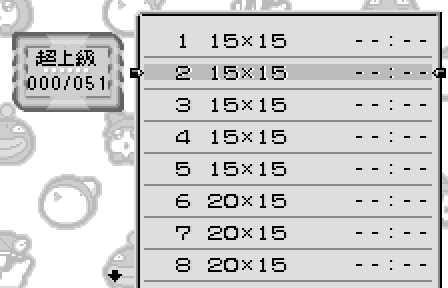
The main mode holds 300 puzzles in four levels: 89 beginner, 90 intermediate, 70 advanced and 51 very advanced. Grids start at 5 by 5 and are square up to 15 by 15; the larger ones stay 15 squares high and grow to 20 and 25 squares wide. Every grid fits on the screen at once, so there is none of the scrolling of the Super Famicom game, and the beginner 5 by 5 puzzles show what each button does beside the grid. Size is not the same as difficulty: a 25 by 15 beginner puzzle can be worked out step by step, while the small very advanced ones give away so few certain squares at the start that they are harder.
A menu during play holds the tools. Memo desu wa stores the board as it stands for a while, and Hint da yo tells whether a chosen square is filled or empty, as often as wanted, but a puzzle solved with a hint gets no recorded time. There is also a command to clear the board, which leaves the clock running, a save command that keeps the board for good so that the puzzle can be continued later from the difficulty menu, and a give-up command that asks whether to save before going back to the puzzle list. The options offer six pieces of music or silence, and three sets of sound effects: ordinary ones, none, or O-chan’s voice calling out each fill, cross and erasure. A hint marker can highlight the clue numbers that the board does not yet contradict, but it only checks for contradictions, so a highlighted number is not necessarily solved, and it ignores filled runs shorter than the clue.
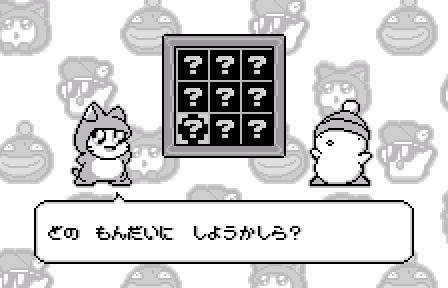
In the story mode each opponent’s picture is a 45 by 45 image cut into nine 15 by 15 puzzles, which can be solved in any order. Each piece has a 30-minute limit and the hint command cannot be used. The pieces are all titled with question marks, and the finished picture’s name is never given. A part-solved story puzzle cannot be kept, and saving in the story mode erases any puzzle that had been kept for later in the main mode. The later opponents set puzzles at the advanced and very advanced level.
Progress is saved to the cartridge, but there is no automatic saving: after every puzzle the game asks whether to save, even when no new record was set, so a hard puzzle solved and not saved before the batteries die is lost. All the data can be wiped, which is mostly useful for starting the story mode again. Once all 300 puzzles have been solved, the staff roll plays after every puzzle and cannot be skipped, and it also plays after a short scene when a finished story mode is continued.
The game is hard. The tutorial runs by itself and explains only the most basic rules, much as the Super Famicom game did, and then declares the player an oekaki logic master, but from partway through the advanced puzzles there are grids that can only be solved by assuming a square and following the assumption until it leads to a contradiction. Some take even experienced solvers more than half an hour. The tip passed on for these is the memo command, which the game never explains: store the board, try a guess, and go back to the memo if it goes wrong. Without it the last opponents of the story mode are close to impossible within the time limit.
Compared with the earlier home versions, this one drops the puzzle editor and the mode for playing against another person; O-chan is the only character with a voice. In return it gets a story mode of its own built on nine-piece pictures, whole-picture views of finished puzzles and grids that fit the screen.
Development and release
The publisher appears under its company name, Sun Electronics, and the copyright line credits Sunsoft together with Sekai Bunka-sha and Sumire Kobo. A company named Santaclaus is also credited alongside Sunsoft, but its role is unclear, and it has never been confirmed as the developer. The cartridge was sold as SWJ-SUN004 for 3,800 yen and uses EEPROM to keep saves.
Ports and other versions
Bandai announced the cartridge as a conversion, and it shares its title with the first O-Chan no Oekaki Logic, which came out on the PlayStation in September 1995, on the Saturn in November and on the Super Famicom in December of that year.
The home versions were not alike. The Saturn release has a story mode in which O-chan travels the world solving puzzles to rescue a kidnapped Hebe, while the Super Famicom one has no story at all. The WonderSwan game has its own story mode built on jigsaw-style puzzles, and its grids, at up to 25 by 15 squares, were laid out for the console’s wide screen. Two PlayStation sequels followed, Logic 2 in 1996 and Logic 3 in 2001, and the WonderSwan game itself was never re-released.