
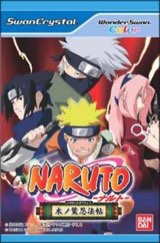
A WonderSwan Color role-playing game based on Masashi Kishimoto's Naruto, published by Bandai in 2003 and the first video game of the series.
Screenshots
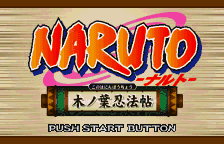
Title screen 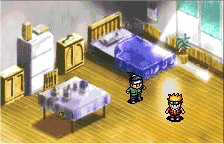
In play 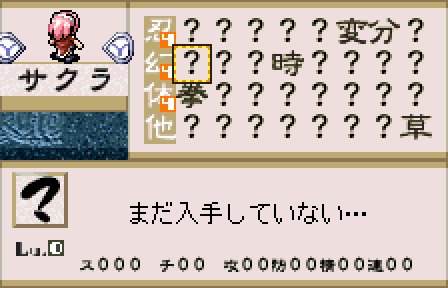
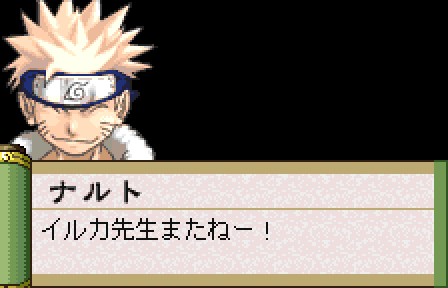
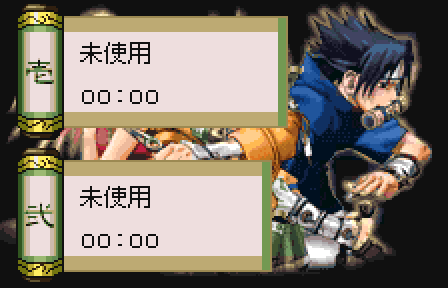
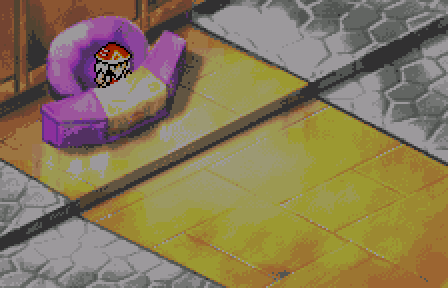
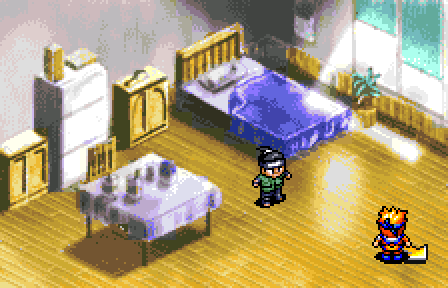
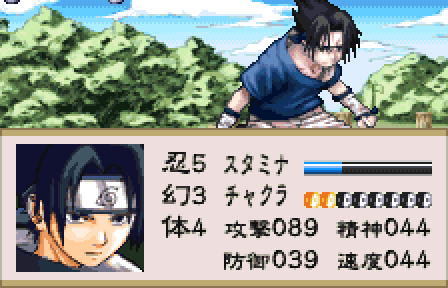
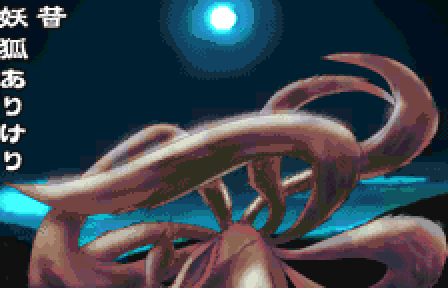
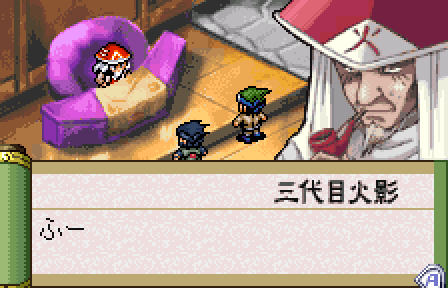
Naruto: Konoha Ninpouchou is a role-playing game for the WonderSwan Color, published by Bandai in Japan on 27 March 2003. It is based on Naruto, Masashi Kishimoto’s ninja manga, which began in Weekly Shonen Jump in 1999 and had been running as a television anime since 2002. It was the first video game made from the series, and it remained the only Naruto game released on one of Bandai’s own consoles.
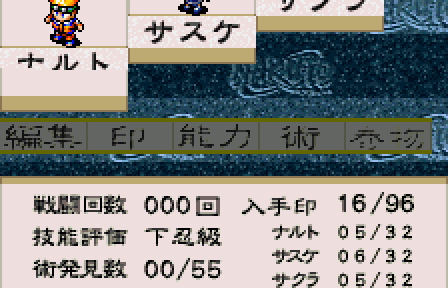
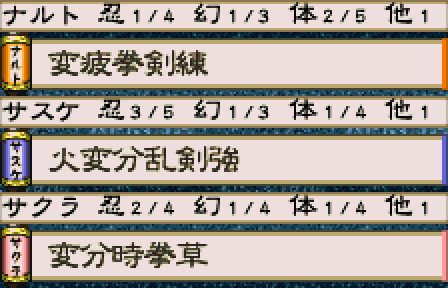
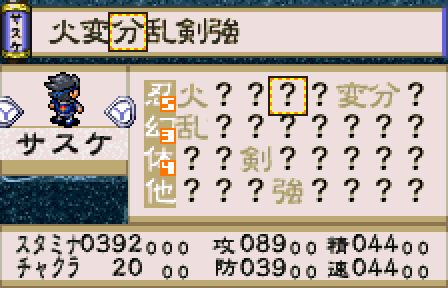
The player leads Naruto Uzumaki and his teammates Sasuke and Sakura through a run of missions in the Hidden Leaf village, some from the manga and many made for the game. Growth and combat both rest on hand seals: the seals a character earns are written into a scroll, where they shape the character’s statistics and also serve as the commands used in battle.
The game was developed by BEC, a studio that made several other WonderSwan titles for Bandai, among them the SD Gundam Eiyuuden games and the Dokodemo Hamster series. It is a WonderSwan Color title and does not run on the original black-and-white WonderSwan. It came out late in the system’s life, about eight months after the SwanCrystal went on sale, and was sold only in Japan.
The story
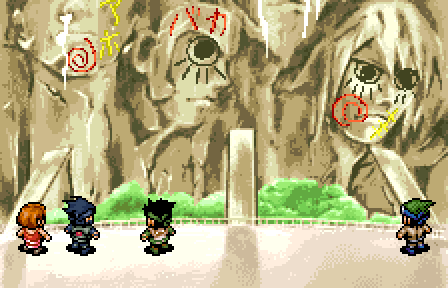
The game is set in the Hidden Leaf village. Naruto Uzumaki is the village troublemaker, a boy who fell behind at the ninja academy but dreams of one day taking the title of Hokage, the highest rank a ninja can hold, and of surpassing the Hokage who came before him. A prologue shows the Fourth Hokage and the Nine-Tailed Fox, and the game then picks up after Naruto has scraped through his graduation and become a genin. Well-known scenes from the early chapters of the manga are staged along the way, such as Naruto daubing graffiti on the carved faces of the Hokage.
Naruto is placed in Team 7 with Sasuke and Sakura under their teacher Kakashi. After a training test with Kakashi, the story moves on to the low-ranked D-rank missions given to new ninja, and the player chooses which of them the team takes on. Some come from the manga, such as the hunt for the runaway cat Tora, and some can be failed. Many others were written for the game and bring in characters of its own: a young princess named Hotaru who asks to be shown around the village under the name Kisago, an important boy named Kawara whom the team must keep entertained, together with his guardian Shikii, and two elders, Kizuchi and Yasuri, who train Team 7 and Team 8 in the forest.
The wider cast of the early manga fills out the village. Iruka, Konohamaru, the other new genin and their teachers all appear, and the other teams’ genin are met as rivals and opponents, some of them joining the player for a while. Konohamaru stirs up trouble that the village blames on Naruto, and at one point the teachers of the four genin teams take their students to the beach to train them against one another. Hired thugs and ninja who have deserted the Hidden Leaf turn up as common enemies. The story runs from Naruto’s first missions into the opening of the manga’s Land of Waves arc, when Team 7 is sent to escort the bridge builder Tazuna home.
How it plays
The story missions are played as Naruto, Sasuke or Sakura, and some of the other characters join for short stretches. Each character carries a scroll of hand seals. Completing missions earns new seals, and writing a seal into the scroll is how a character grows: each kind of seal pushes the character’s statistics in its own direction, and a character’s level is set by the levels of the seals in the scroll. A seal levels up the more it is used. There are 32 kinds of seal in the story, 96 counting each of the three main characters separately, but a scroll holds only 12 at a time, so once it is full the player chooses in the pause menu which seals to keep.
Battles are turn-based, and the seals are the command list. Five seals from the scroll are drawn at random for each choice, and a seal that is used is replaced by another from the scroll. Seals fall into four groups: ninjutsu, genjutsu, taijutsu and others. They also matter in defence, where ninjutsu avoids genjutsu, genjutsu avoids taijutsu, and taijutsu avoids ninjutsu, so the order of play works like rock, paper, scissors.
The ninjutsu seals include basic fire, water, earth, wind and lightning attacks, each of which turns into a stronger seal when it reaches level 10, as well as the Shadow Clone, which adds a clone to the fight that vanishes when it is hit, and the Body Replacement, which is used only to dodge or in combinations. The genjutsu seals work on the opponent: they can hide the opponent’s own seals behind question marks, reveal the seals in a target’s scroll, drain stored chakra, slow a target down, remove a seal from the target’s scroll or block one from use, or stop the target acting at all. The taijutsu seals cover punches, kicks and thrown shuriken, moves that raise attack, defence or speed, and a hiding move that makes the user immune to damage for a few turns. The others group holds the chakra seals, the modifiers and three healing seals of different strength.
Stronger techniques come from combining seals. Chakra is stored with two of the seals in the others group, or by passing a turn, and with enough of it two or more seals can be played together. Fire with the strength modifier gives a more powerful fire technique, fire with the multiple modifier hits every opponent, and fire with both gives an attack that is powerful and hits them all. Some combinations belong to one character, such as Naruto’s Sexy Technique, and Naruto also has his own combination attack, the Uzumaki Naruto Rendan. Seals from different characters can be joined into team attacks.
Some missions set their own conditions. In the mission to entertain Kawara the team fights a pond of carp that can make clones of themselves and recover their health, and all of them must be beaten within a set number of turns. Wild cats and white rabbits appear as random enemies in the search for Tora. All the text is in Japanese. The length of the game and its overall difficulty are not well documented.
Modes and features
Besides the story there is a two-player battle mode over the link cable. Fourteen seals can only be obtained through these link battles, among them the Summoning Technique, which calls a toad to attack, the Chidori, the Mystical Palm Technique for healing and the taijutsu moves Leaf Gale and Front Lotus. The cartridge holds 256 kilobits of SRAM for saved data.
Reception
The game is remembered for the effort it puts into recreating the story of the manga, and its battles depend more on giving orders as the fight unfolds than on preparation beforehand. Little has been written about it in Japanese.
Ports and other versions
Konoha Ninpouchou was made for the WonderSwan Color and was never ported or re-released. The Naruto games that followed on other handhelds came from Tomy rather than Bandai, beginning on the Game Boy Advance with Ninjutsu Zenkai! Saikyou Ninja Daikesshuu in May 2003 and Konoha Senki that September. Despite the shared word in its title, Konoha Senki is a different game, and Tomy’s own Naruto RPG of 2004 is likewise a separate work.
Notes
Bandai sold the game as a role-playing game, while Famitsu classed it as an action game.