
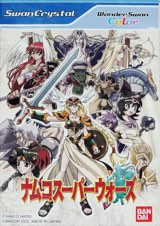
A tactical RPG for the WonderSwan Color that brings together heroes from Namco's older games, published by Bandai before the two companies merged.
Screenshots
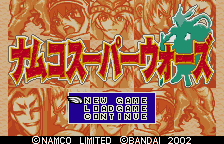
Title screen 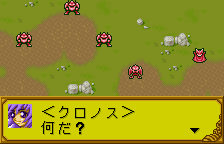
In play 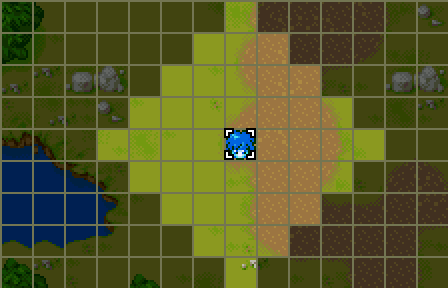
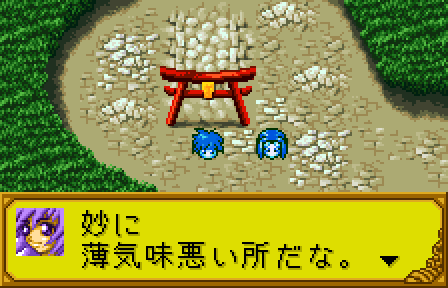
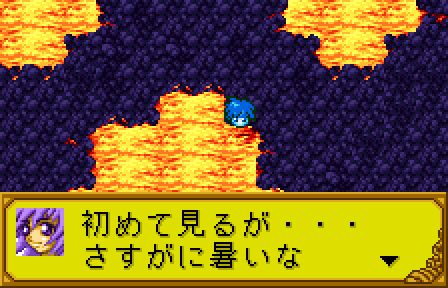
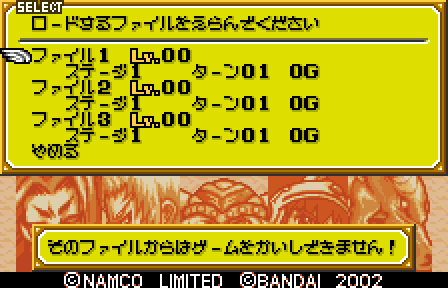
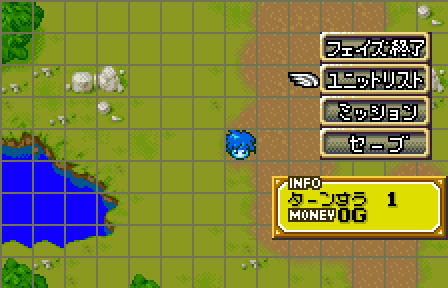
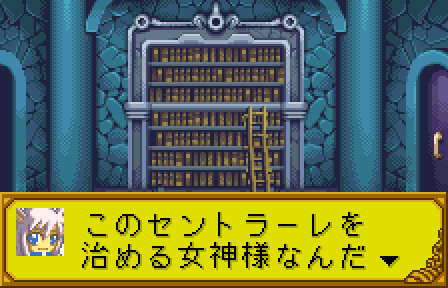
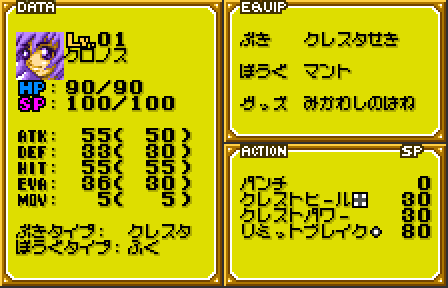
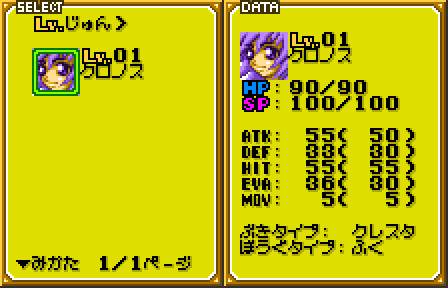
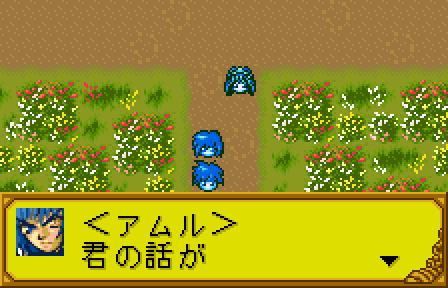
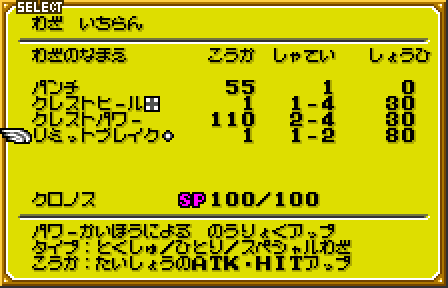
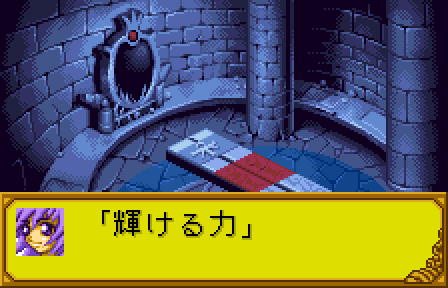
Namco Super Wars is a tactical role-playing game for the WonderSwan Color, published by Bandai in Japan on 31 October 2002. It is a crossover that gathers characters old and new from Namco’s games, among them figures from The Tower of Druaga, Valkyrie no Bouken, Dragon Buster, Genpei Touma Den, Wonder Momo, Bravoman, Mappy and Dig Dug. It was first due out in April 2002 and arrived about six months late. Released three years before Bandai and Namco merged, it is one of the few games the two companies worked on together. Which of the two developed it is unsettled, and the copyright line credits both companies.
The player is a hero with no memory, called to a hub world to recruit the heroes of five Namco worlds and fight beside them on square-grid battle maps, stage by stage. Instead of earning experience in battle, the party is given level-ups to share out after each cleared map.
The cartridge is for the WonderSwan Color only and does not run on the original black-and-white WonderSwan.
The story
The game opens with a voice. Kronos, the hero, wakes on hearing it and finds himself in a world he does not know, with no memory of who he is. Two locals, Kaka and Zeze, have been looking after him while he lay unconscious, and they tell him where he is: Centrale, the world at the centre of everything, ruled by a goddess named Gajes.
Centrale is in a crisis without precedent. Its Gate, which leads to every place there is and must never be opened, has suddenly opened and connected to the Great Calamity, and calamities of every kind are spilling out across the worlds. The Gate can only be closed by gathering the Shining Power, which should lie somewhere out in the worlds. Gajes built a transport device, the Tepota Arch, to reach them and collect it, but she is now sealed inside a crystal barrier and cannot move, so she has summoned Kronos as a new hero to go in her place. He does not know what he is, but he trusts the power he feels inside himself and agrees at once to set out.
The Tepota Arch opens on five worlds, each taken from older Namco games: Marvel Land from the Valkyrie games, Lakshis from Dragon Valor, the kingdom of Midgard from Dragon Spirit, the kingdom of Babylim with the Tower of Druaga, and an old Japanese realm from Genpei Touma Den. Each world has trouble of its own, often an old enemy from its home game such as Zouna in Marvel Land, and a hero who joins Kronos once that trouble is dealt with. Talking to the people of each world fills in what has happened there and what Kronos has to do. Beating the monsters of a single world does not bring lasting peace, so the journey keeps moving on to the next.
The heroes arrive carrying their old stories with them, and each carries a worry. Valkyrie, who has saved Marvel Land twice, feels crushed by the knowledge that she must one day become a goddess and guide its people. Amul, the soldier of Midgard who can become the Blue Dragon, still fears the dragon’s power even though he cannot save anyone without it. Gil, the golden knight of Babylim, has never stopped blaming himself for once failing to protect Ki. Clovis appears in his Dragon Valor form, alongside his son Arlen. The story branches with the characters the player chooses, each choice leading to its own scenario, and it mixes retellings of the heroes’ old tales with new adventures and the allies met along the way.
How it plays
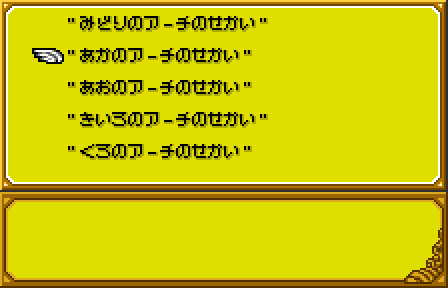
The game begins in Centrale, where Kronos picks one of the five worlds through the arch. Choosing any world other than Marvel Land fetches that world’s hero back to Centrale, after which the arch allows only the door to Marvel Land, so every game starts with Valkyrie’s world. The party starts with four characters: Kronos, Valkyrie, Sandra and the hero picked at the start, who may be Quarkman, Amul, Clovis, Gil or Kagekiyo. A strong first pick is the yellow arch, which brings back Gil: his attack and defence are both high, and his Straight Slash reaches enemies some distance away and does half as much damage again.
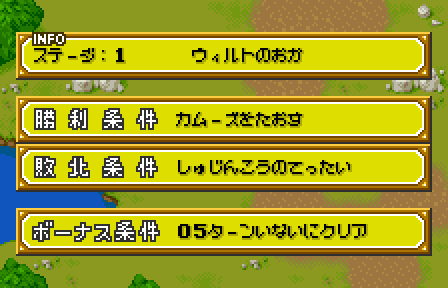
Each stage shows its victory conditions first, and then the player chooses which units to send out. On the square-grid map, allied units are marked in blue and enemies in red. A unit’s commands include moving, which shows the squares it can reach, using a technique, waiting and checking its status. Techniques differ in effect and range: some strike enemies, some heal allies, and where a unit stands decides what it can reach. Most techniques cost SP, a store of points each unit has, and a technique cannot be used without enough of it.
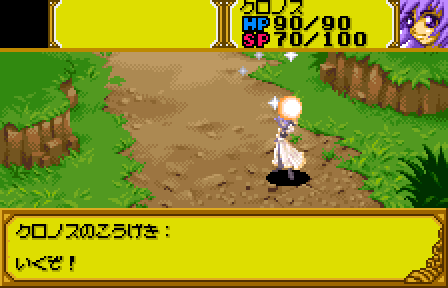
When the enemy turn comes, the player sets in advance how each unit responds to an attack: counter with a technique, try to dodge, or guard. Whether a response works depends on the abilities of the two units, so a dodge or a counter can fail. The map itself shows only the characters’ faces, and attacks play out in animated battle scenes seen from an angle, with cut-in pictures for some techniques. Valkyrie’s Chain Slash adds a timing test to the turn-based fighting: it is very strong, but it loses power if the timing is off.
Characters do not gain experience from defeating enemies. After a stage is won, the intermission screen hands out level-ups, which the player assigns to units as they choose, and offers a shop selling weapons, armour and goods, along with equipment and unit information. Each unit can carry up to 32 items, and Bandai balanced the game so that items can change a unit’s style of play a great deal.
Each world has three or four stages, and after the five worlds the journey passes through the Dimensional Valley and returns to Centrale, for about 22 main stages in all. Every stage has a bonus objective, usually clearing it within a set number of turns, which earns an extra item, and meeting the bonus objective on a world’s final stage opens a hidden stage in the Dimensional Valley, five in all. There are also hidden characters to find.
A stage takes roughly half an hour to forty minutes, in keeping with the quick pace Bandai aimed for. The whole game is short, but enemies come in numbers from the first maps, and clearing a stage within its bonus turn limit can be hard.
Development and release
Bandai announced the game in February 2002 with a release date of 25 April and a price of 4,980 yen before tax, naming nine series as the source of its heroes: the Valkyrie and Druaga games, Dragon Buster, Dragon Spirit, Genpei Touma Den, Phelios, Dragon Valor, Bravoman and Wonder Momo. The box art was drawn by Kazuhiro Soeta. When it finally appeared in October, the GameSpot Japan site ran a long feature on it, including an interview with Suzaki of Bandai’s WonderSwan division.
In that interview he explained that the idea of doing something with Namco for game fans went back to the launch of the WonderSwan, and that since it was to be a WonderSwan original the two sides wanted an all-star cast. The development staff chose the characters together. Characters from Xevious and Assault were planned at first but dropped because they looked out of place on the battlefield. Strategy was chosen over action, he said, because an action game would have needed so much memory per character that far fewer could have been included; early on an idea along the lines of Sky Kid had also been discussed. Combination attacks between characters were wanted but did not fit. He described the balance as deliberately quick to play, so that busy adults could get through a stage on a train journey, and said no sequel or port was planned at that point.
Modes and features
Bandai advertised the game as a multi-scenario story that changes with the characters chosen, so that it could be played through more than once. The game is for one player and supports the link cable, though what the cable is used for is unknown.
Secrets and extras
The game has hidden characters and hidden maps. One of them is a character called Pakku who strikes enemies at long range with home runs; he was added to fill the long-range role first meant for a unit from Assault.
Reception
Opinions of the game are divided. Some players enjoyed seeing familiar characters side by side and learning more about ones they had not played, and found the stages short, at roughly half an hour to forty minutes each, and the fighting easy. Others found the enemies numerous and tough from the start, the angled battle scenes flat and the level-up system awkward, and missed favourites such as Pac-Man. The number of stages has been thought small but fair for a handheld, and Valkyrie’s timed slash strong but demanding.
Ports and other versions
Namco Super Wars was conceived as a WonderSwan original and was never ported, remade or re-released on any other system. No sequel followed either. Its idea of gathering Namco heroes on one tactical map was picked up by later crossover strategy games, Namco x Capcom and then the Project X Zone games, which reuse many of the same characters but are separate, larger productions that also bring in other companies’ casts, rather than versions of this cartridge.