
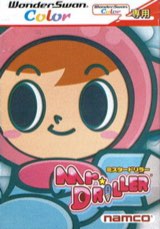
Namco's block-digging puzzle game from the arcades, brought to the WonderSwan Color: drill down through coloured blocks before your air runs out.
Screenshots
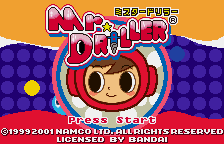
Title screen 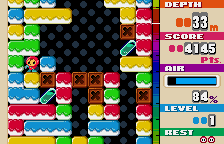
In play 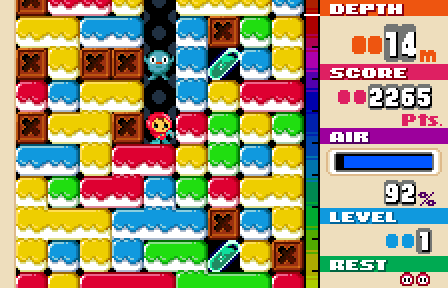
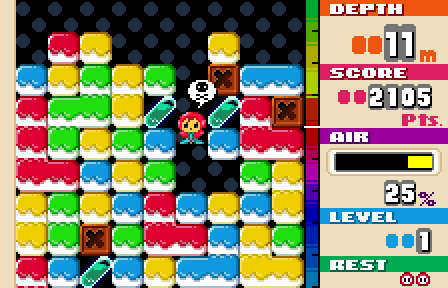
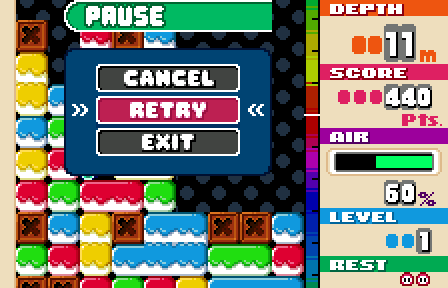
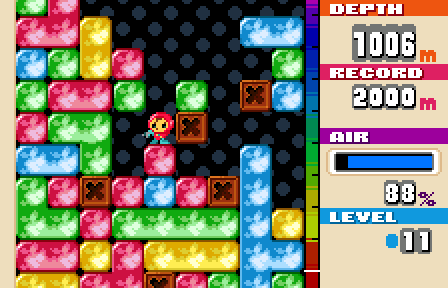
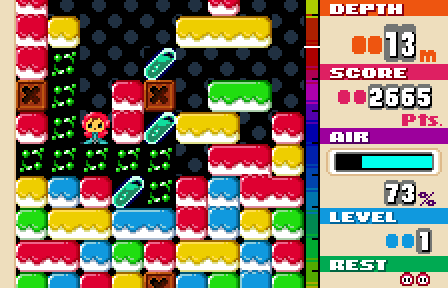
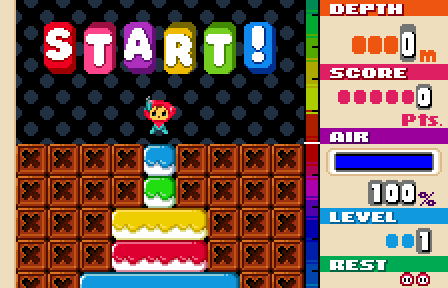
Mr. Driller is a puzzle game by Namco that first appeared in Japanese arcades in November 1999. It grew out of a prototype that was meant to be the third Dig Dug game and was turned into an arcade title of its own under a new name. The game was ported to several home and handheld systems, and the WonderSwan Color version was released by Namco in Japan on 5 April 2001 at 4,500 yen.
The player guides the hero, Susumu Hori, straight down through a shaft packed with coloured blocks, clearing them in groups of one colour, dodging the blocks that fall from above and collecting air capsules before the air runs out.
This version is made for the WonderSwan Color and does not run on the original black-and-white WonderSwan. It came out about four months after the Color went on sale and was sold only in Japan.
The story
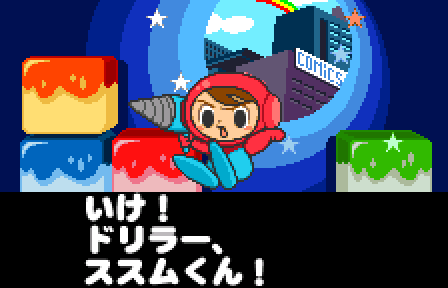
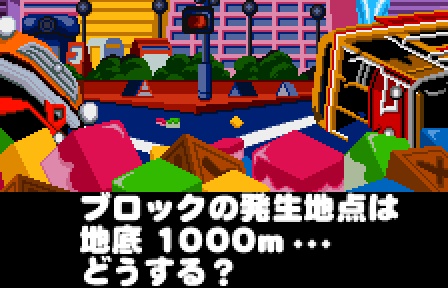
The game has only a light framing story. In the year 20XX strange blocks have started welling up out of the ground, and Susumu Hori, the driller closest to earning the title of “Mr. Driller”, sets out to dig down through them. The premise never grows into a plot told during play: the goal is simply a depth to reach, and the story is there to give the dig a reason.
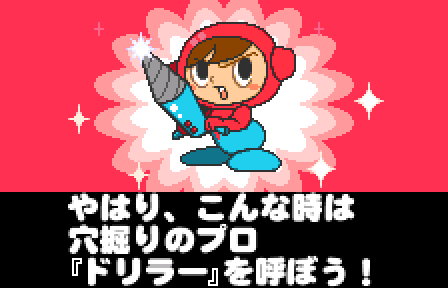
Susumu is a young boy, a little clumsy but with a strong sense of justice and a kind heart. The series ties him to Namco’s earlier digging game: his father is Taizo Hori, the hero of Dig Dug, which fits a game that began as a prototype for a third Dig Dug.
The look is bright and cartoonish, with pop character designs by Kaori Shinozaki, and the colourful blocks suit the WonderSwan Color screen well. Even though the game is a tall, narrow shaft, the WonderSwan Color version is played with the console held sideways, as the original was designed, and does not use the system’s vertical orientation.
How it plays
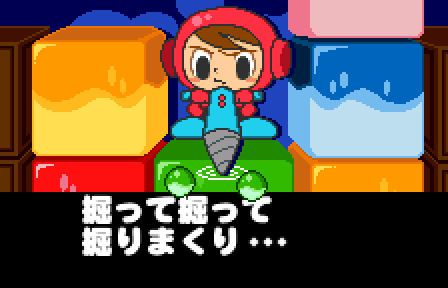
Susumu is moved with the direction keys and drills with a single button. He walks left and right, drills the block beside him or the one under his feet, and can climb onto a block one step higher. Each block he digs down through counts as one metre, and the result of every run is the depth reached.
The blocks come in four colours: red, blue, green and yellow. Blocks of the same colour join when they touch side by side or one above the other, even in mid-air, and drilling any block of a group removes the whole group. When the blocks underneath are gone, the blocks above drop, and a falling block that joins three or more others of its colour vanishes too, which can set off chain reactions that clear large parts of the shaft at once. A block about to fall teeters for about a second first, which gives Susumu time to step aside. If he is fully under a falling block he is crushed and loses a life; if only a small part of him is under it, he is knocked aside and briefly stunned. A group of four or more that is already joined before Susumu reaches it does not vanish on its own; it disappears only when another block of its colour joins it or when it drops and lands, so it is unsafe to assume that blocks overhead will stay where they are.
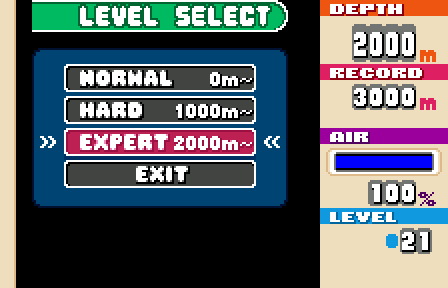
Air is the other limit. The gauge drains all the time, and faster the deeper Susumu goes. Each air capsule restores 20 percent, and once the gauge falls below 30 percent he starts to gasp, turns blue, and a skull and an alarm warn that he is about to run out. Brown X-blocks are the hazard among the coloured ones: one takes five digs to break and costs 20 percent of the air. They are cleared more cheaply by making them fall and join a large group than by drilling them.
Points come from the blocks Susumu removes, and the score is shown beside the shaft together with the depth, the air and the lives left. The game is for one player.
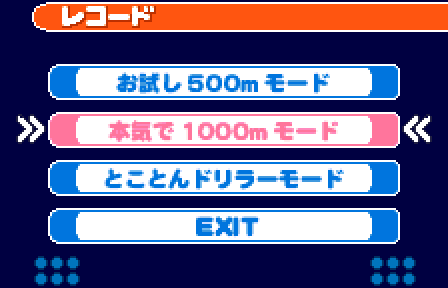
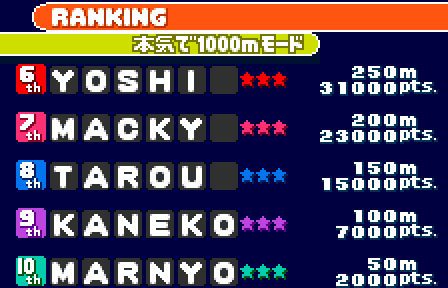
The WonderSwan Color version has three modes. “Otameshi 500m” is a 500-metre trial course of five sections, and “Honki de 1000m” is the full 1,000-metre course of ten sections; these are the two lengths of the arcade game, where clearing the 1,000 metres without a miss, or with 600,000 points or more, earned the title of Mr. Driller and a bonus of 200,000 points. The third mode, “Tokoton Driller”, has no goal: Susumu keeps digging for as long as he can, and the run ends at the first lost life.
Experienced players pass on a few habits. X-blocks are best left alone unless there is no other way, and a capsule taken while the gauge is nearly full is partly wasted. Deeper down the capsules are often surrounded by X-blocks, so the trick is to drop those blocks into groups rather than drill through them. Stepping sideways to let a teetering column fall and then going back to the old path is the basic way to stay alive, and chains of coloured blocks are the quickest way down. The cause of each miss is easy to see, so the game invites one more try; the 1,000 metres take practice, and setting smaller goals such as beating the last depth or passing 800 metres is a common way to work up to them.
Development and release
Bandai announced the game as the WonderSwan Color debut of a digging action game already popular in arcades and on the Game Boy, and framed it with the series’ story: in the year 20XX strange blocks have welled up out of the ground, and Susumu Hori, the driller closest to earning the top title of “Mr. Driller”, has to dig his way 1,000 metres down to stop them. The cartridge, code SWJ-NMCC01, carries 16 megabits of ROM and 256 kilobits of battery-backed SRAM, plays in stereo for one player, and has no link-cable support. It runs only on the WonderSwan Color.
Ports and other versions
The WonderSwan Color cartridge is a conversion of Namco’s arcade game of November 1999. Versions for the PlayStation, Dreamcast and Game Boy Color came first, all three released in Japan on the same day in June 2000, followed by a Windows edition from Holon in February 2001; the WonderSwan Color game arrived in April 2001 and was never released outside Japan. Afterwards the game moved to mobile phones, beginning with an i-mode version in 2002, and to the iPhone in 2009. The PlayStation version had the longest later life: it was included in the PlayStation 2 compilation Namco Collection in 2005, sold as a download for the PSP and PlayStation 3, and built into the PlayStation Classic console in 2018. It was also released for the PlayStation 4 and PlayStation 5 in June 2022.
The WonderSwan Color edition offers only the 500-metre and 1,000-metre courses of the arcade game and the endless mode. The PlayStation and Dreamcast versions added a Time Attack mode, which is not among them. The handheld version released before it lacked the mode as well: the Game Boy Color game has no Time Attack, and its well is seven columns wide instead of the usual nine, about two blocks narrower than the original.
Later Mr. Driller games are separate titles, not versions of this one. Mr. Driller 2 went from the arcades to the Game Boy Advance, and Mr. Driller DrillLand of 2020, known in Japan as Mr. Driller Encore, is a remake of the GameCube’s Mr. Driller Drill Land rather than of the first game.
Notes
The release date is occasionally given as 15 April 2001, but it is usually given as 5 April 2001.