
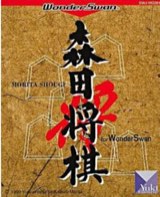
A WonderSwan edition of Morita Shogi, the long-running computer shogi series, with several difficulty levels, handicap games and a take-back option.
Screenshots
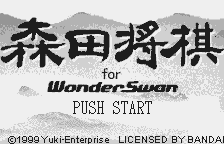
Title screen 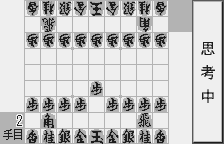
In play 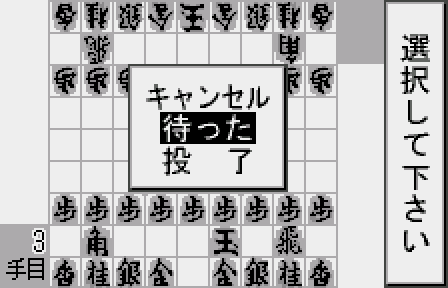
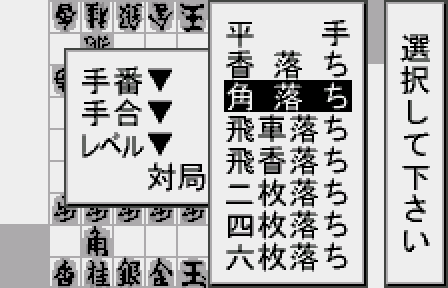
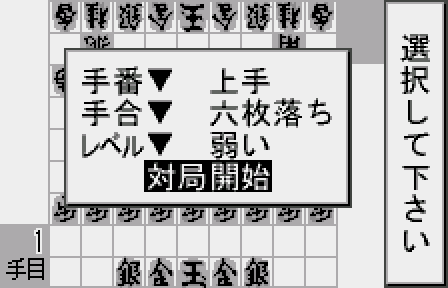
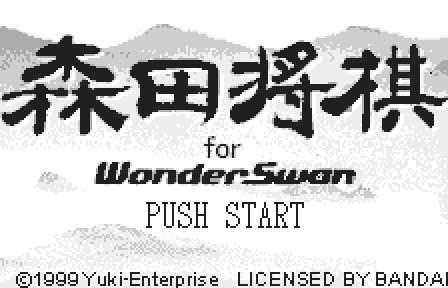
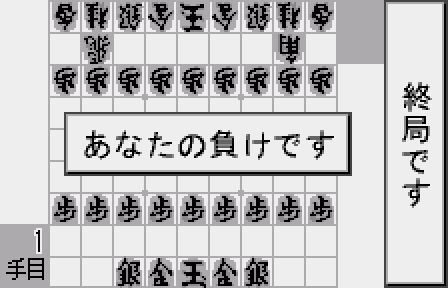
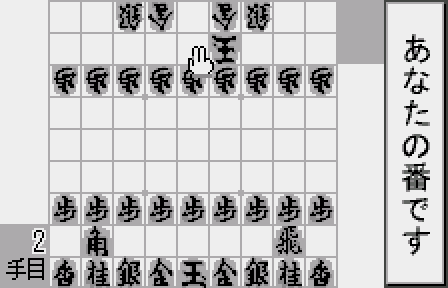
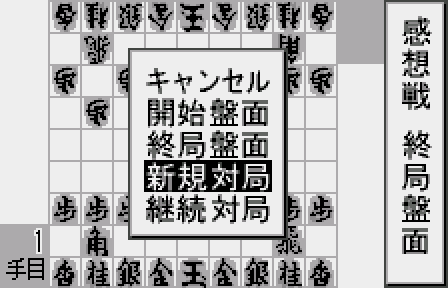
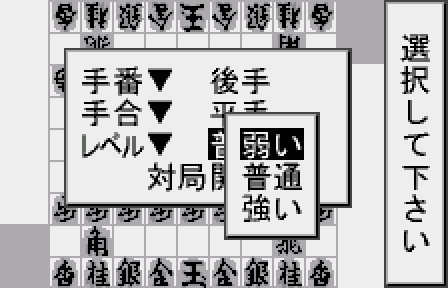
Morita Shogi for WonderSwan is a shogi game for the original WonderSwan, released in Japan on 22 December 1999 by Yuki Enterprise. It is part of Morita Shogi, a series of computer shogi programs named after Kazuro Morita, a programmer of thinking routines for board games. The series was first made by Random House, the company Morita founded, whose business later passed to Yuki Enterprise; it had been appearing on many systems since 1985, and a Morita program won the World Computer Shogi Championship in 1991.
The game is a straightforward computer opponent for Japanese chess on a handheld: the player takes one side of the board and plays a full game against the program, at one of three strengths and with or without a handicap. It was the first Morita Shogi made for a handheld system, and it came out about nine months after the WonderSwan’s launch.
The story
Morita Shogi for WonderSwan has no story. There is no cast, no tournament to climb and no named rival: the opponent is the thinking program itself, the Morita routine that gives the series its name, and the only thing at stake is the game on the board. The title screen sets the tone, with the game’s name in brushed lettering over a quiet landscape of hills.
The presentation is built around the board. It fills most of the screen with the player’s side at the bottom and the computer’s at the top, the computer’s captured pieces sit in a stand beside the board at the upper left and the player’s at the lower right, and a narrow information window on the right tells the player whose turn it is and what is happening. While the computer thinks, the window says so and a small animated icon keeps moving. The game also has a good deal of recorded speech.
What the game does offer in place of a setting is the full rules of shogi, applied as in a real game. Repetition draws, the rule that ends a deadlocked game, and the forbidden moves are all handled, and the manual ends with a short glossary that explains them, together with handicaps and resigning, for players who know the moves but not the finer rules.
How it plays
The WonderSwan is held sideways. The four X buttons move a pointing-hand cursor around the board, the A button picks up a piece and puts it down, and the B button lets go of a piece in hand or, when nothing is held, opens a small menu. Start shows the computer’s last move again, which is useful on a small screen where a move can be missed. The Y buttons are not used. In menus, X1 and X3 move the cursor up and down, A confirms and B backs out.
Pressing Start at the title screen leads to the pre-game menu. If a game is stored on the cartridge, the player can continue it, watch its review or start a new game, which erases the stored one. A new game opens the settings: the player’s turn order, the handicap and the level. The eight handicaps are an even game and the removal of the lance, the bishop, the rook, the rook and a lance, the rook and bishop (two pieces), those two and both lances (four pieces), or those four and both knights (six pieces). In handicap games the side that gives the pieces moves first, so the player picks the stronger or weaker side rather than first or second. The three levels are weak, normal and strong, and the stronger the level, the longer the computer takes over its moves.
A move is made by putting the cursor on a piece, pressing A to pick it up, moving it to the target square and pressing A again. To drop a captured piece, the player moves the cursor off the right edge of the board into the piece stand and takes one from there. When a move allows promotion, a window offers to promote, not promote or cancel. The B menu on the player’s turn holds the take-back, which returns the board to the player’s previous turn and disappears when there is nothing to undo, and the option to resign. The computer’s own moves are automatic, and the menu can also be opened while it is thinking.
The game recognises the end of a game by itself and names the reason in a window: a win, a loss, or a draw. The same position appearing four times without checks is a repetition draw, while a player who keeps giving check through the repetition loses. Instead of the points count that settles a deadlocked game in real tournaments, the game uses a 300-move rule and declares any game that passes 300 moves a draw.
Saving is automatic. The cartridge keeps the game record as it is played, so the console can be switched off in the middle of a game and the game picked up later from the pre-game menu with the continue option. Only the one record is kept, and starting a new game replaces it.
When a game ends, the review, the post-mortem that shogi players call kansousen, starts straight away. X1 and X3 step forward and back through the moves one at a time, and the B menu jumps to the starting or the final position, starts a new game, or returns to a game that was interrupted. Yuki Enterprise suggested the cartridge as a way to study one’s own play while travelling.
The cartridge is one player against the computer and nothing else. It has none of the problem-solving or ranking modes of some other Morita games, and no two-player game. The computer is quick and strong for a handheld of its power, and the handicaps and three levels are the way to match it to the player.
Development and release
Yuki Enterprise was registered as a company in 1999 after taking over the business of Random House, the studio Kazuro Morita had founded in 1983, and Morita moved to the new company as a programmer, later becoming its president. The WonderSwan game came out that same year, and its copyright line credits both Yuki Enterprise and Morita himself. Bandai sold it as the standard shogi program arriving on the WonderSwan, pointing to the series’ history of more than ten years and promising a thinking routine that was both steady and sharp.
The cartridge cost 3,980 yen before tax and carries 8 megabits of ROM with 256 kilobits of battery-backed SRAM. It is played with the console held sideways, in stereo, by one player, with no link-cable support.
Ports and other versions
Morita Shogi for WonderSwan was made for the WonderSwan, and this cartridge was never ported or re-released on another system. The series it belongs to is another matter. Morita programs have appeared on more than a dozen systems from 1985 onwards, from Japanese home computers and the Famicom to the Super Famicom, PC Engine, PlayStation, Nintendo 64 and Dreamcast, each issued as its own product and often by a different publisher. After the WonderSwan edition came a PlayStation 2 game in March 2000 and later editions on the Nintendo DS and the iPhone.
The nearest relative is the next handheld entry, Morita Shogi Advance, which Hudson published for the Game Boy Advance in July 2001 with Yuki Enterprise sharing the copyright. It is a separate entry in the series rather than a conversion of this one, and it has features the WonderSwan cartridge lacks: play for two, with support for the link cable and for Nintendo’s mobile phone adapter, against the WonderSwan edition’s single player and no link play.
Notes
The game uses Yuki Enterprise’s own WonderSwan code prefix, YKE, and it was the company’s only WonderSwan release.