
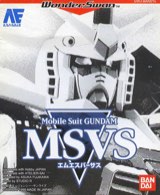
A real-time Gundam battle simulation for the WonderSwan, set inside an Anaheim Electronics simulator, where players outfit mobile suits and train pilots for automatic battles.
Screenshots
Title screen 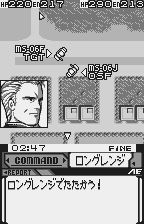
In play 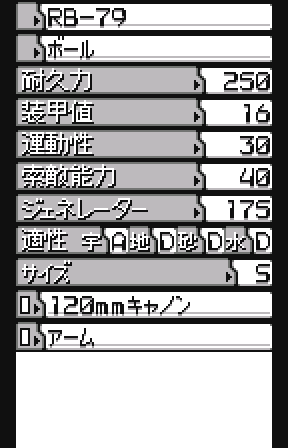
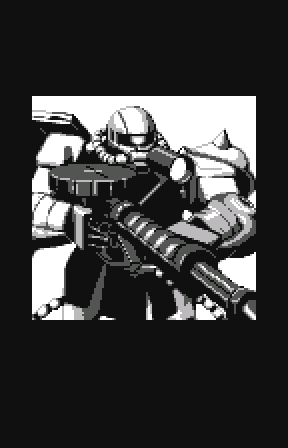
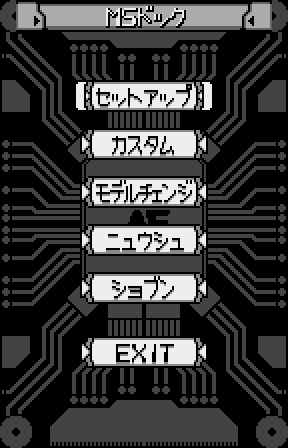
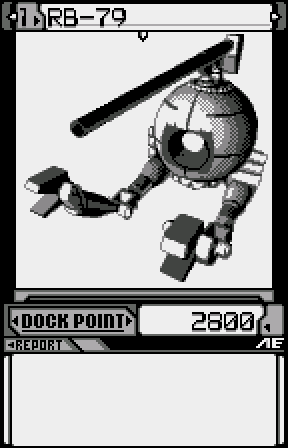
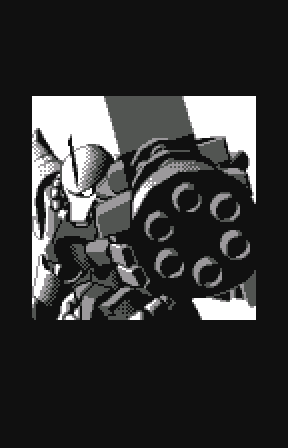
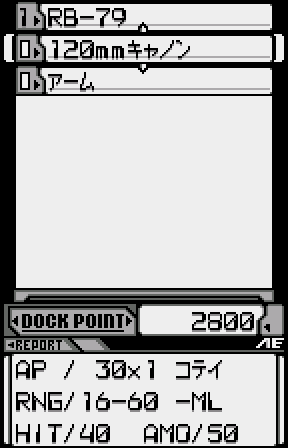
Mobile Suit Gundam MSVS is a battle simulation based on the Universal Century side of the Gundam series, released by Bandai for the original WonderSwan on 26 August 1999, about six months after the console went on sale. It was developed by Sims. The game presents itself as a mobile suit simulator run by Anaheim Electronics, the arms maker of the Gundam world, and gathers more than 70 mobile suits and over 250 weapons and other pieces of equipment from the years 0079 to 0083 of the setting. The title is written in Latin letters and read “Emu Esu Bāsasu”.
Battles take place in real time on a view from above, but the player never steers the suits. Fights run on their own while the player gives broad orders about range, and between battles the points earned go on buying and modifying suits and on raising up to three pilots of the player’s own making.
The story
MSVS has no plot in the usual sense. Its framing is that the cartridge is a training simulator made by Anaheim Electronics, and Bandai kept up the pretence by naming Anaheim as the developer in its own promotion. The opening shows a Gundam in motion and the Anaheim logo, and the six-page history of the company packed in the box goes as far as claiming that Anaheim had a division devoted to the SWAN.
The setting is the One Year War of 0079 and the years up to 0083, and the simulator holds suits from both the Earth Federation and Zeon, from the first series and its MSV designs to War in the Pocket, Stardust Memory and The 08th MS Team. Nobody in the anime is the player’s character. Instead the player creates pilots, gives them a face, a name, an age, a background and a manner of speaking, and puts them into the simulator against virtual copies of the original characters.
Those opponents appear one after another as the stages go by, each introduced on the battle map with a portrait and a line of dialogue. The Black Tri-Stars have a stage of their own, stage 11 brings Steiner from War in the Pocket, and the line-up climbs towards Char himself at stage 17. Near the end the simulator releases its information on the Gundam development project of 0083, and the last opponents fly its prototypes. There is no further story, and finishing the campaign adds an ending list to the options.
How it plays
The console is held upright. A battle is shown from above on a small map, where the suits circle each other and fire on their own; the player can only tell a pilot to fight at short, medium or long range. When a weapon fires, the game cuts to a still picture of it with the suit’s HP and EN, rather than animating the shot, so most of a battle is spent watching. The result depends on the orders, on the suit’s performance and on the pilot’s ability. Only the enemy side gets support fire, and a suit with a weak radar or a pilot with poor intuition will always be hit by the penalty fire, such as cannon shots or anti-submarine rockets, that comes in from off the map.
Each suit has five figures, for durability, armour, mobility, search and generator output, a size, and a grade from A to D for each of four terrains, space, ground, desert and underwater. Its weapons are marked for the ranges they can be used at, with figures for power, range, accuracy, ammunition and energy use, so a machine gun may work only at middle and long range and a heat hawk only up close. Suits cost roughly 700 to 5,000 points. More than 70 suits and mobile armours are in the game, along with over 250 weapons and other parts.
Points are earned after each battle and buy new suits or modify owned ones, up to ten times per suit, so they have to be spent with some care. Many variants are reached by a model change from a base suit once a given stage is cleared: the Zaku I becomes the Zaku II, the Zaku II becomes the high-mobility R1 after stage 3 and the R2 after stage 9, or the Zaku Tank, and the Full Armor Gundam arrives after stage 16. The GM is on sale from the start and the Gundam after stage 4. The suit each player starts with is decided by the individual console rather than by the cartridge. A heavily tuned suit is not always something every pilot can handle, and a mobility figure pushed too high makes a suit hard to control.
Up to three pilots can be registered. Each is built from one of eight faces, including a plain helmet, which differ only in looks and lines, one of six patterns of speech, a name of up to fourteen characters, a personality that only sets the range at which battles begin, and an age that adds a bonus to the starting statistics; older pilots grow more slowly but can still reach the maximum. The background sets intuition, which governs how quickly the enemy is spotted and never grows: civilians start at 60 to 80, cadets at 30 to 50 and others in between, and only a civilian can raise every figure to the top. The other statistics rise after each battle and can pass those of the anime’s own pilots. Skills come from the ranges a pilot fights at, once the matching attack figure reaches 30, and the sway skill needs a piloting figure of 30. The Newtype ability comes only by chance after a fight with a Newtype opponent, and the psycommu test Zaku needs it. Terrain aptitude rises after fifty battles, and the mission figure can fall. Rank does little, except that from second lieutenant up the Zaku and Gelgoog are supplied as commander types.
The campaign has twenty stages and four extra stages, with one save slot and no choice of difficulty. Some stages set conditions, such as a Rick Dom stage that asks for seven kills within the time limit, and the Black Tri-Stars stage and Char in his Elmeth at stage 17 are among the hardest fights. The Zeong and the Gundam come next, then the 0083 project information, and the GP01 and GP02 are fought last. Clearing some stages adds suits to the shop, among them M’Quve’s Gouf from the first extra stage, Dozle’s Zaku from the second, the psycommu test Zaku from stage 18, the unfinished Zeong from stage 19, the GP01 from the third extra stage, and the GP02, Gerbera Tetra and GP03 Stamen from the fourth. Dozle’s high-mobility Zaku is itself a tough extra-stage opponent.
The game is not hard. With enough battles to raise proficiency anyone can finish it, a pilot aged fifteen is fine for simply clearing the game, and the Gundam alone is enough to get through, so the draw is in trying different suits and pilots rather than in beating the campaign. Common advice is to upgrade the radar and fight at long range, but to keep mobility upgrades in check, since too much distance brings the enemy’s support fire, and to raise a pilot’s suit and terrain aptitudes so that attacks come more often. Pilots with low figures make battles slow. Favourite strong units are the Big Zam, the Zeong and the Gerbera Tetra, and under water the Gundiver, Gra-Bro, Z’Gok E and GP01. Because battles need no input, players remember raising pilots while doing their homework.
Two WonderSwans joined by the link cable can fight with any mix of the pilots and suits each player has raised, and the game keeps a record of link results. Suits and pilots can also be traded over the cable, and a Medea transport plane appears on screen when they are.
Development and release
Bandai sold the cartridge on its own for 3,800 yen before tax and played up the fact that the game had supposedly been made by Anaheim Electronics itself. The two console sets followed on 23 March 2000 at 6,800 yen each, under the codes SWJ-77A008 for the Federation colours and SWJ-77A009 for the Zeon colours. The game is for one or two players, with stereo sound, link-cable support and a 256-kilobit battery-backed SRAM for saves, and is played with the console held upright.
A six-page booklet, a “history” of Anaheim Electronics, is packed with the manual and written entirely in character for the setting. The suits come from the first series and its MSV side designs, War in the Pocket, Stardust Memory, The 08th MS Team and a single unit from Gundam ZZ.
Modes and features
The game is for one or two players. Besides the campaign against the computer, the link cable is used for battles and trades between two players.
Secrets and extras
Clearing stage 3 within one minute adds a first extra stage after stage 13, and clearing that one within a minute and a half adds a second after stage 17. There are two more extra stages near the end. Resetting after the ending adds an ending list to the options menu.
Some units cannot be earned at all. The Zeon-coloured console set carries a Big Zam in its preloaded save and the Federation set a Gra-Bro, and an Elmeth was available only on a prize cartridge given to a hundred winners of a draw. Once that starting data is lost, the unit cannot be recovered. Several named aces’ suits, such as Char’s Zaku and Gelgoog, are also never obtainable.
Reception
The game is seen as a niche title for players who enjoy steady levelling and the Anaheim simulator conceit, with little left for the player to do once a battle starts. It is thought easy to finish with enough grinding but oddly hard to put down. Players remember the music in the hangar and the variety of tactics it allowed, while others found battles monotonous, the campaign short and the monochrome graphics plain.
Ports and other versions
MSVS was made for the WonderSwan and was never ported, remade or re-released on another system. It came out three times, as the cartridge of August 1999 and the two console sets of March 2000, all on the WonderSwan. The two sets differ from the plain cartridge only in the rare unit waiting in their save data.
The Gundam licence produced many strategy games on other systems, but MSVS stands apart from them in letting battles play out on their own while the player manages suits and pilots. Players have recalled it as a battle system found in no other Gundam game and wondered why it was never carried over to a later handheld, and some have asked for a remake for the sake of the hangar music.