
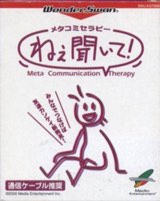
A WonderSwan communication program: tell the ever-moving Yuuyuu about your friends, play its fortune and relationship games, and trade gossip with other players by link cable.
Screenshots
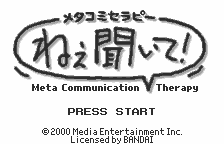
Title screen 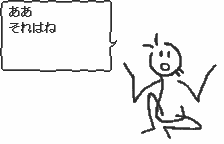
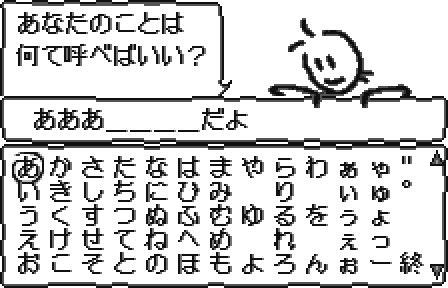
In play 
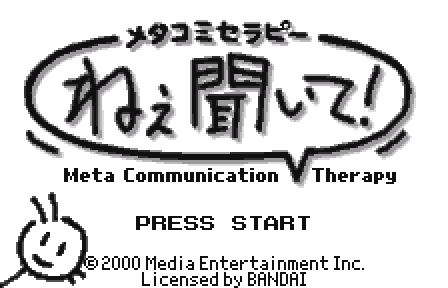
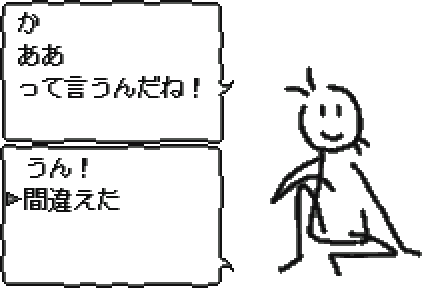
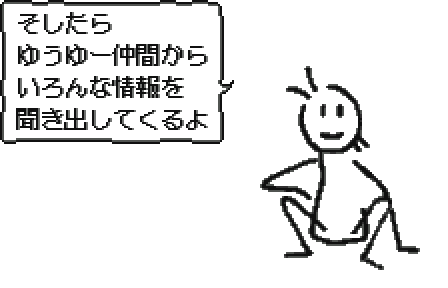
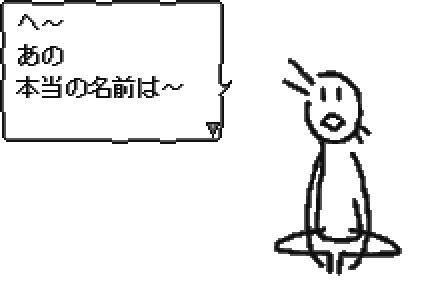
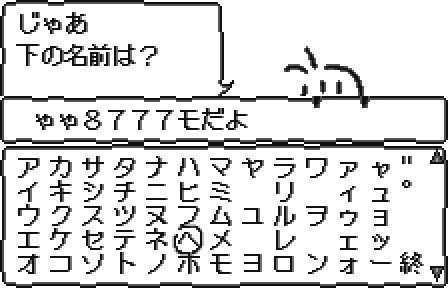
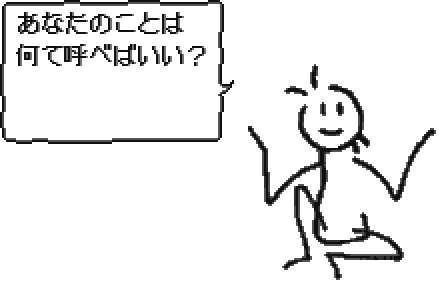
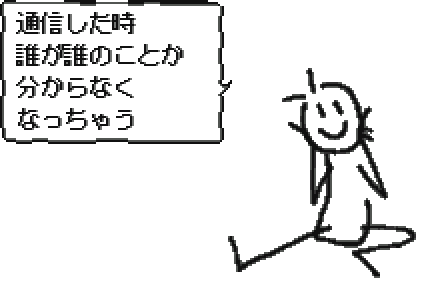
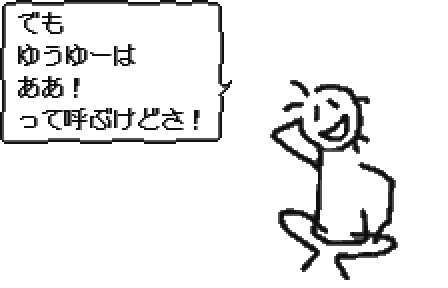
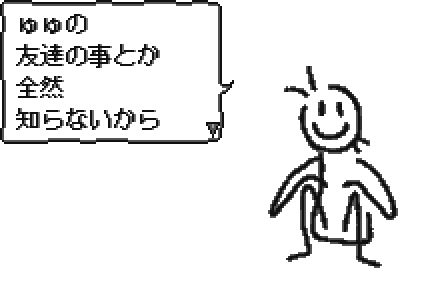
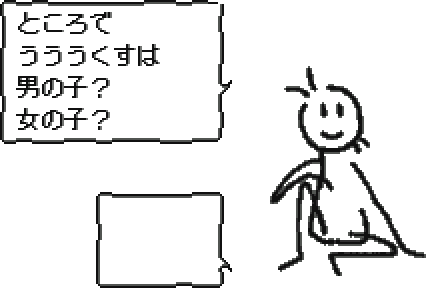
Metakomi Therapy: Nee Kiite! is a piece of software for the original WonderSwan that sits outside the usual game genres. Its title shortens “meta-communication therapy”, and the subtitle means roughly “Hey, listen!”. It went on sale on 23 March 2000, a year after the console’s launch, at 3,980 yen before tax, and it is classed as a communication title rather than a game of any standard type.
The program is built around a soothing companion character, Yuuyuu, which is animated without pause on screen. The idea is that spending time talking with it settles the player’s own mood. Besides general conversation, the player can ask it for advice about love and relationships and sit psychological tests. It can also be given information about friends, which it then works into its conversations and passes on to other players’ copies over the link cable.
Media Entertainment, a Tokyo company founded in 1993 and known mainly for pachislot simulators and food-themed action games on the PlayStation, published it, holds its copyright and ran the game’s official website. Who programmed it is unknown: Kaga Tech is credited, alone or alongside Media Entertainment, and Yoshidayama-Workshop has also been named as the developer.
The story
Nee Kiite! has no story in the usual sense, with no plot, chapters or ending. Its framing is a single character who introduces itself as Yuuyuu and lives inside the player’s WonderSwan. Yuuyuu asks to be told about the people the player likes and dislikes, the relationships around them and what has lately been done to them and by them, and it says it wants to become the player’s very own Yuuyuu, one that knows all of the player’s feelings. Getting what is on the mind off the chest, the program explains, is what meta-communication therapy means.
Yuuyuu is presented as simply itself and nothing more. It is neither human nor animal, its age and sex are unknown, and it is always wobbling about in a soft, fluffy way. The official description calls it comical, surreal and odd but somehow a well-made, lovable little thing. It has a wide range of facial expressions and reactions, its movements are meant to be calming, and it talks in its sleep. Between conversations it is shown going about its daily life: reading the paper, which it rather likes, eating cup noodles, listening to music and doing the cleaning.
The setting is the player’s own circle of friends, classmates and colleagues, and the tone is playful gossip. The examples Media Entertainment gave of what Yuuyuu might pass on include who likes whom and why, who finds someone else stuck-up, which two people went to see a film together, which izakaya someone frequents, and which pair is rumoured to be having an affair. The program also warns the player, half joking, not to spread too many nasty rumours in case friends turn against them.
How it plays
The program is for one player at a time, with the console held sideways, but the official site gave the number of players as one up to however many friends the player has. Play is conversation. Yuuyuu asks questions and the player answers, and the player can also start a conversation and tell it things, in which case it stops whatever it is doing to listen. What it can be taught covers the player’s friends and relationships, how the player feels about each friend and why, what the player and the friends have recently done or had done to them, and other details about them. Each piece of information can be marked top secret, a little secret, or something to spread. The more Yuuyuu is told, the more it remembers and the cleverer it becomes.
The player can also question Yuuyuu to draw out what it knows, which includes not only what the player entered but what has arrived from friends over the link cable. Yuuyuu talks a great deal on its own account as well. Its topics range from small talk to stories with something useful in them, funny anecdotes, novels of its own and true ghost stories, and listening to these is meant to be a pastime in itself.
Yuuyuu proposes games built on what it has learned, and the player is expected to play along when invited. In the relationship puzzle, a square on a chart of the player’s friends is marked with a question mark, and the friend who belongs there has to be deduced from how the other friends feel about that person and how they are related. Compatibility fortune-telling reads the match between the player and a friend, or between two friends, and grows more accurate the more is known about each, such as birthdays, sex and real names. Psychological tests are answered with yes-or-no choices, or judge the player’s state of mind from a description of a dream. The card game is a simple matter of guessing where the winning card has been placed. Doing well in the games and puzzles persuades Yuuyuu to share especially juicy secrets it has picked up from friends.
The link cable is the heart of the idea, and play runs in three steps. First each player builds up a Yuuyuu of their own by telling it about the people around them. Then two players connect their cartridges, the two Yuuyuus talk to each other, and they swap everything that is not marked top secret. Finally, back in conversation, Yuuyuu reports what it heard: what someone really feels about someone else and why. In the same way the player’s own feelings reach the friend’s Yuuyuu without the player saying so directly. Information travels on from link to link, so what arrives is not necessarily written by the person directly connected, and surprising news can come round after passing through many friends.
The same exchange carries rumour mails, short messages for everyone such as a bit of gossip, a piece of trivia, a one-line gag or an announcement. A mail received from one friend can be forwarded unchanged to another, which makes the mails a way of spreading a rumour through a group.
Development and release
The companion is called Yuuyuu. Bandai introduced it as a fluffy, constantly moving healing character and called the cartridge a new kind of communication tool that is both a hobby and of practical use. The cartridge holds 16 megabits with 256 kilobits of save memory, is played with the console held sideways, and has stereo sound and link-cable support, and Media Entertainment’s own site ran a campaign giving away link cables. That site was kept up after release with a downloadable Yuuyuu screensaver, a message board and a diary by Kubon, the artist who designed Yuuyuu, which ran to hundreds of entries.
Ports and other versions
The program was made for the WonderSwan and was never ported or re-released. It belongs to no series, and it has little in common with what its publisher is known for elsewhere, the pachislot simulators and food-themed action games that Media Entertainment released on the PlayStation and later saw carried over to mobile phones. Its Yuuyuu screensaver for computers, offered on the official site, was a promotional download rather than a version of the program.