

A WonderSwan Color spin-off of KID's Memories Off romance series that has its characters play Ponjan, a simplified Japanese take on mahjong.
Screenshots

Title screen 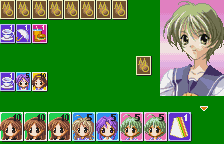
In play 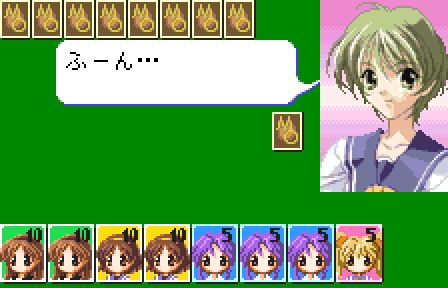





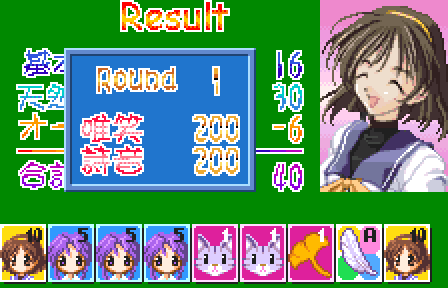

Memories Off Festa is a spin-off of Memories Off, the series of romance visual novels from the Japanese company KID that began on the PlayStation in September 1999. It came out on 8 March 2001 for the WonderSwan Color, and it is the only game of the series made for Bandai’s handheld. An earlier portable entry, Memories Off Pure, had appeared on the Neo Geo Pocket Color.
Rather than telling a new story in the series’ usual visual-novel form, Festa brings the cast of the first Memories Off to a table game called Ponjan. Ponjan was devised in Japan in the 1970s as a simpler relative of mahjong: the standard set uses tiles showing ships, cars and aeroplanes in three colours, and players draw and discard to complete three sets of three tiles. A finished hand wins the round, and a player one tile away from winning can declare riichi, as in mahjong. Festa keeps the three-sets-of-three rule but replaces the usual pictures with the heroines and with everyday items from the series.
The cartridge works only on the WonderSwan Color, and it has no link-cable play.
The story
Festa is set during the school festival at Sumisora Academy, the school of the first Memories Off. The main event of the festival is the Miss Sumisora contest, and before the contest proper the entrants settle things among themselves at the Ponjan table; how a girl fares there decides the costume she ends up wearing. The game mixes a short adventure part, told in scenes between matches, with the Ponjan itself, and the mood is that of a light festival-day side story.
The trouble starts when Yue Imasaka, Tomoya Mikami’s childhood friend, loses the entry card she needs for the contest. Tomoya goes round the school with her, asking whether anyone has seen it. The other entrants could help but would rather not, since Yue dropping out would leave one fewer rival, so the only way to get what they know out of them is to beat them at Ponjan. Story mode has a separate scenario for each character.
The cast are the heroines of the first game, and each is introduced with a trait that carries over into how she plays. Ayaka Hizuki calls herself the real heroine, is good at study and cooking and is Minamo’s cousin, and nobody knows how strong she is at Ponjan. Yue is clingy and scatterbrained and learned the game from Minamo. Kaoru Otowa is breezy and popular, believes in give and take, and goes after big hands that often fail to come off. Shion Futami is a transfer student who prefers her own company, reads a great deal and is particular about tea, and she plays for quick wins. Minamo Ibuki, Tomoya’s junior at school, is frail and often in hospital, where she learned Ponjan and earned a name as an unbeatable player. Koyomi Kirishima, daughter of the woman who runs the school shop, studies economics while being poor at sums, and her claim to be good at Ponjan is probably a bluff. A few characters from other KID games also turn up.
How it plays
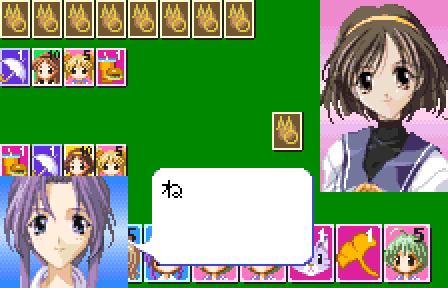
Each round the player and the opponent take turns drawing and discarding cards, and the first to hold three sets of three wins the round. The deck has 13 kinds of card. Each of the six heroines has nine copies of her card, worth 10 points for Ayaka and Yue and 5 for the other four. The six item cards fall into two groups, a cup, a sandwich and an umbrella in one and a ginkgo leaf, a cat and a hamburger in the other, with six copies of each worth 1 point; three different pictures from the same group still count as a set. A single wild card can complete any set, but winning with it takes a fifth off the value of the hand. The number in the top right corner of each card is its base value.
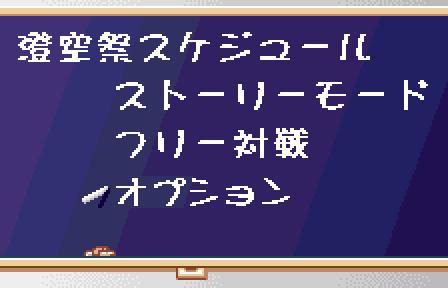
There are 27 scoring hands, and only one counts for a win: if several fit, the higher one applies, and on a tie the one listed lower in the table. A hand all in red or all in blue is worth 40. Pairings of a heroine with an item or with another heroine are worth 30 and are named after the original game, such as Ayaka with the umbrella or Ayaka with her cousin Minamo. Hands of three elements, named after scenes like afternoon tea or an autumn shower, are worth 50, a run through all three items of one group is worth 60, and three sets of the same heroine is the top hand at 180. One button brings up the whole list of hands, and the screen labelled as options is in fact this list.
Riichi can be declared when one card short of winning and adds 10 points. After it the game draws and discards automatically until the winning card arrives, though an unwanted winning card can be let go by when it is an item card. There is no penalty if the hand never wins, and there is no ippatsu or double riichi. Pon takes an opponent’s discard to finish a set; it is not allowed on the first turn and rules out riichi afterwards, but it is the key to winning fast. There is no furiten, so a player may win on an opponent’s discard even after throwing away the same card earlier, and a drawn round costs nothing even for a player who was not ready.
Points work like hit points. A win does not add to the winner’s total but takes the value of the hand off the loser’s. In story mode a match lasts five rounds, and whoever has more points left at the end, or first brings the other to zero, wins. Free play lets the player choose any opponent and goes on until one side is knocked down to zero, which makes it a place to practise for story mode.
Story mode keeps a running score across its matches: a win is worth one point, a win that knocks the opponent out two, and a loss takes one away. The final total decides which picture is shown at the end and which costume the girls appear in, and winning unlocks cards that serve as pictures, cosplay among them; the rewards are pictures only. Play is quick and responsive, so a match fits into a few spare minutes, and the game can be enjoyed without knowing the series, though the hand names mean most to its fans.
Development and release
KID opened an official website for the game in November 2000, announcing it for March 2001 at 4,800 yen before tax. KID is the publisher and Kaga Tech the distributor, and the model number is SWJ-KDKC01. The cartridge holds 16 megabits with 256 kilobits of save memory and has stereo sound. The copyright belongs to KID alone, and KID presented the game as a new Memories Off title, but which studio programmed it is unknown. The character art is by Mutsumi Sasaki, the designer of the main series.
Modes and features
Festa has two modes, story mode with a scenario for each of the six heroines and free play against any of them. It is for one player only.
Reception
Players generally find it a light, pleasant way to pass a few minutes. The quick response and the button that brings up every scoring hand are praised, and the hand names are a treat for fans of the series, though the girls look rather alike. Fans of the series were pleased that Ayaka, who appears mostly in memories in the main story, gets a much larger part here. Others found the options screen confusing and the cosplay rewards unappealing, and see the game as mainly for followers of the series.
Ports and other versions
Festa was made for the WonderSwan Color and was never ported or re-released. Within a series of story-driven romance games that began on the PlayStation, it stands out as a table game with no long scenario of its own. The nearest game elsewhere is KID Mix Section, released for the PlayStation on 28 June 2001, which also uses Ponjan with three sets of three, but it is a separate game rather than a version of Festa: its heroines come from four KID romance games, with Memories Off as only one of them, and each of the four has its own set of 13 tile types and 25 scoring hands, where Festa has one set of 13 cards and 27 hands.
Later history
KID came back to Ponjan a few months later with KID Mix Section on the PlayStation. A fan book covering Memories Off, Memories Off Pure and Festa was also published.