
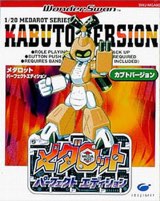
A reworked WonderSwan edition of the first Medarot robot-battling RPG from the Game Boy, in the version where the hero's partner is the beetle-type Metabee.
Screenshots
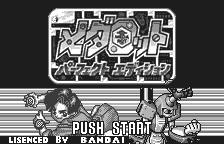
Title screen 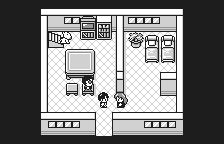
In play 
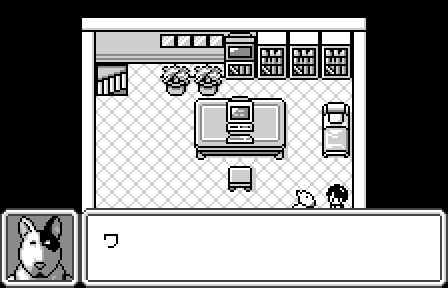

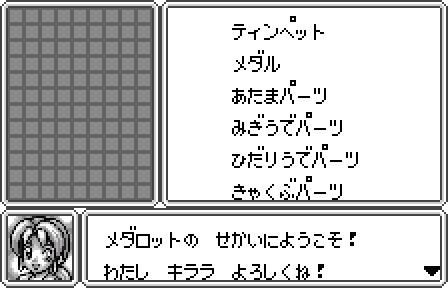
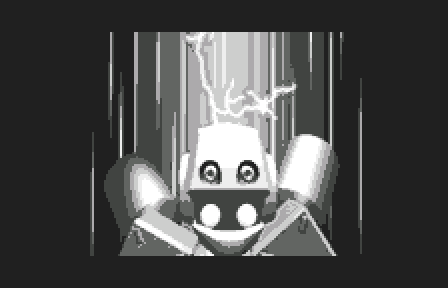
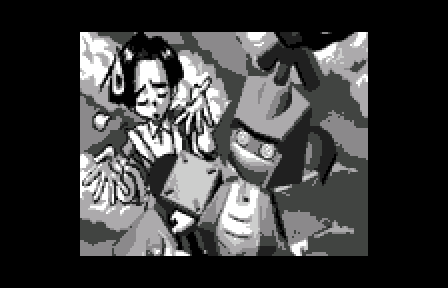
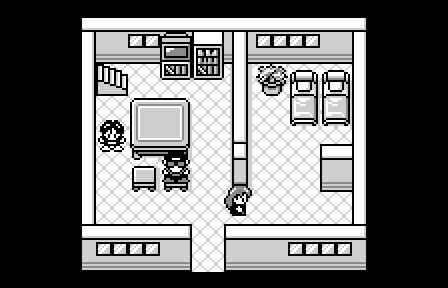
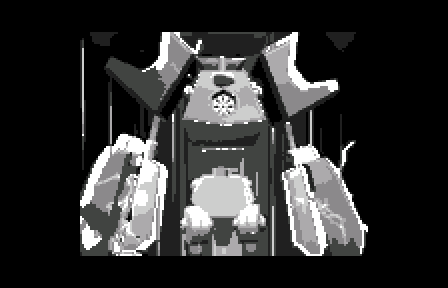
Medarot Perfect Edition is a remake of Medarot, the role-playing game that Natsume developed and Imagineer published for the Game Boy in November 1997 and that started the Medarot series, known in English as Medabots. Imagineer released the WonderSwan edition on 4 May 1999, two months after the console came out, in two versions sold on the same day. This is the Kabuto (rhinoceros beetle) version; its counterpart is the Kuwagata (stag beetle) version.
It is a role-playing game about Medarots, robots built from a frame, four parts and a medal, which children set against each other in battles called Robottles; the winner takes one of the loser’s parts, so collecting parts is central. The player is Hikaru Agata, a schoolboy drawn into tournaments and into trouble with the villainous Roborobo Gang. In the Kabuto version the hero’s own Medarot is Metabee, a beetle type.
The WonderSwan edition replaces almost all of the graphics, rewrites and adds to the dialogue and interface, and uses the console’s wider screen. The hero’s Medarot is given a part in the story instead of being only the first robot. Character designs are by Horumarin. Two players can play together over the link cable.
The story
The game is set in a near future given only as the year 200X. Medarots, robots about a metre tall, are kept as pets, and their name joins the words medal, robot and pet. Robot battles between them, shortened to Robottles, are the craze of the day, and by the rules of the game the winner takes a robot part from the loser. Some people use their Medarots for mischief: the Roborobo Gang causes trouble everywhere, and a justice organization, the Select Corps, keeps an eye on them. The Roborobo members end their sentences with the word robo.
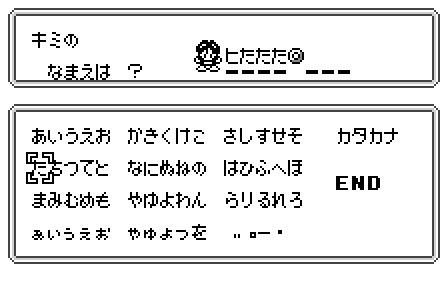
Hikaru Agata is an elementary schoolboy who, unlike everyone around him, has little interest in Medarots; the player can change his given name at the start. The game opens on his diary for 22 July, the day before the summer holidays, as he worries about holiday homework and looks forward to trips to the sea, the mountains and on school study outings. His partner is his dog Bonaparte, a miniature bull terrier. Taking the dog for a walk in the park, the dog comes back with a medal it has found, and that is how he comes to own a Medarot. The first day starts at school with the end-of-term ceremony, where teachers and classmates give him his first pointers.
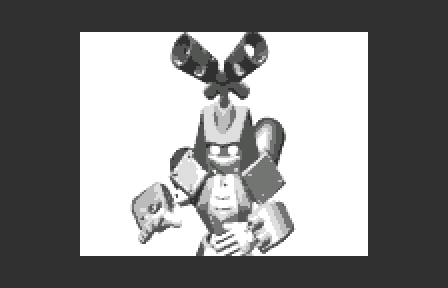
In the Kabuto version his Medarot is Metabee, a male beetle type, and in this edition Metabee talks back during conversations, so Hikaru has a companion through the story rather than a silent first robot. The people around him are introduced early: his childhood friend Kirara Akita, a clever girl who acts like an older sister and fights with Sailor Mates; his rival Yuki Nimousaku, the vain son of a rich family, with the fast laser robot Roll Star; and the three local bad kids, led by the boyish Iseki with the electric Magenta Cat, the talkative show-off Yanma with Cyan Dog, and the slow Kubota with the heavily armed Yellow Turtle. Patty Suidenji is an easygoing rich girl who seldom listens to anyone, and her cute-looking Betty Bear wields powerful gravity attacks. Dr. Medarot, the inventor credited with creating Medarots, explains how they work; his granddaughter Nae Akihabara is another of the people Hikaru gets to know.
The adventure spans one summer around Hikaru’s town and the places beyond it: the school, the convenience store that sells parts, an antique shop with rarer parts, the Medarot laboratory, the Select Corps headquarters still under construction, which Hikaru’s architect father is building, and trips out to the sea, the mountains and Shinobic Park. The first part of the story is built around a town tournament and then the main Robottle tournament, with the Roborobo Gang’s schemes getting in the way, and a second chapter follows. The tone is light and comic, a children’s summer adventure in which a boy who did not care about Medarots grows into a hero, while the manual hints that Hikaru may end up having to save the world. The game has several endings, one of them new to this edition.
How it plays
The WonderSwan is held horizontally. The X buttons move Hikaru on the field and move the cursor, A confirms, talks to people and advances text, B opens the menu and cancels, and Start begins the game and pauses a battle; the Y buttons are not used. Holding Start with A and B resets the game. The field menu has five commands: Keitai, which holds the Medarot, Medal, Parts and Team screens; Item, which includes a town map showing where Hikaru is; Save; Settings; and Close. The game can be saved anywhere outside a battle, and the save screen shows how many of the 240 parts have been collected and how many of the 60 Medarots have been completed.
A Medarot is built on a frame, called a tinpet, which is either male or female and takes only parts of the same sex. Up to nine frames can be held, and they come only from story events, never from battles. Each Medarot has four parts. The head gives a strong special ability with a limited number of uses per battle, or raises the robot’s stats; the right arm carries a light weapon that is accurate and quick to ready but weak; the left arm carries a heavy weapon that takes long to charge but hits hard; and the legs set the basic stats and the movement type, which is flying, hovering, vehicle, tank, two-legged, multi-legged or underwater. Each battlefield has a terrain such as town, forest, desert or coast, and legs suited to it shorten the time a robot needs between actions. Parts have values for armour, success rate and power, uses for heads, charge and cooldown for arms, and propulsion, evasion, melee, shooting and detection for legs.
The medal is the robot’s mind and the only thing that grows. There are 28 medals, each with its own talent; they gain experience in battle and can rank up to four times, changing their design each time, and some turn into a different medal when traded over the link cable. A medal has one of three personalities, which decides how it fights: attack raises the success of its favoured actions, defence weighs both sides’ parts to decide which part to target, and special adjusts to the state of the battle. It also has a compatibility value with the parts it wears and a proficiency for each kind of action, such as punching, wild attacks, shooting, aimed shots, support, protecting and repairing, which rises as that action is used. Metabee wears the Kabuto medal, which is good at shooting, with a Missile head that pierces armour, a single-shot Revolver right arm, a rapid-fire Submachine Gun left arm and Ochitsukar legs suited to shooting types.
Robottles start as random encounters on the field as well as in story events and tournaments. Each side fields up to three Medarots, though one may fight alone, and the encounter screen shows the terrain and the ranks of the enemy medals before the fight; parts and medals cannot be changed once it begins. The player picks which part each robot will use, the robots run to the centre line, act, and run back to their start line to be given the next order. The medal, not the player, chooses which enemy and which of its parts to aim at. A Medarot whose head is destroyed stops working even if its other parts are intact, and destroying the leader, the robot at the top of the line, ends the battle. There is a time limit counted in the game’s own unit, minits; when it runs out the referee decides the winner by robots lost, parts broken and damage taken. All armour is restored after every battle, so there are no healing items to buy, and repairs within a battle come from parts.
The winner of a Robottle takes one of the loser’s parts. Losing a random battle gives away one of Hikaru’s own parts, rare ones included, while losing a tournament or story battle ends the game. Shops sell parts, but most money comes from events and rarely runs short, and the one consumable item is the Roborobo medal, won from gang or Select Corps grunts, which lets Hikaru escape field battles. Other items include a lottery ticket for the shopping street draw, a Roborobo Gang uniform, a ticket to Shinobic Park, kanabun beetles shaken from trees in the mountains, fresh fish for a fisherman, and the Mini Handle for moving faster on the field. The Settings menu sets the message speed in three steps, turns battle animations on or off and sets their speed, and sets the battle time limit, and the Team screen stores three teams, A, B and C.
Two players can link two WonderSwans with a cable, set up through the girl at the back of the convenience store. A friendly battle has no stakes; a serious battle needs at least two complete Medarots each and ends with a roulette that awards the winner a medal or part from the loser; and trading needs at least one complete Medarot, with some parts changing as they are traded. Players pass on a few tips: the right medal and part compatibility matters more than raw power, plain attacks alone are not enough, so defence, healing and combinations are worth using, and missiles and napalm still do blast damage when dodged. Since there are no Medaforce special attacks, a robot whose attacking parts are broken can do nothing more. Hidden events follow the Game Boy game with some changes, and some items and events can be missed for good.
Development and release
Horumarin is credited with the original concept and the character designs, and the editorial team of Kodansha’s children’s magazine Comic BomBom, with which the series was closely tied, was a production partner. The copyright lines name Imagineer and Natsume for both 1997 and 1999. Both versions sold for 3,980 yen before tax.
Modes and features
Collecting all 240 parts takes both versions, because parts exclusive to the other version can only be had by trading over the link cable. The battles have several changes from the Game Boy: the remaining armour of every part is shown on screen, battle animations can be switched off in the options, and teams can be stored for quick use. Metabee now joins in conversations instead of the hero speaking alone, and characters show their expressions in portraits.
The remake also smooths out weak points in the story’s pacing and in the balance of parts sold in shops, adds events, and lets most of the robots that needed the link cable on the Game Boy be obtained without it. The save data cannot be exchanged with the Game Boy game, so parts and medals cannot be carried across or used in battles against it.
Reception
Players regard it as a good, more complete version of the first game. The new opening, the more detailed robot sprites, the cut-in scenes in battle and the portraits in conversations are praised. The music draws criticism, since much of the field music is carried over from the Game Boy with few new pieces, and the battle balance is felt to suffer because the game lacks the Medaforce special attacks of later entries: a robot whose attacking parts are broken can do nothing. Link play is also hard to arrange because so few people own a WonderSwan.
Ports and other versions
The game it remakes is Medarot for the Game Boy, released on 28 November 1997 in Kabuto and Kuwagata versions, followed by two Parts Collection releases, side stories in which the rival is the hero and every part can be found. Perfect Edition brings the two main versions to the WonderSwan with the changes described above, and it is the only Medarot game released on that console. It is a remake, and Natsume remains credited as the developer.
The first game was rebuilt a second time as Shingata Medarot, released by Imagineer for the Game Boy Advance on 16 December 2004 and developed by Rocket Company. It renews the first game’s story and characters, but with graphics in a wholly different style and new character and robot designs by Naoki Kitazawa, with the interface, system and part statistics of Medarot 2 Core, newly written music by Kinuyo Yamashita, and the Medaforce attacks that the 1997 game lacked; its hero is Gamma rather than Hikaru. The Game Boy original has since been collected in Medarot Classics for the Nintendo 3DS in December 2017, which gathers the first five numbered games, and in Medarot Classics Plus for the Nintendo Switch in November 2020; Classics Plus carries the Game Boy game, not this WonderSwan edition.
Fans who compare the WonderSwan edition with the Game Boy game generally favour the remake for its presentation. It is especially recommended to players who already know the original, for Metabee taking part in conversations, the readable armour values and the option to skip battle animations, while the music carried over from the Game Boy remains its main point of criticism.
Notes
Some of the icons showing a Medarot’s leg type are still wrong, as in the original, so that some multi-legged robots show as two-legged and some hovering or underwater types show as flying. A few items and events can be missed for good, which makes a guide useful.