
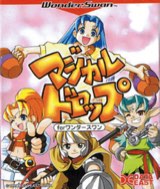
Data East's falling-drop puzzle game for the black-and-white WonderSwan, played upright, with characters from Magical Drop F and a fortune-telling mode of its own.
Screenshots

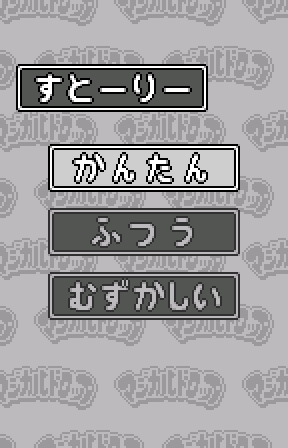
Title screen 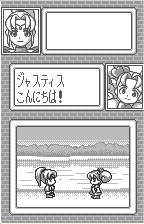
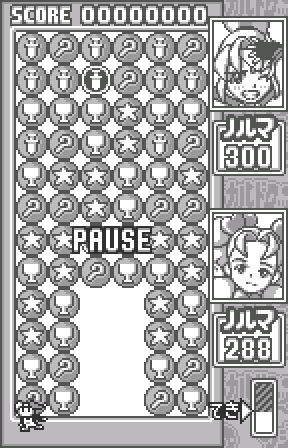
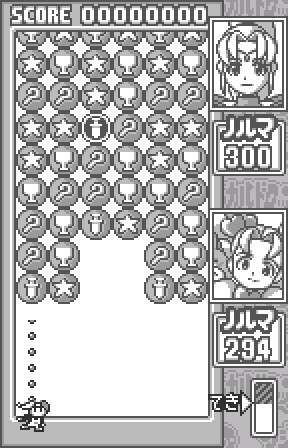
In play 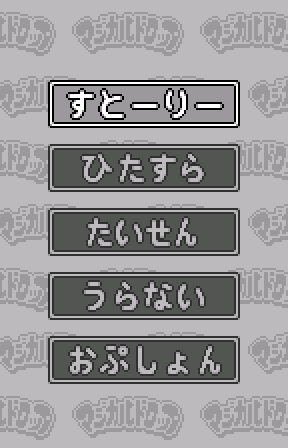
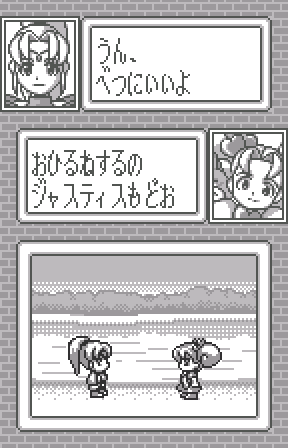
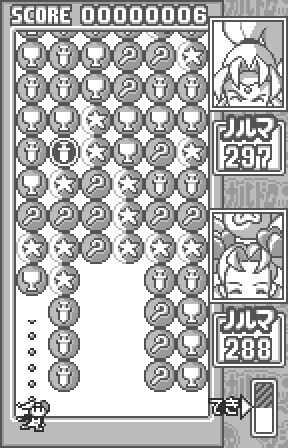
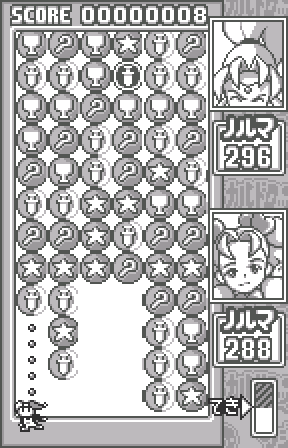
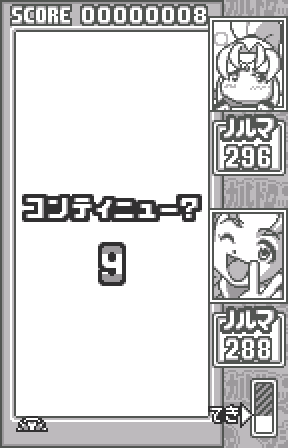
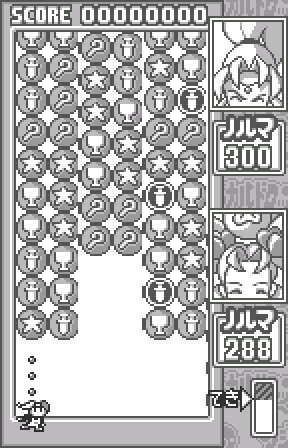
Magical Drop for WonderSwan is a puzzle game for the black-and-white WonderSwan, released by Data East on 14 October 1999 and developed by Gai Brain. Magical Drop is Data East’s own series, which started in the arcades in 1995 and later appeared on a number of home systems. The WonderSwan game is built on Magical Drop F, but leaves out the transformation system that game had.
It keeps the series’ rules, in which a clown at the foot of the field sucks up coloured drops and throws them back to line them up, and it is played with the console held upright. Its cast of characters, named after the cards of the tarot, and its music come from Magical Drop F, and the cartridge adds a fortune-telling mode of its own.
The story
Magical Drop for WonderSwan has only a light story. The box promises cute characters and a little tale to go with the chain-building, and the story mode takes one chosen character through a run of matches against the rest of the cast. How much is told between the matches is not certain. The series places its characters in a world called Magical Land, and every one of them takes the name of one of the major arcana of the tarot.
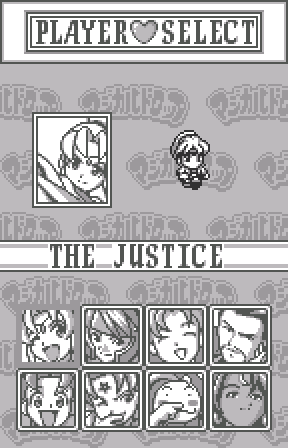
Eight characters can be chosen: Justice, Chariot, Star, Emperor, Lovers, Devil, Fool and Moon, all drawn as they look in Magical Drop F. The series gives them simple comic personalities. Justice is a girl with a big sword and a strong sense of right and wrong, and the heroine of Magical Drop F. Chariot is a hot-headed knight in silver armour and a red cape who once trained alongside her. Star is a girl who loves to sing and has no idea how badly she does it, Devil is a horned child who loves mischief but cries easily, and Fool is a boy with a runny nose and a white cat who speaks only in nonsense sounds. Lovers is a little girl who rides a pig, and Moon is a fashion-loving girl with a crescent moon on her forehead.
After the other playable characters come two bosses who cannot be chosen. The first is Empress, the series’ domineering queen with a whip, who keeps Devil among her henchmen. A final opponent waits after her. In Magical Drop F the characters could transform during a match, but that system is gone from the WonderSwan game.
How it plays
The puzzle modes are played with the WonderSwan held upright. The Y buttons move the clown left and right along the bottom of the field and can also push a new row of drops down by hand, and the X3 and X4 buttons grab and throw. The sound is mono. For the fortune-telling mode the console is turned on its side, and the X buttons move a cursor while A and B make the choices.
The rules are the series’ own. Drops push down from the top of the field a row at a time, and the field here is only six rows high. The clown sucks up the lowest drop in its column, together with any drops of the same kind stacked directly above it, and throws everything it holds back up into whichever column it moves to. Three or more drops of the same kind lined up in a column disappear, taking any touching drops of that kind with them, and the drops below then move up; if that move lines up another set, a chain follows and scores more. A row that pushes past the bottom of the field ends the game. On the black-and-white screen the drops are told apart by their patterns rather than their colours.
The story mode does not have a computer opponent that really plays its own field. The player builds chains to fill a gauge, while the opponent sends attacks across at intervals, much as in the series’ Neo Geo Pocket game. The mode runs through the other playable characters and then the two bosses.
The puzzle mode is the series’ endless game, in which the aim is simply to keep clearing drops for as long as possible. The versus mode connects two WonderSwans with the link cable, and in a two-player match the chains each player makes push the other side’s drops down faster. With the fortune-telling mode, the box counts four modes in all.
The fortune-telling mode is a fortune-teller rather than a game. The player picks a subject, such as love or work, and enters a birthday, and the game gives a reading: the fortune for the day, a reading of the past, present and future, or the player’s luck in love.
Development and release
The game was announced in Bandai’s WonderSwan catalogue as the return of Data East’s puzzle classic, with the vertical screen and two-player link-cable battles as its selling points. The cartridge holds 8 megabits, and the price was 3,800 yen before tax. The developer is usually given as Gai Brain, a small studio founded in 1992 by former staff of Santos, most of whose work was converting arcade games for home consoles and handhelds; the game is also sometimes credited to Data East itself, and the credit is not settled.
Modes and features
The cartridge holds a story mode, an endless puzzle mode and a two-player mode over the link cable, all played upright on a field that is shorter than in the home versions, at six rows.
It also has a mode of its own that Bandai presented as a third way to use it: a fortune-teller, played with the WonderSwan turned on its side. The fortune-telling is seen as the main thing that sets this version apart.
Reception
Players regard it as a plain, scaled-down version of the series. It has far fewer characters than Magical Drop F and much simpler presentation, and on the monochrome screen the drops have to be told apart by their patterns rather than their colours, though the game is still found enjoyable once the chains start to connect.
Ports and other versions
Magical Drop for WonderSwan was made for the WonderSwan, as a handheld spin-off rather than a conversion, and it was never ported or re-released on another system. It is usually connected with Magical Drop F, and its music and art come from that game, but the PlayStation release of Magical Drop F came on 21 October 1999, a week after the WonderSwan cartridge, so it is not a copy of a game already on sale. Its rules are likened variously to Magical Drop III and to the first Magical Drop.
The series had other handheld games in the same period, and they are separate titles rather than versions of this one. Magical Drop Pocket came out on the Neo Geo Pocket in June 1999 and follows the system of Magical Drop III, and a Game Boy Color Magical Drop, also built on Magical Drop III, was released in North America and Europe in 2000 but not in Japan. Against these, the WonderSwan game stands apart for its upright six-row field and its fortune-telling mode played with the console turned sideways.