
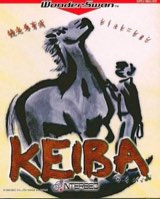
A racehorse breeding game for the WonderSwan: train a horse up through Japan's race classes to the G1s, breed its successors and aim to win the Prix de l'Arc de Triomphe.
Screenshots
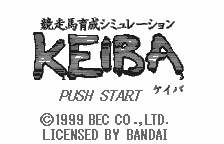
Title screen 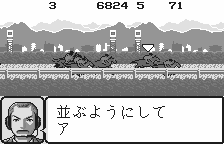
In play 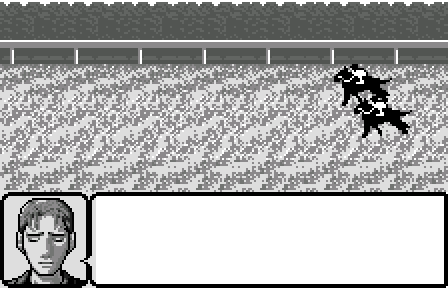
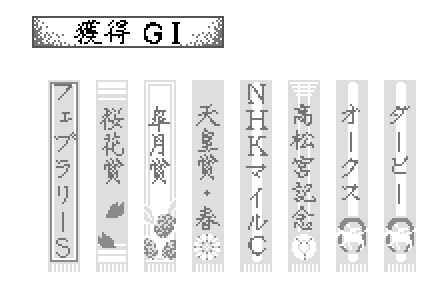
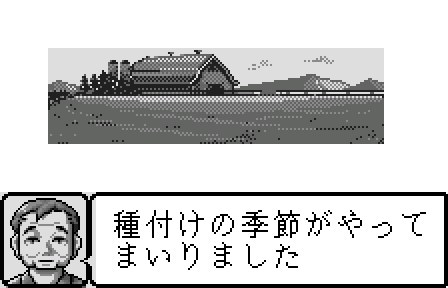
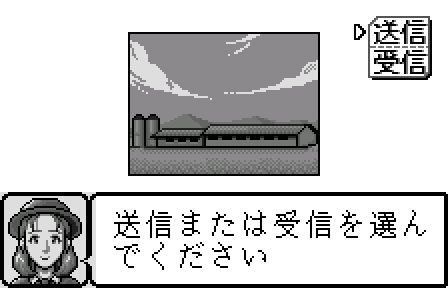
Kyousouba Ikusei Simulation: Keiba is a horse racing simulation released for the WonderSwan on 18 November 1999 by BEC. The title means “racehorse raising simulation: horse racing”, and it describes the game plainly. It came out in the console’s first year, on a black-and-white cartridge.
The aim is to breed the strongest possible racehorse, by pairing stallions with broodmares, training the horses that result and racing them with a favourite jockey up through Japan’s G1 races, with the final goal of winning abroad. The game is set in the world of the Japan Racing Association, and jockeys and horses active at the time appear under their real names, together with famous stallions of the past and well-known horses from abroad.
The game supports the link cable. With two consoles joined, players can race the horses they have each raised against one another, or swap the data of their horses.
The story
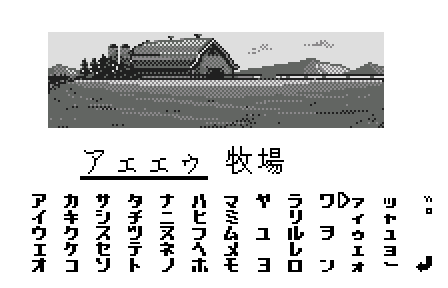
Keiba has no plot. Its framing is that of a horse owner starting out: the player names their own ranch, is handed a small sum of money and a single racehorse, and sets out to become the owner of the strongest horse in the world. The goal the game names is the Prix de l’Arc de Triomphe, which it presents as the highest G1 race in the world; winning it earns the title of the world’s best.
The world is Japan’s central racing of the late 1990s. Real jockeys appear by name, among them Yutaka Take and Okabe, whom the jockey screen introduces as a famous master rider known around the world, and the races are the real ones: the Oka Sho, the Satsuki Sho, the Oaks, the Japanese Derby, the Kikuka Sho, the spring and autumn Tenno Sho and the Yasuda Kinen, each with its trial races, run at courses such as Nakayama.
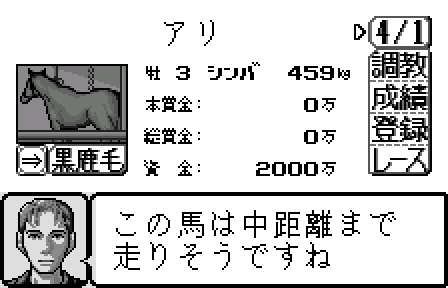
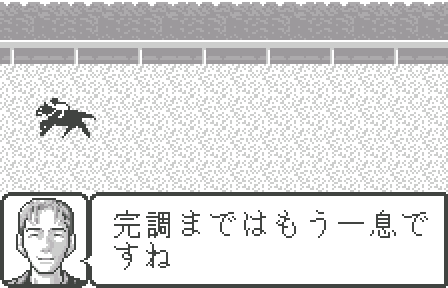
The game’s few speaking characters are there to help. A trainer’s face sits at the foot of the stable screen and offers advice, such as which distances a horse looks suited to, and a commentator in the paddock goes through the condition of every runner before a race. A horse’s career gives the game its shape: a foal is born at the ranch, moves to the stable, makes its debut, climbs through the classes towards the G1s and finally retires to stud, where it becomes the parent of the next horse.
How it plays
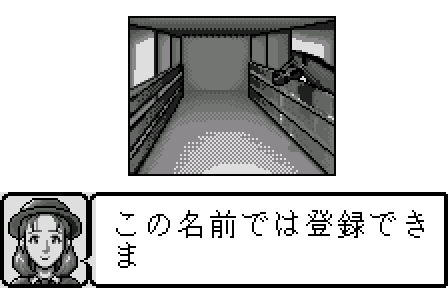
The WonderSwan is held sideways. The X buttons move the cursor, A confirms or moves on to the next screen and B cancels; Y1 and Y3 scroll the record and breeding screens, Y2 and Y4 are not used, and Start begins the game and confirms the ranch and horse names. The title menu offers a new game, a continued game and a versus mode. There is only one save, and starting a new game over it means deleting the old one. The game saves by itself whenever time moves on by a week or a month, and the manual asks for a button press and a wait of a second or two before the power is switched off.
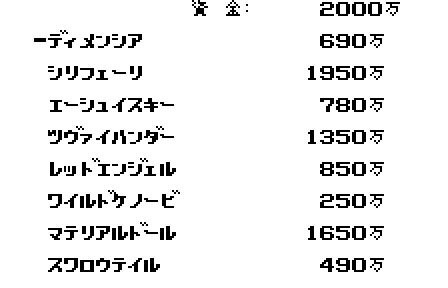
A horse is always in one of two places. At the ranch foals are born and horses rest off fatigue and heal injuries, and time moves a month at a time; in the stable horses are trained and raced, and time moves a week at a time. Both cost money, 500,000 yen a month at the ranch and 1,000,000 yen a month in the stable, and if the player’s funds fall below zero the game is over. The stable screen shows the horse’s name, sex, age, class, body weight, class money, total earnings and the player’s funds, with an arrow comparing its condition with the week before.
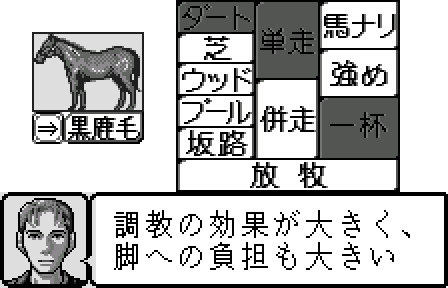
Training is chosen in three steps. First comes the course: dirt is the ordinary choice and easier on the legs than turf, turf is closer to racing but harder on them, the wood chip course softens the impact, the pool builds stamina with no load on the legs, and the uphill slope builds the kick with little strain. Then the horse works alone or alongside another horse, which raises its condition and competitive spirit but is harder on the legs. Last is the effort, from letting the horse go as it pleases through being pushed a little to a full race-pace gallop. Hard training kept up for too long can break a horse down, and a tired or injured horse can be sent out to the ranch to rest, although it then cannot return to the stable for a month.
Racing follows a fixed sequence. The player picks a race from a weekly calendar for each racecourse, where marks show dirt races, G1, G2 and G3 races, handicaps and other special races, and grey boxes mark races for fillies only. Then comes a jockey, chosen from a list in which riders who are not available are greyed out, then the week advances. On race day the course map appears with its record time, the paddock shows each runner’s body weight and its change while the commentator assesses them, the odds follow, and the race card lists every runner with the forecast marks, jockey, weight carried, sex and age and running style. Last of all the jockey gets one of five orders: lead from the start, sit just behind the leaders, wait in midfield and move from the final turn, hold back for the home straight, or leave it to the horse and rider. The race is then run on screen and the result and prize money are shown.
Which races a horse can enter depends on its class money and age. There are six ranks, the debut race, the maiden race, the 5 million, 9 million and 16 million yen classes and open class, and within open class sit the graded races, with the G1 races at the top. Class money only grows with a win, or a second place in a G1 or G2 race; up to 4 million yen of a prize counts in full, a prize of 4 to 10 million counts as 4 million, and a larger prize counts at half. Total earnings, by contrast, take in prizes for any of the first five places. Debut races are open only to three-year-olds by the game’s count of age, after which a horse that has not won runs in maiden races. A G1 race needs enough class money, but a high enough finish in one of its trial races gives priority entry, and the manual lists ten G1 races with their trials. The Arc opens up once certain conditions have been met.
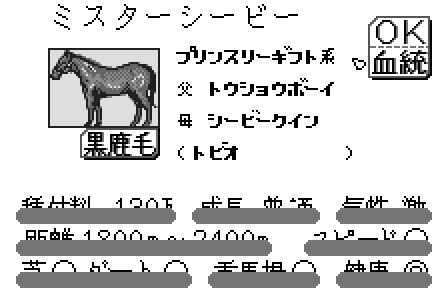
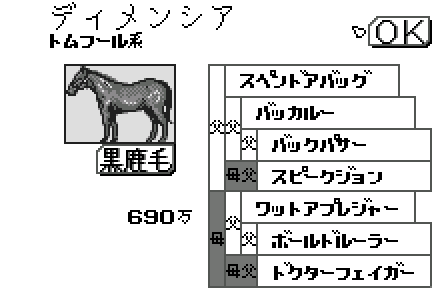
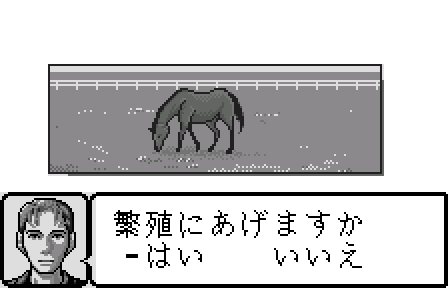
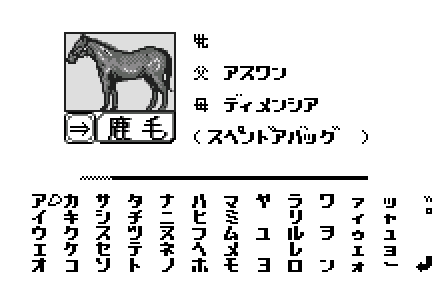
Breeding is how the game goes on. A retired colt becomes a stallion and a retired filly a broodmare, and the player then chooses a mare and a stallion for the next foal. Each stallion’s page gives his stud fee and what he tends to pass on: his best distances, his aptitude for turf and dirt, how well his offspring handle heavy going, his growth type (early, maturing at three; normal, at four; late, at five; or long-lasting), his temperament (calm, normal or fierce, with normal the best and fierce horses hard for jockeys to handle), his speed and his health on a four-step scale. Pedigrees go back three generations. A pairing with no common ancestor is an outbreed and should give a healthy foal; inbreeding can lift the foal’s speed or stamina but sometimes backfires; and a pairing whose common ancestor sits closer than two generations back is marked as dangerous and tends to produce a frail foal.
The versus mode needs two WonderSwans and a link cable. One console sends and the other receives; the sender chooses up to four runners from horses saved with the stable menu’s register option, the receiver then chooses its own, and the horses race against each other before both return to the title screen. Friends can also swap the data of their horses. Its systems are the familiar ones of the genre, which Derby Stallion and Winning Post had already established, and what sets it apart is that it carries them, real horses and jockeys included, on a handheld.
Development and release
BEC was a Japanese studio founded in December 1990 that mainly developed character games released under the Bandai label; it later became part of the Bandai Namco group and was merged with Banpresoft into B.B. Studio in 2011. On the WonderSwan it published a handful of games under its own name, Keiba among them, alongside the Dokodemo Hamster games of 2000. Who programmed the game has never been confirmed.
Ports and other versions
Keiba was made for the WonderSwan and was never released on any other system or re-released later. As a handheld game, it leans on the link cable, which lets friends race the horses they have raised against each other and swap horse data. The closest relatives on other systems are BEC’s own horse racing games, the Jitsumei Jikkyou Keiba Dream Classic series for the PlayStation in 2000 and the PlayStation 2 from 2001, but they are not known to be connected to this one.
Notes
The title is written in two ways. Bandai’s WonderSwan catalogue uses 競争馬, “competition horse”, throughout, while the cover of the manual prints the usual word for a racehorse, 競走馬, and the manual’s own text mixes the two. Which form is on the cartridge label and the box is not confirmed.