
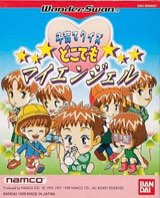
A handheld version of Namco's quiz series Kosodate Quiz My Angel, in which answering four-choice questions raises a daughter from birth to adulthood.
Screenshots
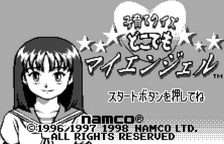
Title screen 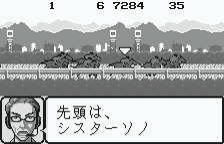
In play 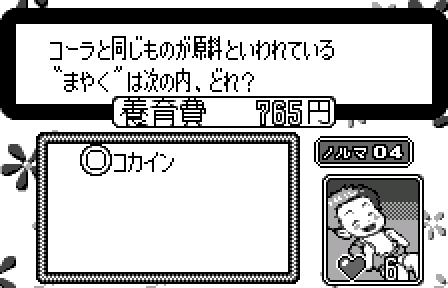
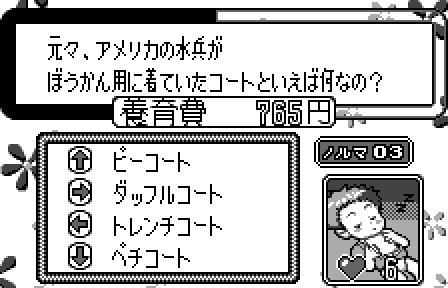

Kosodate Quiz Dokodemo My Angel is a WonderSwan version, published by Bandai and planned and developed by Namco, of Kosodate Quiz My Angel, a quiz series that Namco started in arcades in July 1996 and later brought to the PlayStation. It went on sale on 15 April 1999, about six weeks after the console itself, which makes it one of the early WonderSwan releases. The word “dokodemo” in the new title means “anywhere”, pointing to a game that can now be played wherever the player is.
The series mixes a quiz with raising a child. The player, as the father or the mother, brings up a daughter from birth to the age of 25 by answering multiple-choice questions, and the way the questions are answered shapes who she becomes and what work she ends up doing.
The story
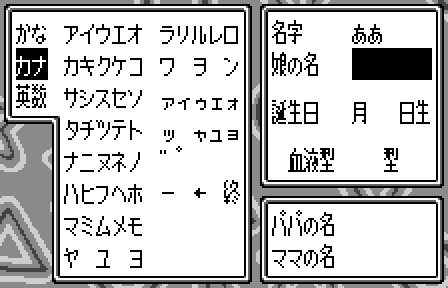
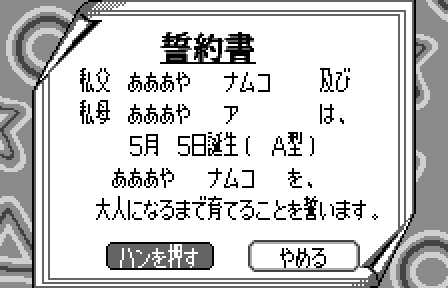
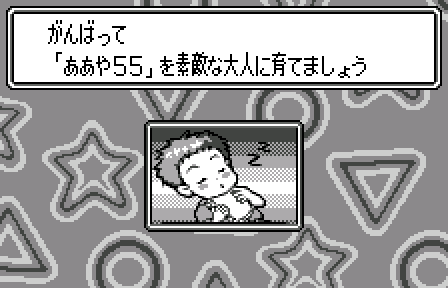
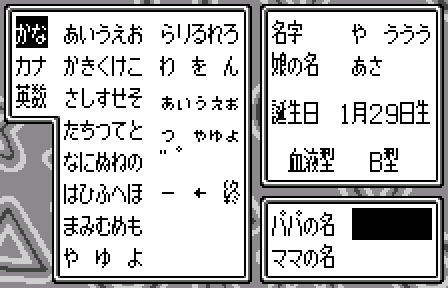
There is no story in the usual sense: the frame is family life. A new game starts with the birth registration, where the player chooses to play as the father or the mother, enters the baby’s name and the names of both parents, and stamps a pledge to bring her up. From then on the game follows her one year at a time.
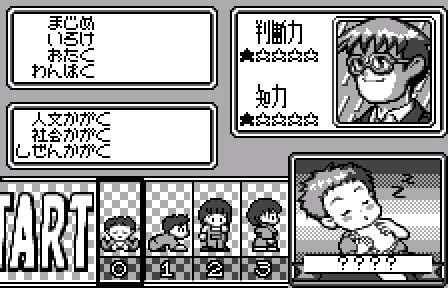
Each year of her life is a stage, and the years take her from a newborn through kindergarten and school, and then on to high school, university or vocational school and a first job, depending on how she has been raised. Her personality is drawn in the game: as it shifts between earnest, alluring, otaku and tomboyish, her look changes with it, and as an otaku, for instance, she wears glasses. Her personality and her strengths together decide the careers open to her; a girl leaning towards the natural sciences with an alluring personality can become a flight attendant, and an otaku with a head for the social sciences a diplomat, while astronaut and announcer are among the dream jobs.
At 25 her upbringing comes to an end and the game reaches its ending. The tone is light and comic, with anime-style drawings of the daughter at her different ages and personalities. In the ordinary game only a girl is born; in the link-up mode for two players a boy can be born instead, the only way to raise a son.
How it plays
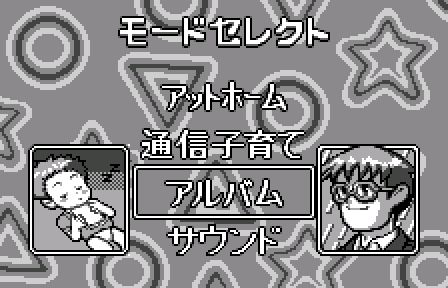
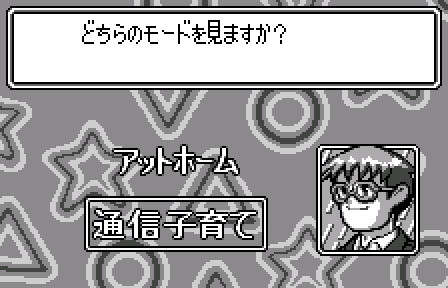
The quiz is played with the WonderSwan held sideways. The four directions of the X buttons pick the four answers, the A button confirms in menus and the B button cancels. The Start button on the title screen leads to the mode menu, which offers four modes: At Home, the main game for one player; the link-up child-raising mode for two; Album; and Sound.
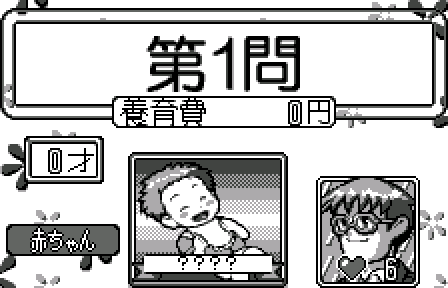
Each stage covers one year and is made up of quizzes, events and mini-games, drawn from more than 5,000 questions, a large number for a handheld game. Questions usually have four answers and sometimes three. A right answer earns money for the daughter’s upbringing, and the faster the answer the more it earns, so thinking too long costs money. A wrong answer, or letting the time bar run out, costs a life, shown as a heart, and losing the last one ends the game. The quiz screen shows her age, status and current personality, the money saved, the lives left and how many right answers are still needed to clear the stage. Clearing that target leads to an event in which the player picks from several choices; some of them cost money and cannot be chosen when the savings are too low.
Each question raises one of the four personality traits, earnest, alluring, otaku or tomboyish, depending on its subject, and choices in events move them too. The strongest trait sets the daughter’s character and her look; in the PlayStation and WonderSwan versions a close second trait adds a qualifier to that description in some modes. Three fields of strength, humanities, social sciences and natural sciences, steer her choice of career. Entry to kindergarten and each school comes with an exam stage of its own. Up to junior high school she can go to whichever school the player likes, but from high school on she has to pass the entrance exam to get into the school she wants. After university or vocational school the player picks a job and sits its employment exam, with questions about that line of work; reaching the target rate gets her the job, and failing leaves her without one.
Mini-games also turn up as special events, and a good result in one adds a life. In hide-and-seek the daughter hides around a park and the player has to pick the spot where she hid last, and she hides faster each round. The shooting game is played with the console turned upright: animals come from the back of the screen to carry off her toys, and the player drives them away with a water pistol, moving with the Y buttons and firing with any X button. In whack-a-mole the player moves a cursor to moles popping out of holes, and the daughter’s own turn can be skipped.
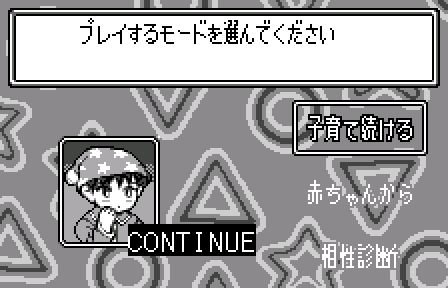
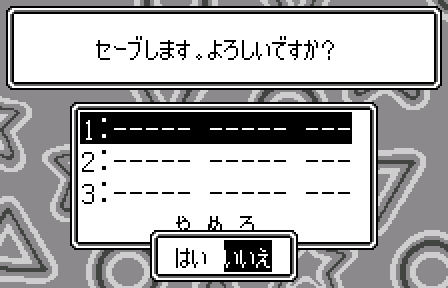
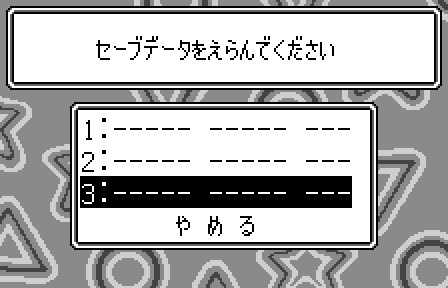
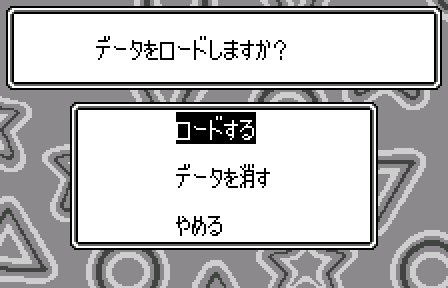
At the end of each year’s event the game offers to save, and the cartridge’s 64 kilobits of save RAM hold three files. A saved game is picked up again from the At Home menu, alongside the option to start again from a new baby. The Album mode shows memorable scenes from the events of both the At Home and the link-up modes, and what it contains depends on how each daughter was raised; save files can also be deleted there. The Sound mode turns the music and the voices on and off, though a loaded game uses the settings that were in force when it was saved.
The link-up mode needs two consoles, two cartridges and the link cable, which has to be connected before the power is turned on; while the cable is in, this is the only mode on offer. The player who presses Start first becomes the father. To begin, the father fills in the birth registration, both parents stamp the pledge, and the cable is then removed, after which each raises the same child on his or her own console in the same way as in At Home. Once both have raised the child, connecting again compares the two upbringings up to the age the less advanced one has reached, and gives a reading of how well the father and mother suit each other, judged by how each raised the child, and a measure of how fond the child is of each parent.
Ports and other versions
Bandai presented the cartridge as Kosodate Quiz My Angel brought over to the WonderSwan under a new name. Namco had opened the game in arcades in July 1996 and released it on the PlayStation on 13 November 1997. Which of those two releases the handheld version follows most closely is unknown. The arcade sequels My Angel 2 and My Angel 3, from 1997 and 1998, are separate games rather than versions of this one.
The main difference is a two-player mode that exists only on the WonderSwan. With two consoles joined by the link cable, choosing the two-player option from the menu lets the players act as the father and the mother, compare how each of them has raised the daughter, and get a reading of how well they suit each other. Bandai stressed that moving to a handheld had not made the game any smaller, though its more than 5,000 questions are fewer than the 7,000 of the arcade game and the 15,000 of the PlayStation version’s At Home mode, and the cartridge has stereo sound.
Later history
Namco followed the PlayStation version of the original with Kosodate Quiz Motto My Angel, a sequel made for home consoles, released on 25 March 1999, three weeks before this cartridge. The series later reached the Nintendo DS in September 2006 as part of the Unou no Tatsujin series, with questions built around right-brain thinking. In 2009 the WonderSwan game was still listed among past titles on the website of Namco Bandai Games, which presented it as a Namco cartridge.