
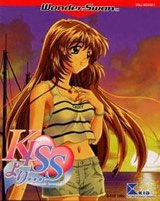
KID's WonderSwan version of its Saturn romance game Kiss Yori..., a summer at the seaside spent working off a debt and getting to know the girls met on the beach.
Screenshots
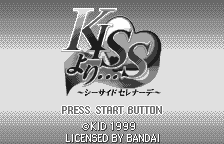
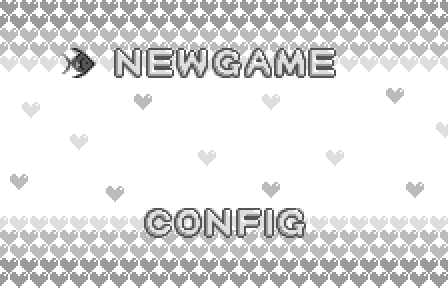
Title screen 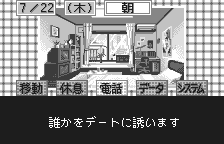
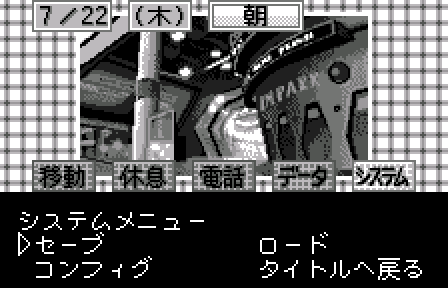
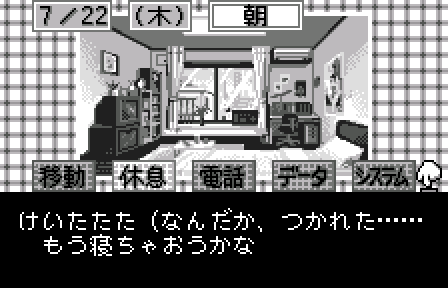
In play 

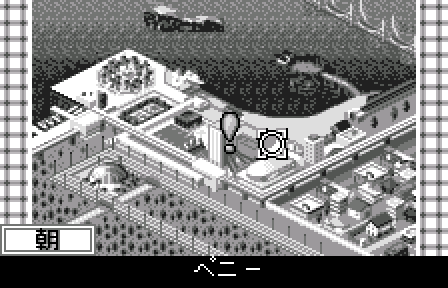
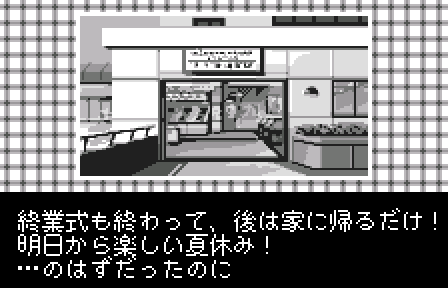
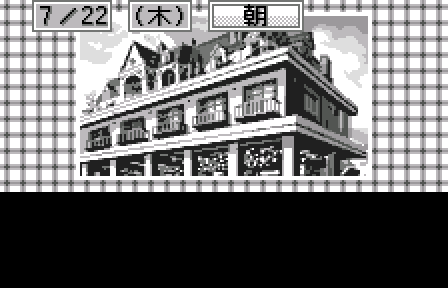
Kiss Yori…: Seaside Serenade is a romance adventure game released by KID for the WonderSwan on 2 December 1999. It is a version of Kiss Yori…, which KID had published for the Sega Saturn in March of the same year. It was presented as the first romance game on the WonderSwan, then still a black-and-white console.
It is set over one summer holiday at a seaside resort, where the hero gets by on part-time work while getting to know the girls he meets by the sea. Its main feature, carried over from the Saturn game and expanded, is a real-time conversation system in which the hero and a heroine question each other against the clock. The cartridge is for one player and has no link-cable play.
The story
The game takes place during the summer holiday of the hero’s second year of high school, in a resort town by the sea. His mother goes off to join his father and leaves him no money to live on, so he is broke from the start. The owner of the business where he finds part-time work lets him draw his wages in advance, and the summer turns into a race to pay that debt back before the holiday ends, while he spends what free time he has with the girls he meets.
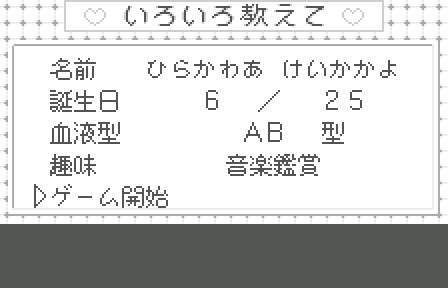
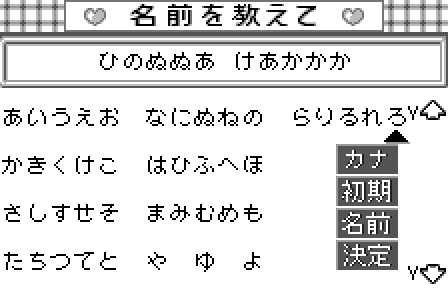
The hero is a cheerful, rather foolish young man. His name can be changed, and his default name on the WonderSwan is not the one used in the Saturn and Windows versions. The main heroine is Chihiro Asaoka, a girl he was in love with in junior high school and runs into again by chance. She is often seen with Shingo Kunimi, a young man whose relationship with her is unclear. Other girls turn up in the ordinary course of his days: one runs into him in front of his workplace, and another is first seen playing with a dog.
The tone is a light summer romance, and which girl the hero grows close to is up to the player.
How it plays
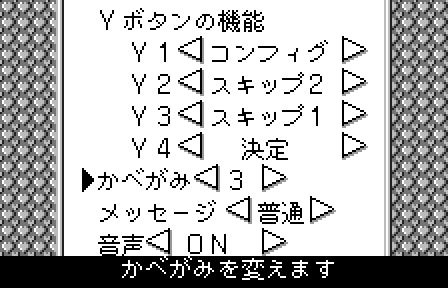
The game is played with the WonderSwan held sideways, and everything is drawn in black and white, as the console had no colour model when it was planned. In the manner of KID’s games there are many settings to adjust, and several wallpapers to choose from.
With his parents away, the hero gets through the summer on part-time work, and the time left over goes on meeting the girls.
Meeting a heroine in town starts a real-time conversation, in which the two ask each other questions against a time limit, and replies that suit her interests raise her affection. For the WonderSwan, KID greatly expanded these conversations and made them and the adventure part affect each other, so what is said in conversation and what happens in the story feed back on one another.
Which girl the hero ends the summer with depends on the time he spends with her and on how their conversations go.
The cartridge supports stereo sound and came with a 16-page manual.
Development and release
The Saturn original was KID’s last game for that console; from then on the company made the PlayStation its main platform. That release came with a joint spring promotion with MediaWorks and Datam Polystar, in which buyers of Kiss Yori… and two other Saturn titles could send off for bonus cards. The WonderSwan version followed in December 1999. Bandai’s catalogue pitched it to fans of bishoujo games as the first such game on the system, and the magazine Dengeki Oh described it as the console’s first romance adventure. The hero is a second-year high school student, and Bandai promoted the real-time conversation system, popular in the earlier versions, as the main draw.
Ports and other versions
The game began on the Sega Saturn, where KID released Kiss Yori… on 18 March 1999 as an all-ages title. An adult version for Windows 95 and 98 followed from another publisher on 24 June 1999, and the WonderSwan cartridge came last, in December. It was never released on any other system.
The real-time conversation system, well liked in the Saturn game, was greatly expanded for the WonderSwan, and the adventure part and the conversations now affect each other. The Saturn game voiced every character except the hero. How much of the Saturn and Windows releases’ heroines, endings and extras such as the snapshot album made it onto it is unknown.
The Windows version went its own way. Besides adding adult scenes, it left the characters’ school ages vague and simplified the system: the real-time events, the snapshot feature, stamina and the rest command were dropped, there were fewer places to visit and jobs to take, and a gallery mode was added.
Notes
The title is written in Latin script in two slightly different ways, once with Kiss in lower case and three dots, once with KISS in capitals and the subtitle as Seaside Serenade, and the subtitle is also written in katakana. The cartridge label reads KISSより… Seaside Serenade.