
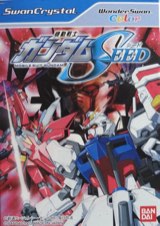
An eight-stage action game in which the player pilots the Strike Gundam, released while Gundam SEED was still on the air and the first game based on the series.
Screenshots
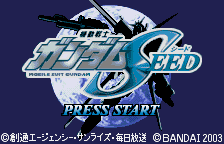
Title screen 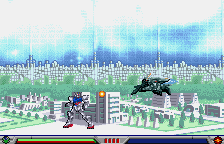
In play 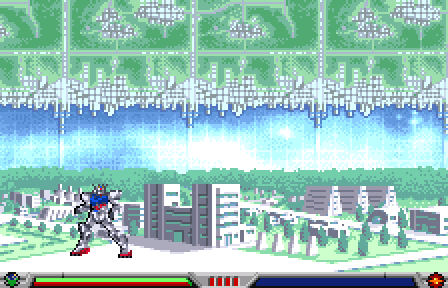
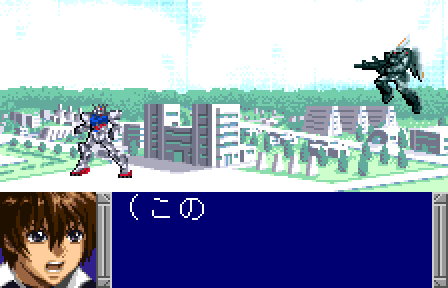
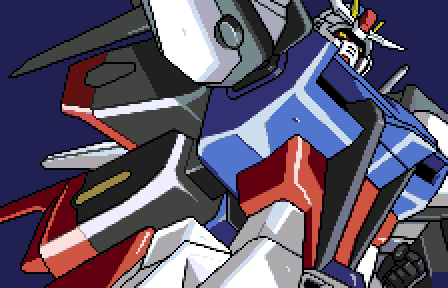
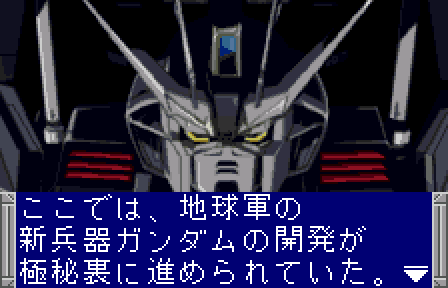
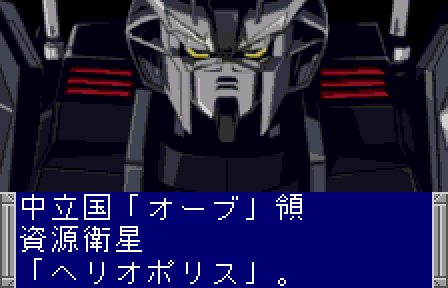
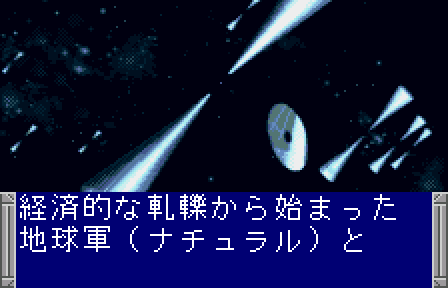
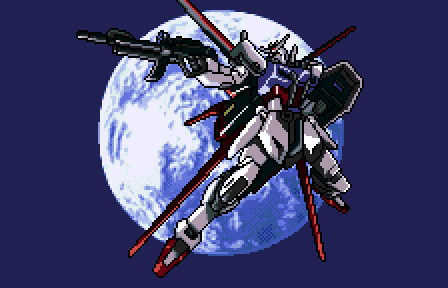
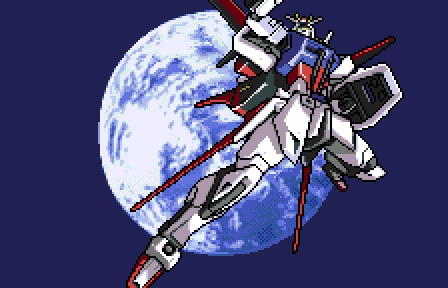
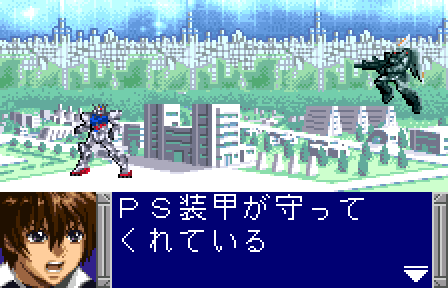
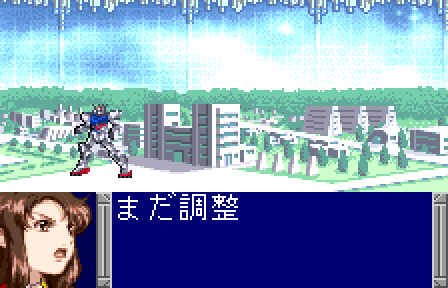
Kidou Senshi Gundam SEED is an action game for the WonderSwan Color based on Mobile Suit Gundam SEED, the anime series that began on Japanese television in 2002. Bandai released it on 15 March 2003, while the series was still being broadcast, and it was the first game made from SEED on any system. Some of its stages reach events the series had not yet shown, so players could see mobile suits that matter to the story before they appeared on television.
The player flies the Strike Gundam through eight short side-scrolling stages, fighting ZAFT’s mobile suits and, in the boss battles, the four Gundams on the enemy side, while the game switches the Strike between its Aile, Sword and Launcher equipment packs. Points from each stage are spent on tuning the Strike’s operating system, and once the main game is cleared, side stories open up for the Aegis, Duel, Buster and Blitz Gundams.
The story
Gundam SEED is set in the Cosmic Era, when humanity has split into the Naturals of Earth and the Coordinators, genetically enhanced people who live in the space colonies called the PLANTs. The two are at war, with the Earth Alliance on one side and ZAFT, the Coordinators’ armed force, on the other. The story opens at Heliopolis, a colony belonging to the neutral Orb Union, where five new mobile suit prototypes and the warship Archangel that is to carry them are being built in secret for the Earth Alliance. ZAFT attacks the colony to seize the machines, and Kira Yamato, a Coordinator student living there, takes the controls of the GAT-X105 Strike to protect his friends.
The other four prototypes end up in ZAFT’s hands, and the Aegis, Duel, Buster and Blitz become the enemy Gundams that the Strike has to face again and again. The Aegis is flown by Athrun Zala, Kira’s childhood friend, now a ZAFT soldier. With the colony lost, the survivors board the Archangel and set out for the Earth Alliance base in Alaska, with Kira piloting the Strike against one ZAFT attack after another on the way.
The game follows that journey over its eight stages, starting inside the colony against Miguel’s GINN and moving out into space, down to the desert and the sea floor and on to Alaska. Each stage is introduced by a short summary of the story so far, played as conversation over still pictures of the machines, with the outside of the Archangel standing in for scenes on board and character portraits shown only in the conversation windows. The summaries are brief and leave a good deal unexplained, so the game is easiest to follow for someone who has seen the series. Some events come up during the fighting as well, with allies such as Miriallia passing on information about the enemy.
The cartridge came out on the day the 24th episode was broadcast, so its later stages reach parts of the story that television had not yet shown, and it hints at a few developments without explaining them. The side stories unlocked after the ending turn the camera round to ZAFT, giving one short episode to each of the four enemy pilots, each of which ends in a duel with the Strike.
How it plays
The Strike moves freely around a side-on screen and can hover, which drains energy, or dash, which costs none. There are only two attacks, shooting and melee. A shot can be charged for more damage, and melee strikes in a combo of up to three hits; with an enemy locked on, melee sends the Strike lunging at the target to slash it, and with the Sword pack it fires an anchor instead. The shield halves damage whichever way the Strike is facing. Lock-on sits under the left hand, and because it is easily confused with the bomb, bombs often go off by mistake; there are no options or button settings to change this. A bomb calls covering fire from the warship that hits the whole screen, with four per stage, refilled when the stage ends.
The Strike’s life is shown as two gauges, Phase Shift armour and hit points. Beam attacks cut straight into hit points, while solid rounds, and also heavy use of the Strike’s own weapons, wear the armour down. When Phase Shift goes down, beam weapons can no longer be used and the Strike is left with its vulcans and knife, which use no energy; the Launcher also loses its lock-on in that state and cannot turn to the left. The game fits the pack to each stage. The Aile favours mobility and carries the largest energy supply, 12,000 against the Sword’s 8,000 and the Launcher’s 6,000, with a rifle and a saber. The Sword’s long blade covers a wide area, cuts enemies behind the Strike as well and destroys ordinary enemies in one hit, and its boomerang strikes twice. The Launcher’s cannon hits hardest.
Each of the eight stages takes around five minutes and the whole game less than an hour. The stages have no obstacles and no vertical scrolling, and the only real gimmick is one stage in which a battleship’s gun turrets have to be destroyed. Some enemies keep coming back without end, while others must be destroyed before the stage moves on. Several stretches consist only of dodging, with the four enemy Gundams or missiles from an unseen source firing at the Strike. Every stage ends with a boss: Miguel’s GINN, the Blitz, the Duel, the Duel in its Assault Shroud armour, the LaGOWE, the ZnO, the Aegis, and finally a CGUE escorted by two red and blue CGUEs that are original to the game, with DINNs firing beams.
The story events in each stage are played as short action scenes, either a button press with the right timing or a contest of mashing a button faster than the computer, as when the Strike fires its cannon at a CGUE, receives the Launcher pack, locks sabers with the Duel or intercepts missiles. They are easy, but failing one has a cost, usually starting the next fight with half the Strike’s hit points or with its Phase Shift already down.
The score for a stage counts down from a maximum of roughly 12,000 to 13,600 points as time passes, and the timer stops during conversations. Kills add nothing directly, but clearing enemies faster brings on the next ones sooner, so fast play scores best. Scores add up across stages, and every 20,000 points earns one point for the operating system, which is split into attack, energy use, speed and defence. Each starts at three, twelve points bring all four to their maximum, at most six unspent points can be held, and points once spent cannot be taken back, although a value can be lowered to raise its partner. A first run reaches about 80,000 points by stage seven, enough for around four points before the final stage. After the ending, the cleared save starts again from stage one with its score and points carried over.
There is one save file and no difficulty or stage select. Clearing the game once adds score attack, which joins all the stages into a single run of about ten minutes with the bosses in between, starts the score at 22,000 and ends at Alaska against the Aile Strike; its score is not recorded and finishing it brings nothing. Raising the total score on a cleared save opens the ZAFT side stories and their machines one by one, which takes about five runs, and the total stops at 9,999,999. The side stories all reuse the same space stage, with only Earth Alliance fighters as small enemies. The Buster has more hit points than the others but no shield, and the Freedom, flown only in score attack, has no knife and so cannot fight hand to hand once its Phase Shift is down.
The game is easy and turns simple once learned, though without upgrades the Aegis in stage seven is a real obstacle. Common advice is to keep firing the rifle rather than save energy, since spent energy matters less than damage taken, and to stay near the lower left of the screen, which is fairly safe. The Buster’s cannon fire hurts most and is the one attack to dodge every time. In the Duel stage, Dearka’s threat to shoot the Strike through the head does not mean he aims high, and Miriallia’s reports are the better guide. In the last stage the rifle works better than the saber.
Development and release
Sunrise, the studio behind the anime, announced the game on 14 January 2003 as the first game adaptation of Gundam SEED, describing a stage-clearing mecha action game with smoothly animated movement for the Strike, simple controls for taking on several enemies at once and all three of the Strike’s equipment packs. It gave the planned price as 3,980 yen and the release date as 15 March, and noted that the game also ran on the SwanCrystal. No developer was named when the game was announced. It is credited to Arowana, a company that began in 1997 as the game and web division of another firm and was incorporated in 2000, though this has never been confirmed. It is not one of the games of Vanguard, which made several of Bandai’s other Gundam games for the system.
Modes and features
The game is for one player, plays in stereo, does not use the link cable, and needs a WonderSwan Color or SwanCrystal.
Secrets and extras
Clearing the story once opens a score attack mode that runs the stages back to back. The side stories for the four enemy Gundams form an extra mode on the ZAFT side, and each one opens when the total score on a cleared save passes a threshold, from 140,000 points for the Duel up to 320,000 for the Aegis. A fifth machine, the Freedom, unlocks at 380,000 points and can only be flown in score attack.
Reception
The game has drawn little attention. It is criticised for monotonous stages and thin content, with no obstacles or vertical scrolling, enemies that respawn endlessly in places, a lock-on button placed so that bombs are easily fired by mistake and no option or button settings, which has led to suspicions of a short development time. The wide reach of the Strike’s sword and the upgrade system are better liked.
Ports and other versions
This game was made for the WonderSwan Color and was never ported, remade or re-released on any other system. It is easily confused with a PlayStation 2 game that carries exactly the same title, but that one is a separate game by a different developer, released in July 2003, a few months after this cartridge. Many more SEED games followed on the Game Boy Advance, the PlayStation 2, the PSP and in arcades, but they are other games built on the same anime rather than versions of this short side-scrolling one.