
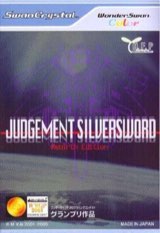
A vertical shooter by M-KAI that began as a winning WonderWitch contest entry and was expanded into a cartridge sold by Qute through limited mail order.
Screenshots
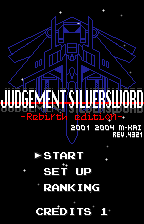
Title screen 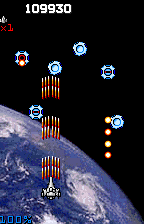
In play 
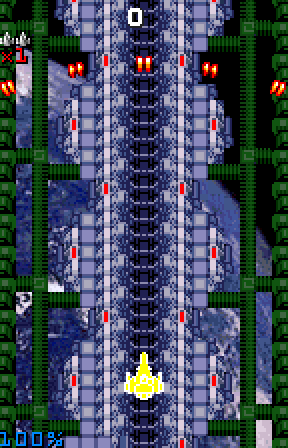
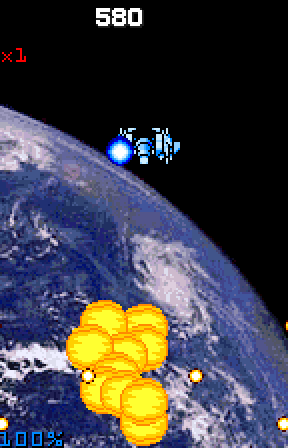
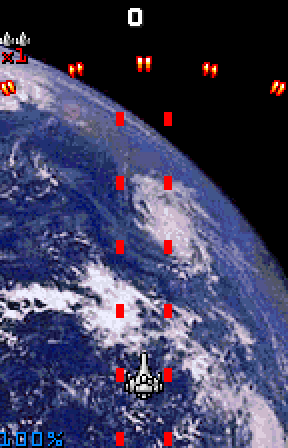
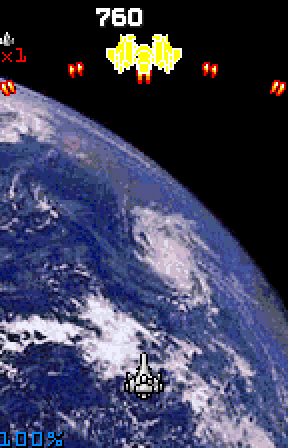
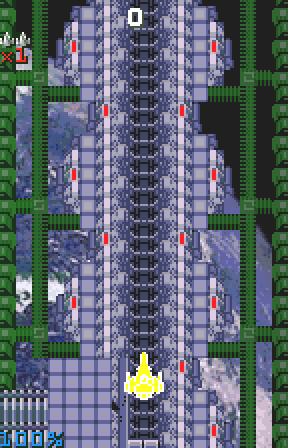
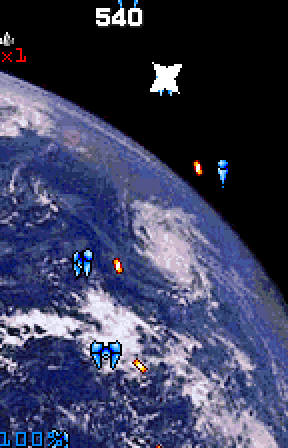
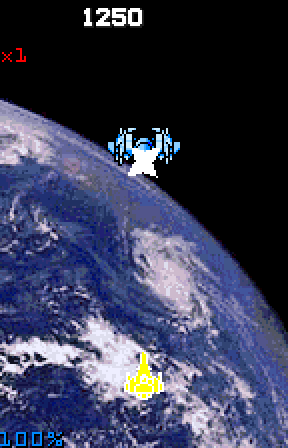
Judgement Silversword: Rebirth Edition is a vertically scrolling shooter created by the independent developer M-KAI and published by Qute for the WonderSwan Color on 5 February 2004. It started life as a homebrew game made with WonderWitch, Qute’s kit for writing software for the WonderSwan, and took the grand prize in Qute’s WWGP2001 contest. M-KAI gave away the contest version and a bug-fixed revision for free. For the cartridge release the game was renamed and its content strengthened.
The console is held upright, giving the screen a tall playfield. The ship fights with two kinds of shot and a shield, each area is a race to clear the screen, and the options menu offers more settings as the player builds up score.
Rebirth Edition arrived about a year after Bandai had stopped making the WonderSwan, and it was sold only through limited-period mail order, offered three times. Qute’s first run was followed by a second one made to order, and a reissue came out in 2005 from another publisher, Glep. The first run was small, which has made the cartridge one of the scarcer items for the system. It plays on the WonderSwan Color and SwanCrystal only. M-KAI later worked on the shooter Eschatos, whose system is based on this game.
The story
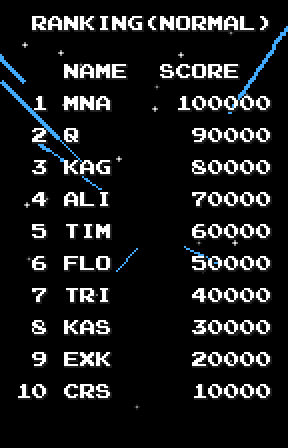
Judgement Silversword is presented with almost no story. Its framing comes from the title and from the way it was sold, as a lone ship’s confrontation with a mysterious judgement that the player has to survive. M-KAI’s earlier games supply the default names on the high score table.
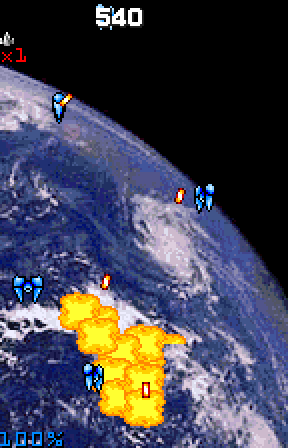
The setting is space. The first areas show a photographic Earth that slips out of view as the ship pulls away, and from there most backgrounds are black space with the occasional edge of a planet. The bosses are named craft whose look recalls the mecha anime of the 1980s and 1990s. One family of bosses, the Mitsurugi, returns in several forms, and the largest, Judge Magnificence, fills the screen.
The tone is that of an arcade shooter shrunk onto a handheld: a deliberately old-fashioned look, fast waves and a long climb in difficulty toward a final run of bosses. It is widely taken to draw on Treasure’s arcade shooter Radiant Silvergun. The sound test in the options lets the player hear the music, the effects and the game’s voice samples.
How it plays
The WonderSwan is turned on its side and held upright. One set of direction keys steers the ship, and the buttons on the other side fire the straight shot, fire the wide shot and raise the shield. There are no power-up items, no weapon pick-ups and no bomb: the ship has the same three tools from the first area to the last, and the player switches between the shots at will, using the straight shot to focus on a single target and the wide shot to sweep up groups of small enemies. Alternating the two shots at the right rhythm puts more bullets on screen than holding either one.
The shield, called the force field, is a round barrier in front of the ship that runs on energy. A percentage in the bottom-left corner shows how much is left; every bullet it absorbs takes some away, and it refills while the shield is not in use. It erases most enemy bullets, but some bullets are tougher and take several hits to wear away, and the force of the shots pushes the ship backward while it is raised, sometimes into the path of other fire. Enemies that touch the shield take damage. For simply staying alive, dodging is often safer than relying on it.
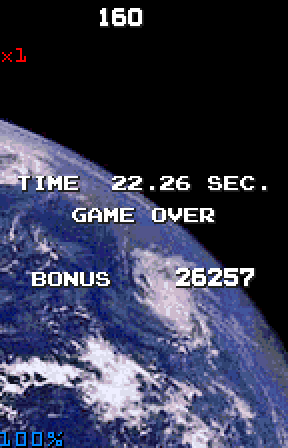
The game is built from thirty short areas grouped into five stages. An area ends when all of its enemies have been destroyed, and the faster that happens the larger the bonus, so each area is in effect a time attack; most waves last less than half a minute. Bosses with their own attack patterns appear along the way. Easy, Normal and Hard are offered, and the commercial release adds a special stage of its own.
Scoring rests on a multiplier, the score pace bonus. It rises while the player keeps damaging enemies and their bullets without a pause and falls away quickly when the attack stops. Hitting enemies with shots keeps it climbing; blocking bullets with the shield or ramming enemies with it raises it much faster. Reaching the end is a simple matter of shooting and dodging, while a high score asks for close, aggressive play with the shield, and the game treats the two as separate goals.
The difficulty rises steeply. In the early areas a little side-to-side movement avoids most fire and extra ships pile up, to around ten, but the last areas are dense enough to take all of them within a few minutes. After the thirtieth area comes a hidden true final boss, fought in a run of battles one after another, and it is regarded as harder than all thirty areas before it.
The cartridge adds up the score from every game played and raises an option level as the total grows. Each level opens more settings that favour the player, along with extra credits, a new ship, a boss rush mode and special difficulty settings, though the later rewards take a long time to earn. High scores are saved on the cartridge.
Development and release
Qute announced the cartridge in January 2004, presenting it as a renewed version of the first WonderWitch programming contest’s grand-prize winner. Qute set the release for 5 February 2004 at 4,800 yen including tax, with postage extra, and stressed that the game came on an ordinary cartridge, so no WonderWitch kit was needed to play it. Sales went through Qute’s own web shop. M-KAI ran the game’s official site and posted promotional videos there, and at the end of January 2004 thanked buyers there for selling out the advance orders. The build-to-order second run stopped taking orders on 25 March 2004.
Modes and features
The cartridge version covers thirty areas grouped into five stages, plus extra content beyond them. Compared with the contest version it adds a choice of Easy, Normal and Hard, a special stage made for the commercial release, new enemies and stages, and reworked earlier stages. M-KAI rewrote the program so that more enemies and bullets could be on screen at once with less flicker.
Reception
Shooting-game fans regard it as a serious, modern design behind a deliberately retro look, with a scoring system, in which shielding against bullets or ramming enemies with the shield drives the multiplier up, that is quite separate from the simpler task of reaching the end. The game shows the limits of the hardware: shots or the player’s ship disappear when too many bullets are on screen, and the variety of enemies is small. The closing stretch and the hidden final boss are considered extremely demanding.
Ports and other versions
Judgement Silversword was made for the WonderSwan from the start. Its first form was a program that ran on the WonderWitch kit, and Rebirth Edition is the expanded cartridge version of it, with the additions described above. The cartridge itself exists in more than one state: the options unlocked at each level differ between the first run and the later reissue, so the two are not identical. Both Qute and M-KAI strongly recommended playing on a SwanCrystal, warning that parts of the screen can be hard to see on a WonderSwan Color.
The game left the WonderSwan as an extra inside Eschatos. The Xbox 360 release of 2011 includes Judgement Silversword together with Cardinal Sins. The Steam version of Eschatos leaves them out; instead the two were sold on Steam as a separate package, Judgement Silversword Resurrection, released in September 2015 in Japanese and English and with Steam achievements added. It was sold as a faithful reproduction of the WonderSwan Color game. When Eschatos came to the Nintendo Switch in November 2021, both games were bundled with it again.
The Steam release is considered an accurate emulation of both games, and it adds control and display settings and lengthened soundtracks.
Later history
In late 2004 M-KAI released Cardinal Sins, also called the Recycle Edition, a short freeware shooter for WonderWitch that reuses the game’s graphics and sound. M-KAI went on to lead the team behind Qute’s shooter Eschatos for the Xbox 360 in 2011, whose system grew out of this game.