
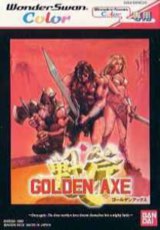
Sega's 1989 Golden Axe on the WonderSwan Color, built from the Mega Drive version with a new prologue, Japanese text, saves between stages and fiercer enemies.
Screenshots
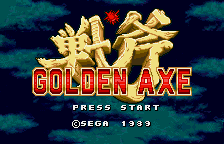
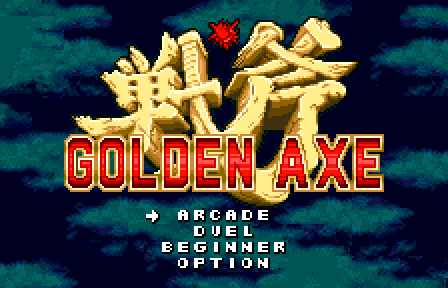
Title screen 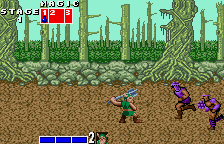
In play 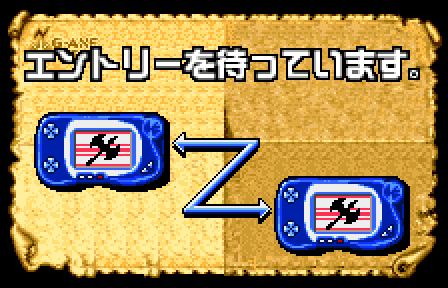
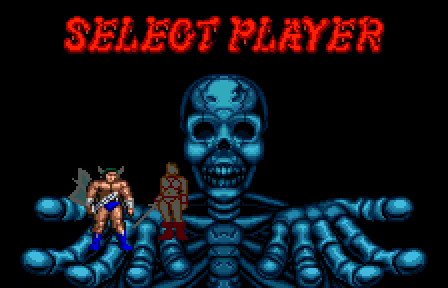
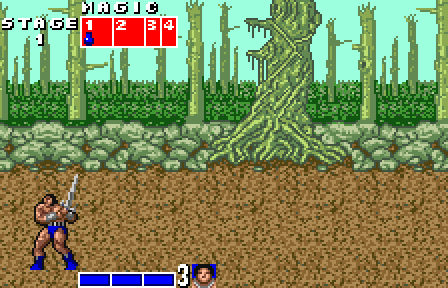
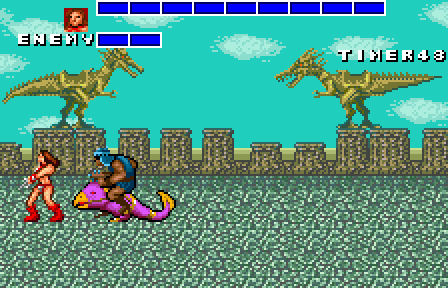
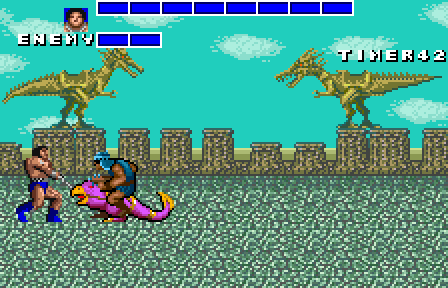
Golden Axe for the WonderSwan Color is a port of the first Golden Axe, the side-scrolling action game that Sega released in arcades in 1989. Bandai published it in Japan on 28 February 2002, and Sega developed it.
The player picks one of three heroes and cuts through Death Adder’s army with sword, magic and captured beasts. The cartridge is made for the Color and does not run on the original black-and-white WonderSwan.
The story
This version opens with a prologue written for it. Six years have passed since Death Adder, a survivor of a race of evil giants, destroyed the kingdom of Firewood. The town where the tale begins still carries the scars of that war, its shops are run down, and in one shabby tavern sit the three people who will take him on. The quest itself is the one from the original game: Death Adder has seized the king and his family and wields the Golden Axe, the weapon the game is named for, and the three heroes set out for his castle.
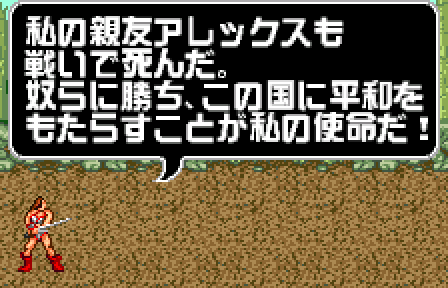
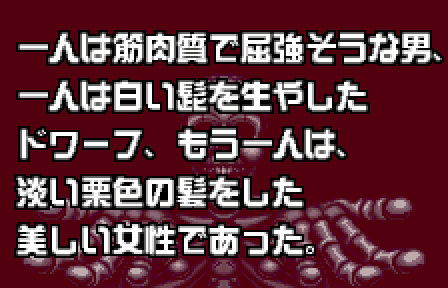
Ax Battler is the muscular barbarian, and in the prologue he names his grudge: Death Adder’s forces killed his friend and his mother twenty years ago. Gilius Thunderhead is a white-bearded dwarf warrior out to avenge his brother, and Tyris Flare, a chestnut-haired Amazon, has lost her family to Death Adder as well. Revenge comes first for all three, though they also fight to bring peace back to the land.
The story is told in short pieces rather than long scenes: an animated opening, a few lines between stages and on the start screen, and an animated ending. In this version all of that text is in Japanese, where the Mega Drive release it is based on used English only. The world is sword and sorcery in the manner of the Conan stories, full of barbarians, skeleton warriors and strange beasts, and the game is the journey across it to Death Adder.
How it plays
Golden Axe is a side-scrolling fighting game. The hero walks through each stage, moving up and down the ground as well as along it, and has to beat each group of enemies before the screen moves on. There are three actions: attack, jump and magic. Pressing attack over and over strings blows into a combo that ends in a throw or a heavy strike, attack and jump together hit an enemy standing behind the hero, and tapping a direction twice makes the hero run, which allows a running attack and a running jump attack. Many moves look different from other versions but work the same way, with one cut: the hero can attack only once during each jump.
Magic runs on potions. Beating the fairies that turn up in the stages makes them drop potions, and the more the hero holds, the stronger the spell that can be cast. Every spell hits all the enemies on the screen. The heroes differ here: Ax uses earth magic, Tyris fire and Gilius lightning.
Some enemies ride beasts, dragons among them. Knocking a rider off lets the hero climb on and use the beast’s own attack, such as a tail swipe or fire. A hit throws the hero off again, so staying mounted takes care.
The game follows the course of the Mega Drive version. Progress can be saved between stages, so a run does not have to be finished in one sitting.
This is a harder version than most. Enemies come at the hero two at a time, but they are far more aggressive than in any other release, and the enemy line-ups were changed for it. Because enemies close in from both sides, standing still to finish a combo invites a blow from behind; the back attack, the jump attack and the running attack knock enemies down more safely, and stepping up or down out of an enemy’s line is the basic way to dodge. Spells are a quick way to damage a boss or thin out a crowd.
Development and release
Sega announced in September 2001 that it would start making games for the WonderSwan Color, and named Golden Axe as the first. Under the same arrangement as Namco’s WonderSwan games, Sega developed the game and Bandai published it. At the announcement it was due in early spring 2002, with fully redrawn graphics and improved presentation promised and no price yet set. It arrived on 28 February 2002 at 4,800 yen before tax, with stereo sound.
Modes and features
One player can go alone, or two can fight side by side: the game is for one or two players and supports the link cable.
Ports and other versions
Golden Axe began in arcades in 1989 and was converted for many systems before the WonderSwan Color cartridge appeared, among them the Mega Drive version from December 1989, a Master System version sold outside Japan, a PC Engine CD-ROM² version in 1990, and European releases for home computers such as the Amiga and Atari ST. Later the game reappeared on the Mega-CD in the Sega Classics Arcade Collection, on the Game Boy Advance, in a 3D remake for the PlayStation 2 in the Sega Ages 2500 series in 2003, on Windows, through Virtual Console on the Wii, on PlayStation 3 and Xbox 360 as downloads, on smartphones, and on Nintendo Switch through its Mega Drive library in 2021. It has also appeared in compilations for the Dreamcast, PSP and PlayStation 4, among others. Most of these carry the Mega Drive version, some the arcade game. The WonderSwan Color version itself was never released on another system.
The WonderSwan Color game was built from the Mega Drive version rather than the arcade original. More animation frames were drawn so the characters move more smoothly, the opening and ending gained animated scenes, and the lines shown between stages and on the start screen are in Japanese. It also adds a prologue written for this version, saving between stages, and changed enemy line-ups. Like the Mega Drive, Mega-CD and Game Boy Advance versions, it ends with Death Bringer, Death Adder’s teacher, as a hidden final opponent.
The Mega Drive version is the best known and is generally thought a good conversion despite some losses, while the PC Engine version is ranked among the weakest, with its smaller playing area, fewer characters on screen, poor controls and long loading, though it added voices and picture scenes. The Master System version is for one player only, with a single barbarian hero, variously identified as Ax Battler or as a look-alike named Tarik.