
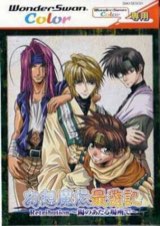
A WonderSwan Color board game based on Kazuya Minekura's Saiyuki, in which Sanzo's party works at a festival food stall to pay for their lodging.
Screenshots
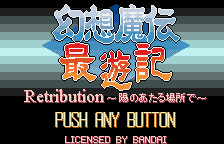
Title screen 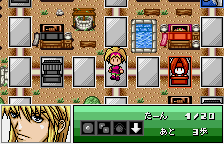
In play 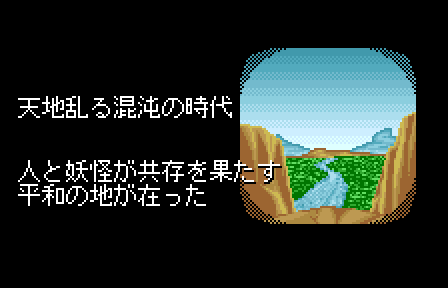
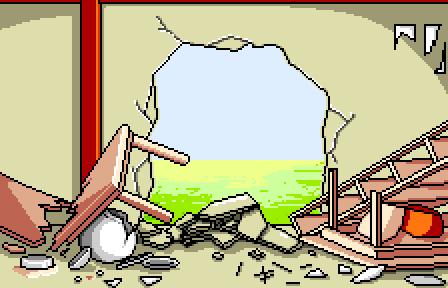
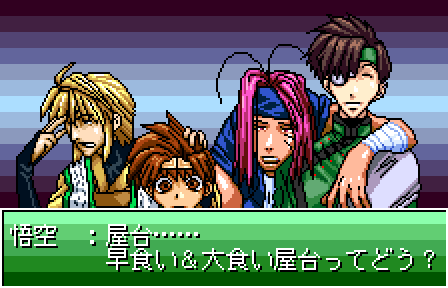
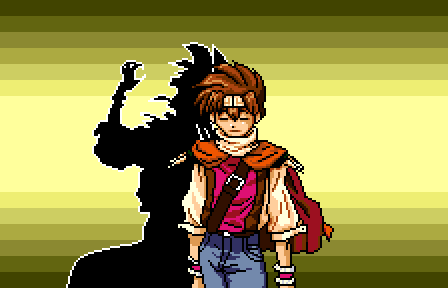
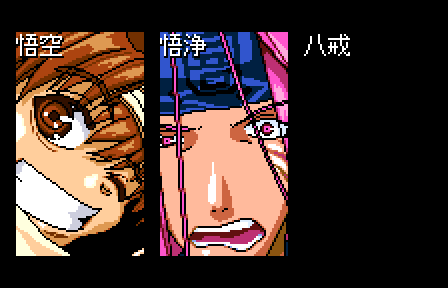
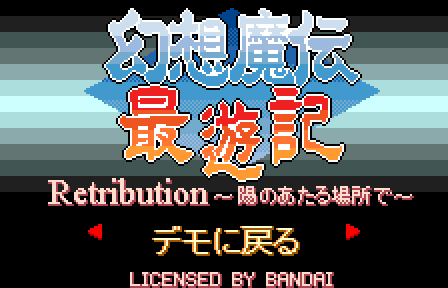
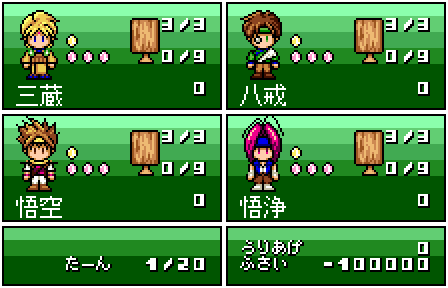
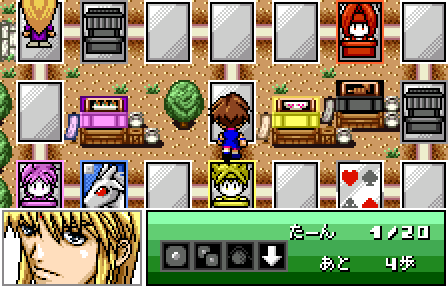
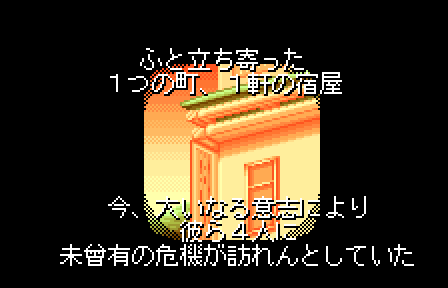
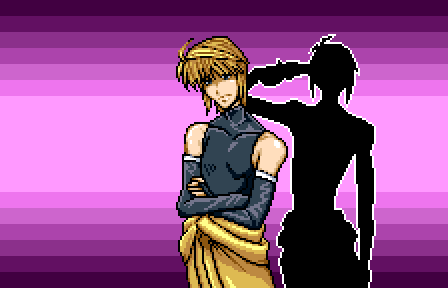
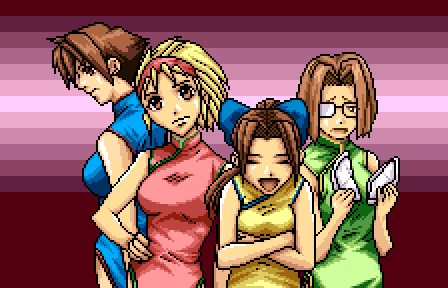
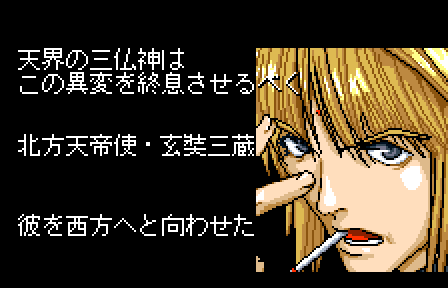
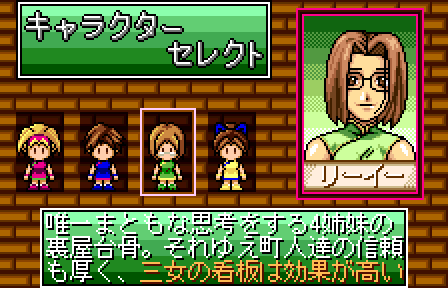
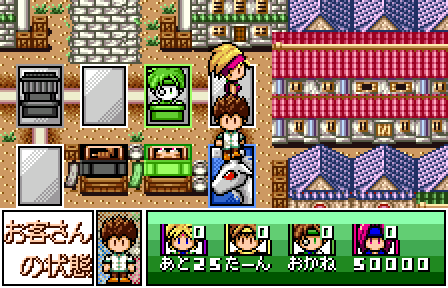
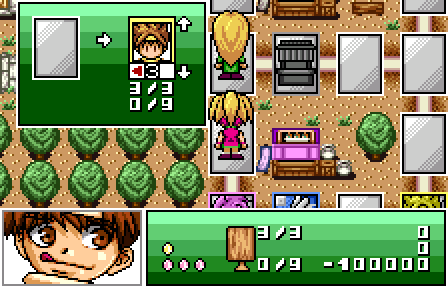
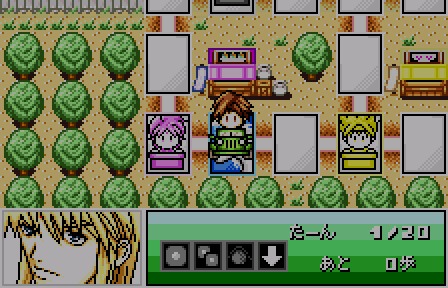
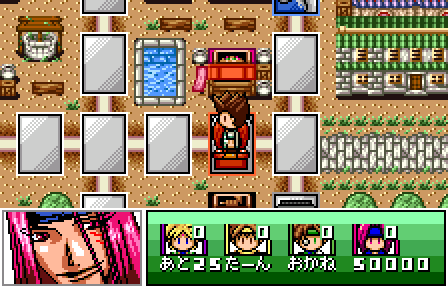
Gensoumaden Saiyuki Retribution: Hi no Ataru Basho de is a WonderSwan Color game based on Saiyuki, Kazuya Minekura’s manga that draws its cast from the Chinese classic Journey to the West: the monk Genjo Sanzo and his three companions Son Goku, Sha Gojyo and Cho Hakkai. The title borrows the name of the anime adaptation, Gensoumaden Saiyuki, which TV Tokyo broadcast in 50 episodes between April 2000 and March 2001. The game came out on 7 June 2001, a few months after the series ended.
It is a board game rather than an adventure through the story. Sanzo’s party cannot pay their bill at an inn, and the player, as one of the four daughters of the house, has to keep the four men working at a festival food stall until the money is earned.
It was published by Movic and the anime company Soeishinsha together, though it is sometimes credited to Soeishinsha alone, and the two companies are usually credited jointly with making the game. The cartridge is made for the Color and does not run on the original black-and-white WonderSwan.
The story
The game is set in Tougenkyou, a land where humans and yokai have lived side by side. Something has upset that balance: the yokai have turned violent and begun attacking people, and the gods of heaven have ordered the monk Genjo Sanzo, with Son Goku, Sha Gojyo and Cho Hakkai, to stop Gyumao from being brought back to life. That journey is only the backdrop here, and the blurb on the back of the box has little to do with what the game is actually about.
On the road the four stop at an inn kept by four beautiful sisters, and eat and drink as freely as they always do. Only then do they find that they have lost the credit card the Sanbutsushin gave them for travel money. With no way to settle the bill, they accept the sisters’ suggestion: a festival begins the next day, and if the men help run the inn’s food stall there, the takings will pay for their lodging and leave them some money for the road.
The player takes the part of one of the sisters, and the comedy comes from the four men being unreliable workers. If calling in customers goes badly, they drift away from the stall to eat yakisoba and okonomiyaki around the festival or simply do as they please. The tone is light and comic throughout. The game is a character piece for fans of the anime: it uses the reward structure of a dating game, with friendship and event pictures, but it was made for a female audience.
How it plays
The game is played on a board, for one player. At the start the player picks one of the four sisters, who becomes the player’s character and partner for the rest of the game, and together with Sanzo’s party she works the festival stall. How the board is laid out and how many turns or days a game lasts are not well documented.
The heart of the game is managing the four men. Each has his own temperament, and jobs at the stall are handed out to suit it. The player then has to keep giving instructions and keep the customers coming in; when that fails, the men start to slack off, leave the stall to go eating, or wander off on their own business. Sales are the measure of how well it is going.
The aim is to raise sales far enough to pay the inn and earn travel money for the party. Doing so brings reward events. Alongside the money, the heroine’s friendship with the men can be raised, which opens event scenes with illustrated pictures. Progress is saved to the cartridge.
Three minigames are hidden in the game: a card game, a yokai-hunting game and a puzzle game. What has to be done to reach them is not well documented.
Development and release
Bandai presented the cartridge as a game arriving ahead of the anime’s first cinema film, Requiem, released on 18 August 2001. It sold for 4,500 yen before tax on a 16-megabit cartridge with a small EEPROM for saved data, with mono sound and no link-cable play. The box holds a 19-page manual and a survey postcard. A first-print edition came with an original mascot figure, its face visible through a small window in the package.
Ports and other versions
Hi no Ataru Basho de was made for the WonderSwan Color and was never ported, remade or re-released on another system. It was one of several Saiyuki games of the early 2000s, each its own title: a card game for the Game Boy Color a few months earlier, adventure games for the PlayStation and the Game Boy Advance, and two Saiyuki Reload games for the PlayStation 2. None of them is a version of this one. The festival-stall story and the board-game format, with the four sisters of the inn as partners, are particular to the WonderSwan cartridge.