
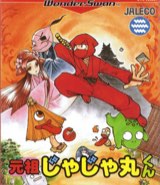
Jaleco's WonderSwan remake of its 1985 Famicom action game Ninja Jajamaru-kun, adding a map, boss fights, new enemies and story scenes.
Screenshots
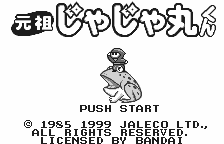
Title screen 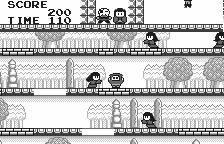
In play 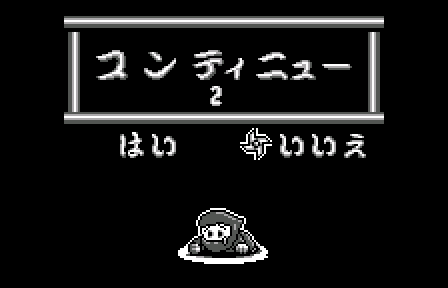
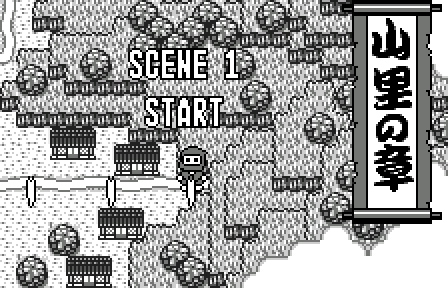
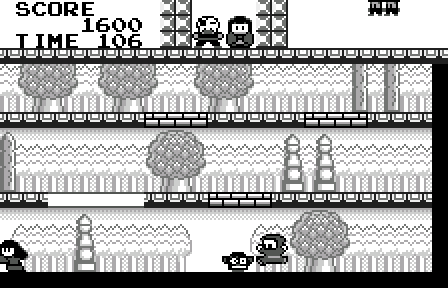
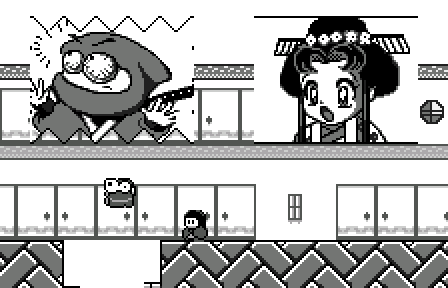
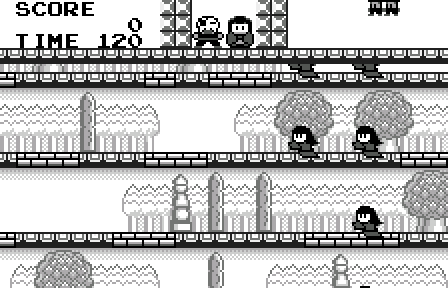
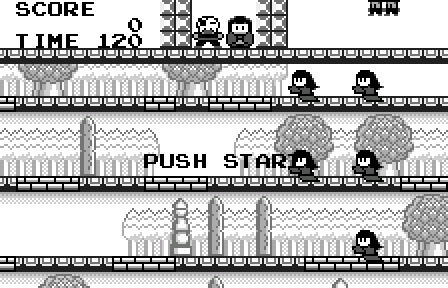
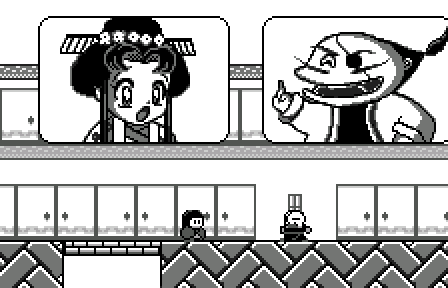
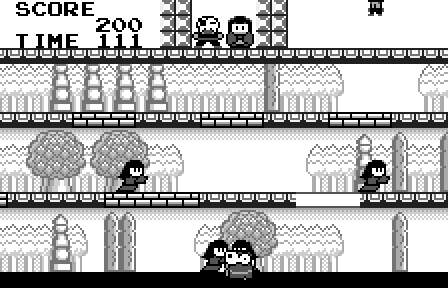
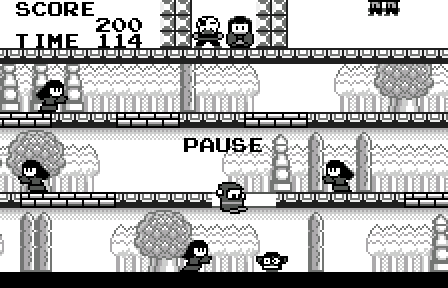
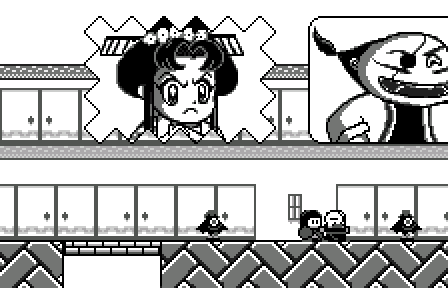
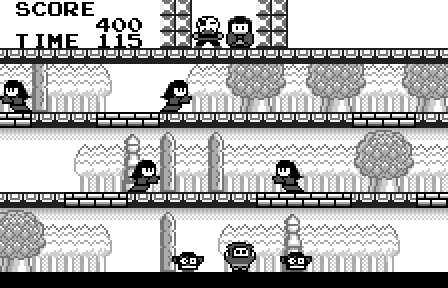
Ganso Jajamaru-kun (“The Original Jajamaru-kun”) is Jaleco’s new version of Ninja Jajamaru-kun, the ninja action game it first released for the Famicom in 1985. It came out for the WonderSwan on 15 April 1999, about six weeks after the console went on sale, which makes it one of the system’s early games. Its developer is uncertain: it is credited both to Jaleco itself and to TOSE, the studio that made the Famicom original.
It keeps the Famicom game’s premise and the core of its stages, then builds a stage map, chapters that end in boss fights, new enemies and story scenes around them, so it is more than a straight conversion.
The story
The story is a simple rescue. Princess Sakura has been carried off by Namazu Dayu, a catfish lord who commands an army of yokai and other creatures from Japanese folklore, and the young ninja Jajamaru sets out to win her back. In the series’ original setting Jajamaru is the younger brother of Ninja-kun, the hero of the UPL arcade game from which Ninja Jajamaru-kun was spun off.
Unlike the Famicom game, which had no story scenes, the WonderSwan version tells its story on screen. An opening scene shows the princess being taken, and story scenes between stages, some of them full-screen pictures, carry the tale forward, with short voice clips of the characters crying out names. Princess Sakura is drawn with noticeably more care than anyone else, and the backgrounds behind the stages vary more than they did on the Famicom.
The quest is split into five chapters. Each one takes Jajamaru through ordinary stages against Namazu Dayu’s yokai to a boss, and every boss beaten brings him a step closer to the princess. Sakura is part of every stage as well as the goal at the end, since she drops a cherry blossom petal in each one for Jajamaru to catch.
The tone is light and comic, and failure has its own small story: when the game is over, a short wordless scene shows Namazu Dayu laughing as he carries the princess off before the words GAME OVER appear.
How it plays
The WonderSwan is held horizontally, and the controls are as simple as the Famicom game’s, though Jajamaru moves more smoothly and answers the controls more quickly than he did there. Each ordinary stage is a wide area of four floors. The original scrolled only sideways, but the WonderSwan screen is not tall enough to show all four floors at once, so here the view also scrolls up and down to follow Jajamaru.
Eight enemies roam each stage, and it is cleared once every one of them is beaten, either with shuriken or by knocking them out with a jump. The enemies are yokai, and before each stage a portrait introduces one of them by name; the cast mixes Famicom regulars such as Kurobee, Kakutan and Onigiri with eighteen new characters.
Jajamaru breaks the blocks in the ceiling above him by jumping into them from below, which opens gaps between the floors and sometimes uncovers an item. Alongside the familiar power-ups, the set of ninja arts is larger than on the Famicom. After he has collected three different power-ups, the secret one appears and calls up the giant frog Gama Pakkun, which he can ride around the stage.
Every ordinary stage has a 120-second clock, and a watch item adds seconds to it. When the clock reaches 90 seconds the princess drops her petal, and catching it is now required: a stage cleared without its petal has to be played again before Jajamaru may enter the chapter’s boss stage. A stage cleared without losing a life pays a time bonus for the seconds left, and the bonus per second rises by 10 points after each boss is beaten.
There are 25 stages in five chapters, against 21 stages in the Famicom game, and stages are picked from a map screen. In each chapter the last stage is a special stage that scrolls vertically upward and ends in a fight with the boss. These stages break up the old formula but are generally harder than the ordinary ones, and the bosses have their own characters. There is only a one-player game, with no link-cable play.
Because the petal falls only once the clock reaches 90 seconds, a stage can be replayed for points as long as the petal is left alone, which weakens the game as a score attack. Repeating stages is a poor plan in the long run, though: the time bonus grows only with bosses beaten, so pressing on through the chapters raises the score faster, and the repetition is tiring besides.
Development and release
In 1999 Jaleco presented the cartridge as the return of Ninja Jajamaru-kun fourteen years after the Famicom game. It promised that the stage designs and characters would keep the feel of the original while adding new elements made for the WonderSwan, a larger set of ninja arts, and the familiar Famicom theme tune. It was sold as an action game at a standard price of 3,800 yen, with product code SWJ-JLC001, and carries a 1985 and 1999 Jaleco copyright line. Jaleco named no outside studio, and who actually programmed this version is unknown.
Modes and features
Against the Famicom game’s 21 stages there are 25, some of them scrolling vertically, and the new elements are the stage map, the chapter bosses, the compulsory petal, the opening and story scenes with their voice clips, and enemy portraits at the start of each stage where the Famicom game showed only names. The game is for one player only, with stereo sound and no link-cable features.
Reception
Players who returned to it years later have mixed feelings. Some found it pleasantly nostalgic but felt it was so close to the Famicom game that nostalgia was most of its appeal. Others liked the bosses and the look of the story scenes but thought the petal rule mainly made stages longer, and that it spoiled score attack, since a stage can be repeated for points as long as the petal is left alone. Players on the console have praised how much more smoothly Jajamaru moves than in earlier versions, despite the monochrome screen.
Ports and other versions
Ganso Jajamaru-kun is a remake of the 1985 Famicom game rather than a new title, and it counts among the versions of Ninja Jajamaru-kun. The original spread widely before and after this cartridge, with a Nintendo VS. System arcade version and an MSX conversion from the mid-1980s, the Famicom game on the PlayStation compilation Jaleco Collection Vol. 1 in 2003, Windows releases, downloads for Japanese mobile phones in the early 2000s, and Virtual Console releases for Wii, 3DS and Wii U, followed by Nintendo Switch. The Famicom game was also included in a 2004 Game Boy Advance collection and in later Switch and PlayStation 4 collections. All of these carry the Famicom or arcade game; the WonderSwan remake itself was never ported or re-released.
Against the Famicom game, the WonderSwan version keeps the core of each stage, with four floors, eight enemies, breakable floor panels and the giant frog, and builds new structure around it: eighteen new characters, a stage map, bosses, the petal rule and story scenes. Time bonuses also grow after each boss. The graphics are monochrome, since the game was made for the original black-and-white WonderSwan, though the backgrounds and the full-screen story pictures are generally thought well drawn.
Jajamaru handles better on the WonderSwan than in the Famicom game, with movement that is smoother and quicker to respond. The cartridge is sometimes seen as closer to a sequel than a remake, though one that stays nearer the original than the earlier sequels did.