
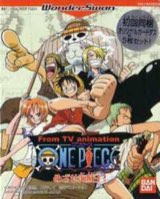
The first One Piece video game, a Bandai board game for the original WonderSwan in which route cards move Luffy's ship through the early East Blue story.
Screenshots
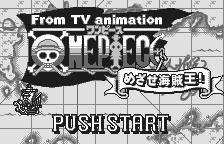
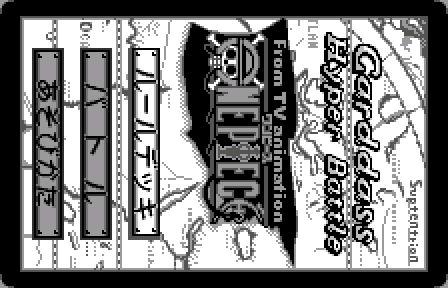
Title screen 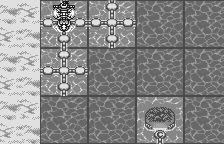
In play 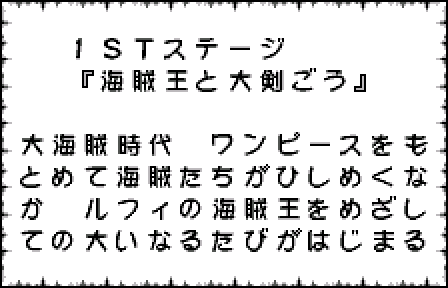
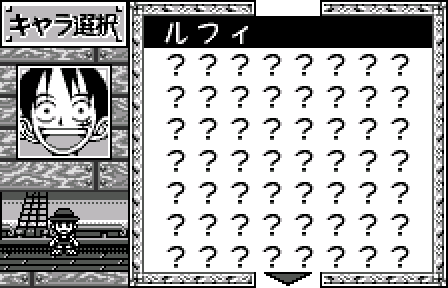
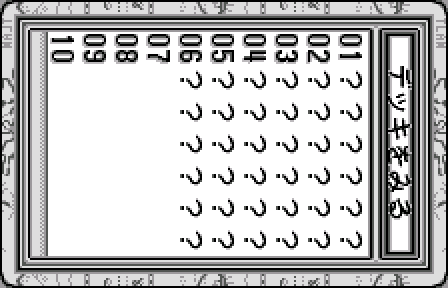
Mezase Kaizoku Ou! (“Aim to be King of the Pirates!”) is a One Piece game that Bandai released for the original WonderSwan on 19 July 2000, nine months after the television anime began airing in Japan. It was the first video game made from Eiichiro Oda’s manga and its anime, and it was developed by Soft Machine. Its story covers the East Blue part of the series, from Luffy setting out to sea through the fights with the pirates he meets on the way, and it also draws on the first One Piece film.
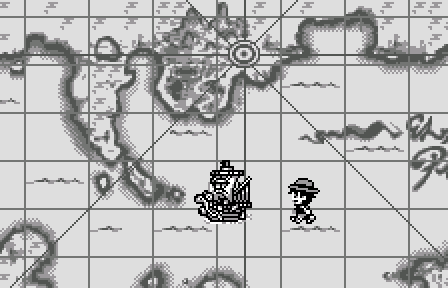
The game is played like a board game on the sea. The player picks from a hand of cards, each showing a shape of route and a number of spaces, and uses them to steer the ship across a chapter’s map toward its goal. Enemies can appear on the way, and battles are won by beating the three opposing fighters or sinking their ship. Luffy, Zoro, Nami, Usopp and Sanji can all be played, and the villains include Alvida, Buggy, Kuro, Don Krieg and Arlong.
Bandai sold it as a “voyage adventure” for one to four players. Besides the story there is a race for up to four players on one console, a mode for use with Bandai’s card game and a team battle mode. Every main character from the first twelve volumes of the manga appears, each with the special ability they have in the original. Bandai listed the game as working with the WonderSwan’s link cable, and it saves to a small EEPROM on the cartridge.
The story
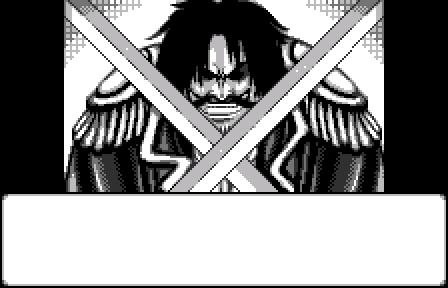
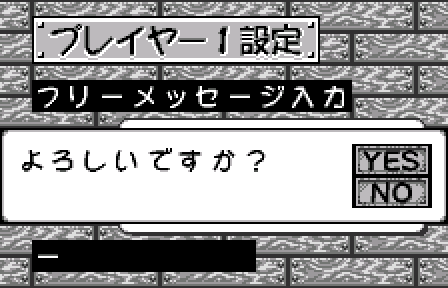
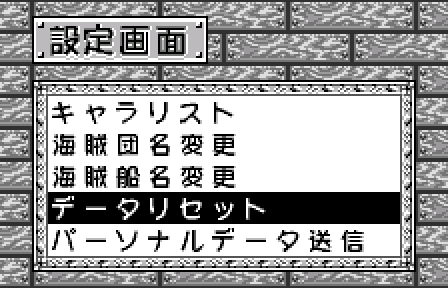
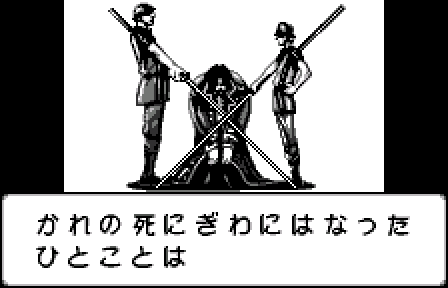
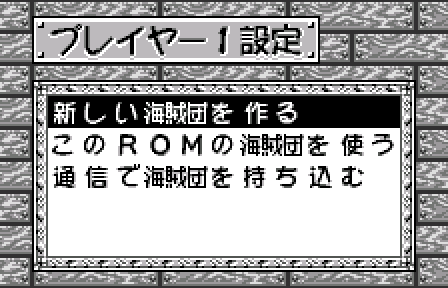
The game opens on the execution of Gol D. Roger, the King of the Pirates, whose death set off a great age of piracy. The story then joins Monkey D. Luffy at seventeen, ten years after his parting from Shanks, as he puts out to sea to become King of the Pirates himself. He sails in the Going Merry from the very start, and on a first game the player names both the crew and the ship.
The single-player story follows the manga’s East Blue chapters in six stages, each named after one of its arcs: Morgan, Buggy, the Black Cat Pirates, Don Krieg, Arlong and Loguetown. Each stage also carries a title of its own, such as “Uso 800” for the Black Cat chapter and “Soup” for the Krieg chapter. In the first, Luffy is attacked at sea by the Lord of the Coast, a sea monster, crosses the pirate Alvida and then heads for the Marine base of Captain Morgan, racing Helmeppo’s ship to the island where the swordsman Zoro is held.
The crew grows one member a stage, as in the manga. Zoro joins after the first stage, Nami after the second, Usopp after the third and Sanji after the fourth, and every main character of the first twelve volumes turns up somewhere. The villains of each arc wait on the islands of its map, among them Buggy and his crew, Captain Kuro’s Black Cat Pirates, Don Krieg and Gin, Arlong and his fish-men, and in Loguetown the Marine captain Smoker. In the Krieg stage Sanji is allowed to attack female characters.
The scenes are told in text and still pictures, and the dialogue is taken closely from the manga, with some scenes shortened or cut, such as the stories of Boodle and Chouchou. Islands cannot be walked around, so meetings and conversations happen as the ship reaches each island on the sea map, which does not always match the geography of the story. The tone is the light one of the early series. Clearing the six stages shows the staff roll and opens a seventh, extra stage based on the first One Piece film, in which the crew races the pirate El Drago.
How it plays
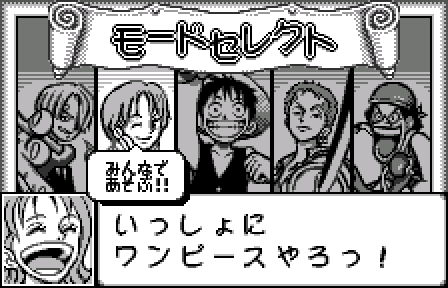
The game is held horizontally for sailing and is designed to be turned on its side for battles, though they can be played without turning it. There is no tutorial, and the top menu has four modes. On the sea map the menu offers commands to move, to arrange the crew, to use items, and to see information such as the HP of each character and of the ship.
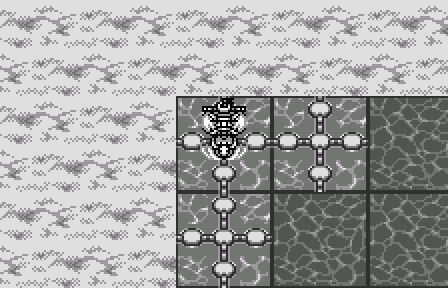
Sailing is done with route panels. The player holds a hand of five, and five more wait in a pool from which the gap is refilled after each panel is used. A panel carries a straight, an L-shaped bend, a T or a cross, and a movement value from one to five. Each turn exactly one panel must be laid. It can be rotated first and can go anywhere on the map, not only beside the route already laid, and it can cover an ordinary panel, an enemy’s included, but once laid it cannot be taken back. The ship then gets the panel’s movement points, the player marks a destination along connected routes, and the ship sails there. Points not used are lost at the end of the turn. Lock panels can never be covered and block routes on the map and in battle, which makes them useful for cutting off an enemy, but laying one across the only way into a goal leaves the stage impossible to finish, and the only way out is to switch the console off.
Each stage is a series of goals that appear one after another: reach an island to start the next scene, catch an enemy ship, or win a race. In the first stage Helmeppo’s ship sets off for Zoro’s island, and if it gets there first the game is over. Later stages have more races and chases, an escort in the Arlong stage in which a Marine ship has to be guided by the panels laid in front of it, a whirlpool that carries the ship off to an island, and a race to the Grand Line in Loguetown in which touching Smoker’s ship ends the game. Enemy ships follow their own routes and can be held up with lock panels. Losing any battle or mission means a game over and a restart from the beginning of the stage, the game cannot be saved in the middle of a stage, and damage carries over from battle to battle until the stage is cleared.
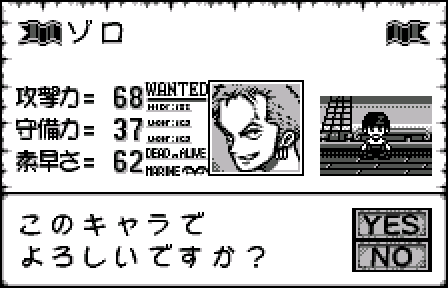
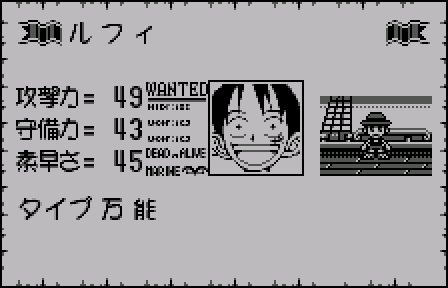
Up to three crew members fight, and the line-up can only be changed on the sea map, so it has to be set before landing on an island where a story battle waits. The battle field is a three-by-three grid with the two sides and their ships at opposite ends. The outer rows already have routes, and each side lays up to three panels from its hand into the empty middle row. The side with the higher total of movement points acts first, and the opponent’s numbers are hidden. Each fighter takes the lane in front of them, and the order can be changed each round. Characters are of three types: close-range fighters such as Zoro have to reach the far row and attack the nearest enemy, or the ship if the square is empty; long-range fighters such as Usopp stop in the middle row and can only hit the ship; and all-rounders such as Luffy can do both. Each character has values for offence, defence and speed, and each ship has up to 100 HP.
Special moves cannot be chosen directly. Each character has two or three, and each is set off by a particular pattern of panels in the middle row; Luffy’s Gomu Gomu no Bazooka, for example, comes from a cross between two straights. A special move does a fixed amount of damage to every enemy and their ship, but no ally can attack in that round. Luffy’s Gomu Gomu no Pistol does 24 and his Bazooka 36, Zoro’s Oni Giri 24 and Sanzen Sekai 38, while one of Nami’s is a grumble about having to fight at all that does 12.
Named enemies have between 16 and 51 HP and ordinary pirates and Marines 25, so many fights end in one or two blows, and the last boss is weak. Beating a named enemy pays a bounty in berries, from 3,000 for Alvida to 20,000 for Arlong. Up to ten items can be carried and used outside battle to restore HP: a mikan restores 10, raw ham melon 15, bean sprout stir-fry 20, a rice ball a quarter of the maximum, meat on the bone half and a pirate’s bento all of it, while lumber repairs 30 of the ship’s HP and steel 50. The game is easy and was aimed at children. Cleared stages can be replayed, and finishing a replay within a set number of turns, such as 17 for the Buggy stage or 45 for Arlong’s, recruits that stage’s characters one at a time in a fixed order. A few have conditions of their own, and Shanks joins last, once everyone else has, which makes 36 playable characters in all.
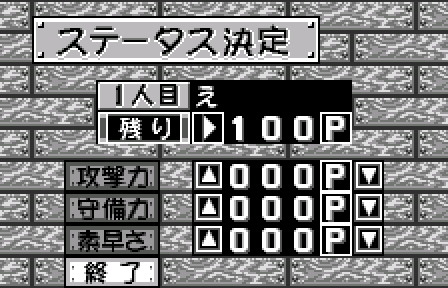
Minna de Asobu (“Everyone plays”) is a race for up to four players, who pass one console between them. Each builds a crew and sails one of eight maps, a rival ship is only visible when it is next to the player’s, and when two ships stop on the same point they fight a battle of one round, after which the losers miss a turn and come back with full HP. Special panels with no route can be laid as well: tailwind doubles the movement of the player’s next two panels, headwind halves that of every opponent’s next two, a cannon destroys one panel within range and capsizes any ship on it, and rocks, a Sea King and whirlpools are traps hidden from the other players that do damage, the whirlpool also sending the ship to a random point. Players can send each other short messages. Checkpoint islands start mini-games for everyone: an eating contest in which each player grabs dishes for 30 seconds while avoiding those with flies on them, Mihawk’s Pastime, a take-away game like nim whose loser is cut down to 1 HP, and a sea battle in which the players shoot down thirty Marine ships before they reach a line, with the losers losing their items. A Hyper Battle mode adds rules for Bandai’s Carddass Hyper Battle card game. Saikyou Kaizoku Ketteisen (“Strongest Pirate Championship”) is a team battle in which the player makes a crew of three new characters, shares 100 points among offence, defence and speed for each, gives each one of six classes such as pirate, swordsman or Marine, and picks one of thirteen characters from the series to help from the side, after which the fight plays itself out.
Development and release
Bandai priced the cartridge at 3,800 yen before tax. A set of bonus cards of the Straw Hat crew was packed in with the game, and the route panels in the game carry the card-back design of Carddass Hyper Battle, the One Piece card line Bandai was selling at the time.
Modes and features
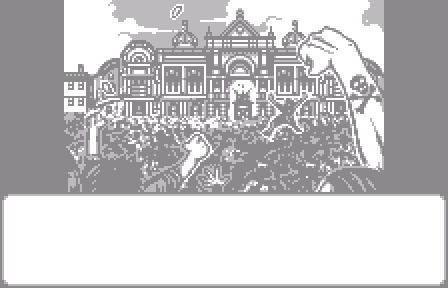
The opening shows Gol D. Roger’s execution and a slideshow of pixel-art stills of towns and ships, many redrawn from panels in the manga. The story mode is called Ore ga Asobu!! (“I’ll play!”). Its seven chapters are six that follow East Blue, from Morgan’s base, where Alvida also appears, through Buggy, the Black Cat Pirates, Don Krieg, Arlong and Loguetown, and an extra chapter based on the first One Piece film and its villain El Drago. For battles the console is turned on its side and held vertically, and a fighter with no opponent in front of it damages the enemy ship instead, which gives the second way to win.
Secrets and extras
Pandaman, the series’ habitual hidden character, hides on one panel in each of the seven chapters, and finding him in all of them adds him to the crew. Clearing a chapter again recruits its other characters: the Morgan chapter gives Zoro the first time, then Alvida and later Morgan, and villains such as Buggy, Arlong and Smoker can be won the same way. Repeat clears must be finished within a set number of turns.
Reception
Its pixel art is thought strong for its time and hardware. Some players found that there was a lot to do but the battles were too easy and hard to follow, and felt the game was built mainly for link play.
Ports and other versions
Mezase Kaizoku Ou! was made for the original WonderSwan and was never released on another system. One Piece reached other systems the following year with separate games, among them Bandai’s fighting game Grand Battle! on the PlayStation and a role-playing game from Banpresto on the Game Boy. Most of the One Piece games of the next few years were fighting games or role-playing games, which leaves this one’s sailing steered by route cards as its own, along with its battles played with the console turned on its side.
Notes
The cartridge is monochrome and plays in black and white on the WonderSwan Color. Its genre is described in different ways: Bandai called it a “voyage adventure”, and it is also classed as a simulation game or as action, while in play it resembles a board game with cards in place of dice.