
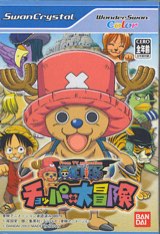
An action RPG based on the One Piece anime, in which Chopper explores a strange island to change his crewmates back after they are all turned into animals.
Screenshots
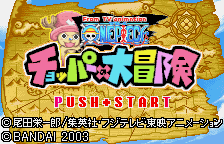
Title screen 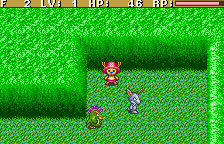
In play 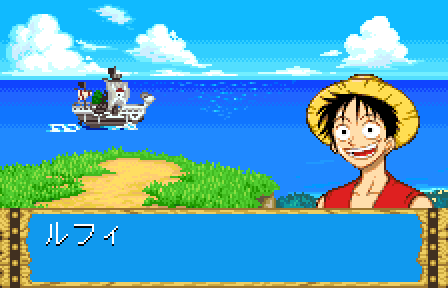
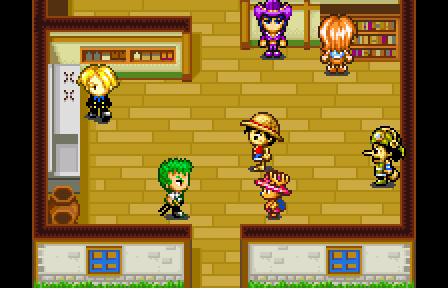
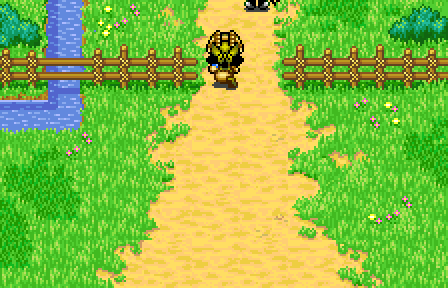
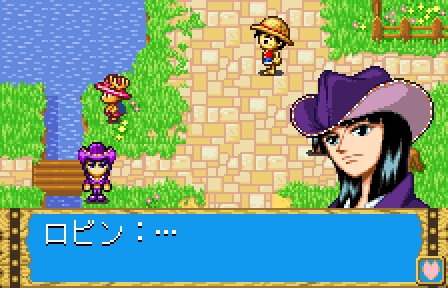
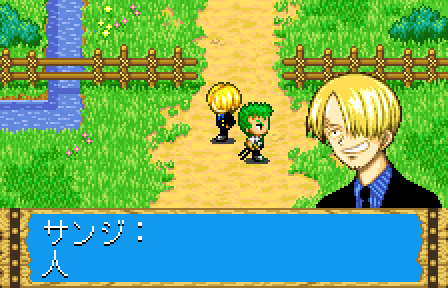
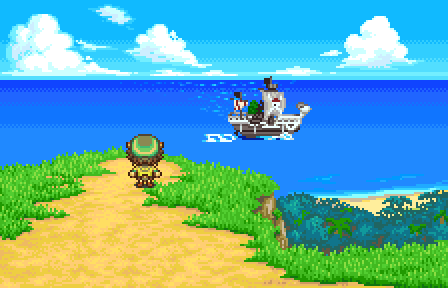
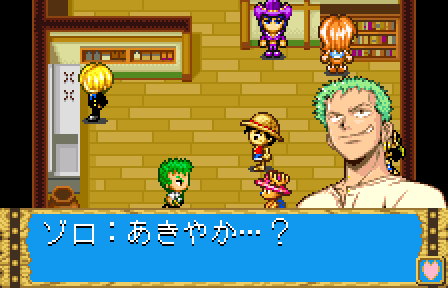
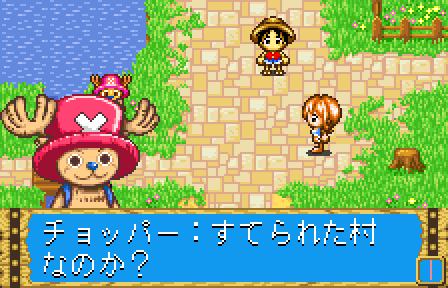
From TV Animation One Piece: Chopper no Daibouken is a role-playing game based on the One Piece television anime. Bandai released it in Japan on 16 October 2003 for the WonderSwan Color. It is usually credited to TOSE, though this has never been confirmed, since the company rarely makes its contract work public. The cartridge needs a WonderSwan Color or SwanCrystal and does not run on the original black-and-white WonderSwan.
The Straw Hat Pirates come ashore on a mysterious island and wake up the next morning changed into animals, all except Chopper, who sets out to find a cure and turn his friends back. It is an action RPG with Chopper as the hero, built around dungeons that change on every visit, a medicine-mixing system and his Rumble transformations.
The story
The Straw Hat Pirates put in at an island to restock their food and begin by searching the village beside the harbour. Nobody is there. The ponds are tended and the kitchens look as if someone was cooking in them a moment ago, but the villagers have vanished, and with no clue to where they went the crew settles down to spend the night in one of the empty houses.
The next morning Chopper wakes up to find a tiger in front of him. He bolts out of the house, across the square and out of the village, and ends up lost in the grasslands beyond. There Robin, now a bird, finds him and tells him what has happened: every member of the crew except Chopper has been turned into an animal. Luffy is a monkey, Zoro a tiger, Sanji a fox, Nami a cat, Robin a parrot and Usopp, of all things, a kappa. Chopper goes back to the village to examine his friends and finds that he does not have the herbs he needs to treat them, so the ship’s doctor, in his first leading role in a One Piece game, sets out to save the crew.
Two new characters made for the game appear from the start. Raccoon is a mysterious boy with a raccoon’s ears and tail who knows the secret of why the crew became animals, and he helps Chopper wherever he goes. Fang, a scientist wrapped in a wolf’s skin, wants revenge on the people of the island and means to misuse its solar energy to get it. Why the crew changed, where the villagers went and what is waiting on the island are the questions that carry the story.
The story is an original one written for the WonderSwan rather than taken from the anime, and it moves in a cycle between the village and the wilds around it. The village is Chopper’s base, where he talks to villagers and crewmates, shops and gets ready; then he goes into a dungeon after herbs, brings them back to give to a crewmate, and sets off for the next dungeon after more. Each friend restored to human form becomes useful again in their own way. The tone is the light, comic one of the anime, with the crew’s new shapes played for laughs, and the stakes are simple: Chopper has to cure everyone.
How it plays
The game is for one player, with the console held horizontally. The X buttons move Chopper, and pressing a direction twice and holding it the second time makes him dash. A attacks, moves dialogue on and confirms; B guards and cancels, and guarding cuts the damage when an enemy attacks without warning. Start opens the menu. The Y buttons are a shortcut that uses a chosen item with one press, a feature that opens up once a character in the game gives Chopper a pair of trousers. Pressing A and B together sets off a Rumble transformation when the Rumble gauge is full.
Play starts in the village and comes back to it between dungeons. Its menu has four commands: Move, to walk to another spot; Talk, which gathers information from a villager or crewmate chosen at random; Buy and Sell at the shop; and Give, which hands items or berries, the game’s money, to a crewmate. The restored crew help through Give. Usopp stores items and Nami stores money, Usopp trades ten pieces of iron sand for a rubber band and eighty pieces of coal for an item called Eight Thousand Men, and Sanji turns food he is given into points, enough of which earn a cooked dish. The game can be saved only in the village, in one of three files, and a saved game restarts at the village entrance.
The dungeons are where most of the game happens. Each is a stack of floors whose layout is generated anew on every visit, and Chopper climbs by stairs and ladders towards the herb on the top floor. Enemies walk the floors in plain sight and can be fought or avoided. Beating one gives experience, Rumble points and berries, the amounts depending on the enemy, and treasure chests hold items, though Chopper can carry only so many, so a full bag means passing up the new item or throwing something away. Levelling up raises maximum HP and three stats: stamina, which reduces the damage taken, strength, which raises the damage dealt, and speed, which improves hitting and dodging. If HP runs out, Chopper is sent back to the village entrance and loses half his berries. The map on the Start menu shows the parts of the floor already explored, with enemies, stairs, chests and obstacles marked. A dungeon cannot be saved, but it can be suspended, and a suspended game resumes from just before the current floor.
Luffy, Zoro, Sanji and Usopp can each come into a dungeon once an event in the village allows it, one at a time. The computer controls them according to their characters, and they cannot be knocked out. Luffy hits an enemy and knocks it back a little, Zoro does heavy damage, Sanji kicks enemies away and stuns them if they hit a wall, and Usopp does little damage but attacks from a distance. When Chopper’s HP falls to 30 percent or less, a companion who is back in human form uses a special move, once per floor, at the cost of some of Chopper’s Rumble points. Luffy and Zoro have no sense of direction: if Chopper gets too far ahead they wander off, and he has to find them before they follow him again.
The dungeons also bring status problems, in three degrees of strength shown on the menu screen. Poison drains HP. Confusion comes from being slammed into a wall, scrambles the buttons and stops Chopper mixing. Complacency sets in when a companion beats several enemies in a row and lowers strength, stamina and speed. Loss of nerve strikes when Chopper is alone, or his companion has wandered off, and his HP is low, and it sometimes stops him attacking. The first three wear off with time, with items or with a trip to the village, and the last with healing.
The Rumble gauge fills as enemies fall. When it is full it turns blue, A and B together trigger Chopper’s transformation, and the gauge turns yellow and drains until he changes back. Brain Point brings up a target cursor, and an enemy marked with it takes more damage once Brain Point ends. Jumping Point lets him strike during an enemy’s attack, dodging and hitting at once. Horn Point rams enemies when A is pressed during a dash. Guard Point, on B, cuts almost every attack to zero damage. Holding A until Chopper changes colour readies Kokutei Roseo, which fires when A is released.
Bonus stages called Rumble Stages sometimes turn up in the dungeons. Each is a timed challenge built around one form, and a good time may earn a rare item. In Walk Point, Chopper runs for a goal, moving up and down, clearing obstacles with a big jump and gaining speed by pressing B just as the dust rises after a small jump, while hitting an obstacle slows him badly. In Arm Point he punches through oncoming blocks, pink ones in one hit, red in two, blue in three and white not at all, and a fall into a hole sends him back to the start. Brain Point is a grid puzzle in which each number shows how many weak points surround that square, and every weak point has to be hit with the cursor, with each miss hurting Chopper. In Guard Point he has to step on every off switch on a floor of separate sections joined by numbered jump panels, after which the goal appears.
Mixing turns two items into a third, one of each, and a pair held in numbers can be mixed several times at once. Ingredients come from chests and from beaten enemies, and they are plants and fruit such as mugwort, plums, sugar cane, cacao, Chinese milk vetch, parsley, aloe, mint, chili and chicory, and the results restore HP, cure each status problem, raise a stat for a minute, make enemies more likely to drop chests or carry more berries, or keep enemies from attacking. Some have side effects, such as a chili mint that restores 20 percent of HP but adds confusion. Bracelets and charms can be equipped: bracelets raise a stat by two, let a companion use the special move twice, give Chopper the experience from enemies his companion beats, or restore one HP every five seconds while he is in a room, and each charm wards off one status problem.
Development and release
Bandai promoted the game as the first in which the popular Chopper takes the lead role, and stressed that the story was written for the WonderSwan alone rather than taken from the anime. It was the sixth and last One Piece game released for the WonderSwan, following the earlier simulation, action RPG, board and fighting games, and it came out late in the system’s life, in October 2003. The cartridge sold for 4,500 yen before tax, plays in stereo, and has no link-cable play. The developer is variously given as TOSE or Bandai.
Ports and other versions
Chopper no Daibouken was made for the WonderSwan Color and was never ported or re-released. Its closest relatives are the five earlier One Piece games on the WonderSwan, none of which is a version of it: Bandai stressed that its island story was written for this cartridge alone, and it is the one among the WonderSwan games in which Chopper, not Luffy, leads.