
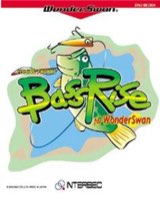
A bass fishing game for the original WonderSwan: five waters, 16 lure types, a guided Lecture Mode, three tournaments against 20 rivals and two-player contests by cable.
Screenshots

Title screen 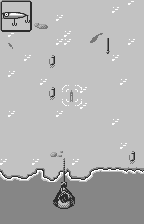
In play 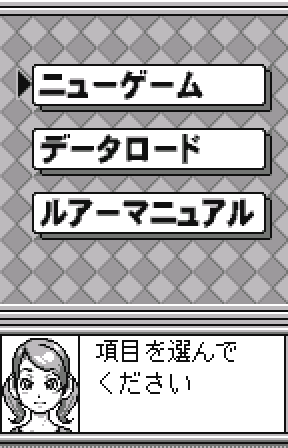
Fishing Freaks: Bass Rise for WonderSwan is a fishing game for the original black-and-white WonderSwan, released in Japan on 24 February 2000. It carries the name of Fishing Freaks: Bass Rise, a bass fishing game that Bec developed and Bandai published for the PlayStation in 1999. Bec published the handheld game under its Interbec logo.
Like the PlayStation game, it is about bass fishing and nothing else. The player picks a lake, a season and a time of day, chooses lures and tackle to suit them, and then casts and works the lure to hook and land bass, either alone, with a guide giving advice, in tournaments against rival anglers, or against a friend over the link cable.
The story
Fishing Freaks has no story. It sets out to make the player a master of bass fishing, and its world is a handful of Japanese fishing waters: a farm pond and four lakes, Kasumigaura, Lake Biwa, Lake Ikehara and Lake Hibara. Each can be fished in spring, summer, autumn or winter, and in the morning, at midday or in the evening.
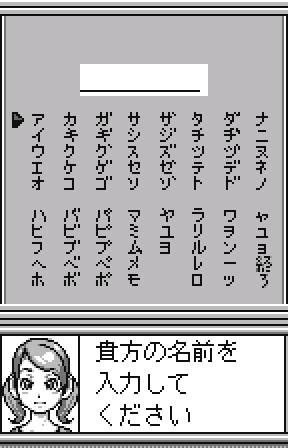
The few people in the game are there to help or to compete. The player is an angler who enters a name at the start, and a shop clerk opens the game by handing over a tackle box to be filled with lures, worms and jigs. In Lecture Mode a guide stays at the player’s side while fishing and talks about which lures, colours and spots to try. The rivals are twenty anglers who appear only by name in the tournament rankings; their names are the surnames of the people who made the game.
The nearest thing to a plot is the tournament circuit in Free Mode. There are three kinds of tournament, each played over three rounds, and winning all three leads to the ending and the staff roll. The presentation is plain: the game is in black and white, the lake is seen from above, and the title screen, the Interbec logo and the “Hit!” that appears when a fish bites are in English in the original.
How it plays
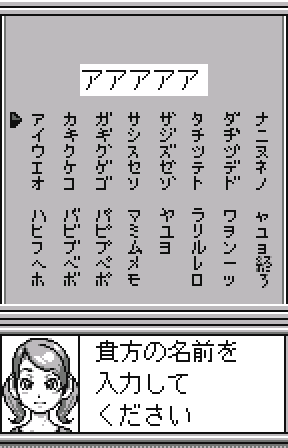
The WonderSwan is held upright. One set of four buttons gives the directions, and the other set acts as the action buttons, including confirm and cancel. After the title and name entry, the mode menu offers Lecture Mode and Free Mode, along with a Lure Manual, a log of the fish caught and the link battle.
Every outing starts with preparation. On the map screen the player picks the place, the season and the time of day. The tackle box holds lures chosen from 16 types, among them poppers, pencil baits, minnows, crankbaits, spinnerbaits, buzzbaits and craws and grubs, each in a choice of colours such as Black Gold, Ayu, Hot Tiger, Watermelon and Chartreuse. Soft baits go on one of six rigs: Texas Rig, Drop Shot, Split Shot, Jighead, Rubber Jig or No Sinker. The reel is chosen too. The lures are generic types rather than the Megabass models of the PlayStation game, and the lure in use can be changed at any time.
Fishing itself takes place on an overhead view of the lake. The player chooses a spot, moves a cursor to aim, and can see the shadows of fish below the surface, which helps in picking where to cast. Casting uses a meter in the corner of the screen: a bar runs quickly up and down, and pressing the button at the right moment drops the lure where it was aimed. The lure is then worked by reeling slowly or quickly and pulling the rod left or right, with a fast reel to bring it back for another cast. When a fish bites, the player has to set the hook and then fight it in. Bass are the target, but other fish, including char and masu trout, can take the lure as well. The menu on the water moves the player to another spot or ends the session.
Lecture Mode is free fishing with the guide’s tips, and it is where a newcomer learns the techniques. The Lure Manual explains each lure, colour and rig when asked about it. Every fish landed goes into the catch log with its species, size and weight, the lure and colour that caught it, and the lake, season, time and weather. Pressing Start on a catch shows a password for that fish, ten kana and kanji characters meant to be written down; what it was used for at the time is not known.
Free Mode has free fishing and the three tournaments: one for the greatest total weight, one for the biggest single fish and one for the most fish. Each round ends with a ranking of the player and the twenty rivals by weight, size, number of fish and points, and winning a tournament earns a prize lure. Winning all three tournaments is the goal of the game and brings the ending.
The link battle joins two consoles for a contest played at the same time. Before it starts, the two players set the size and weight of fish to aim for, so that both fish under the same conditions.
Getting a bite is easier than landing the fish, and a first session can end without a single catch while the player learns which lures work and how to fight a fish. There is no demo on the title screen. A sound test is hidden: holding Y1 and Y3 together with X1 and X3 while switching the console on opens it.
Development and release
Bec was a Bandai subsidiary that developed character games for Bandai, and around the WonderSwan’s launch it worked as a second-party company for the system. Whether Bec also developed the WonderSwan game is not known, and the credit to Media Entertainment has never been confirmed. The cartridge bears a Bec copyright line, plays in stereo and is held upright, and Bandai announced it at 3,800 yen before tax.
Ports and other versions
The PlayStation game whose name this cartridge borrows came out from Bandai on 25 March 1999 in Japan, and it was released in America later that year under the shorter title Bass Rise. In Japan it was sold alone and in a pack with a fishing controller, it featured more than 160 lures from the tackle maker Megabass, and Bandai followed it with Fishing Freaks: Bass Rise Plus on 3 February 2000. Whether the WonderSwan game is a cut-down conversion of that disc or a new game built under its name is unknown.
The WonderSwan game was never ported to another system or re-released.
Notes
Bandai listed the game as for one player, and presented the two-player contest separately as a link-cable feature played on two consoles joined together. The cartridge has 256 kilobits of S-RAM for saving. Very little has been written about the game beyond its listings.