
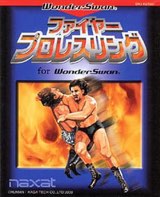
A handheld Fire Pro Wrestling for the original WonderSwan, published by Kaga Tech with 136 wrestlers, the series' familiar match types and a wrestler editor.
Screenshots
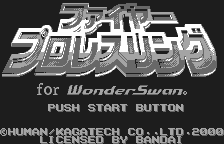
Title screen 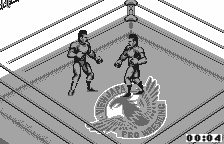
In play 
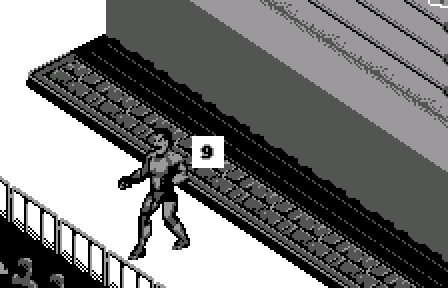
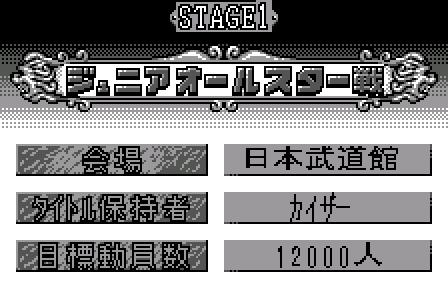
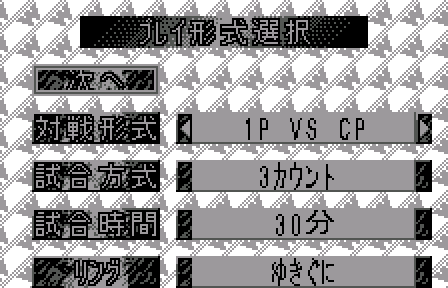
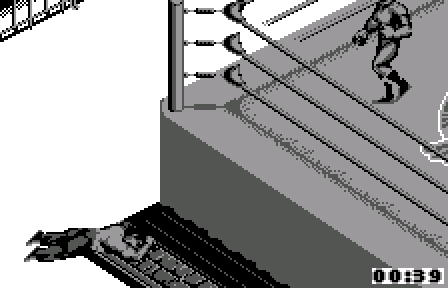
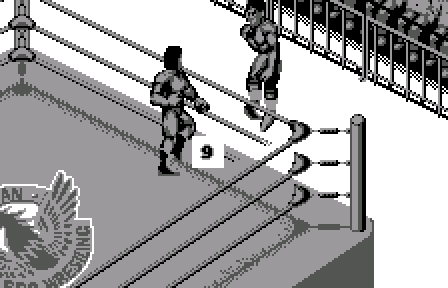
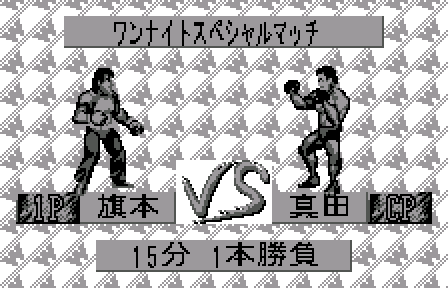
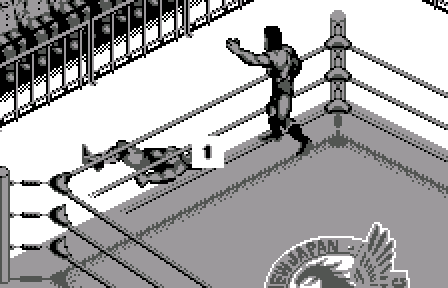
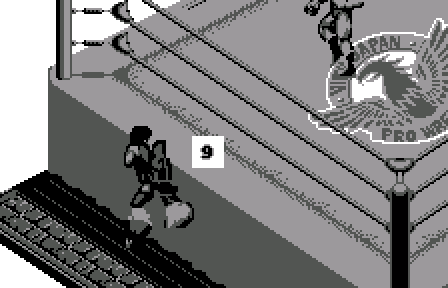

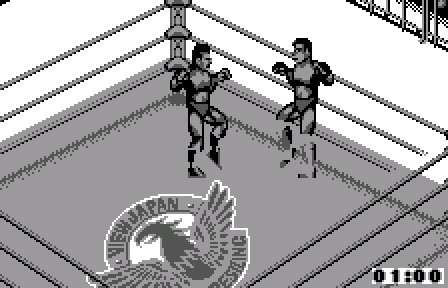
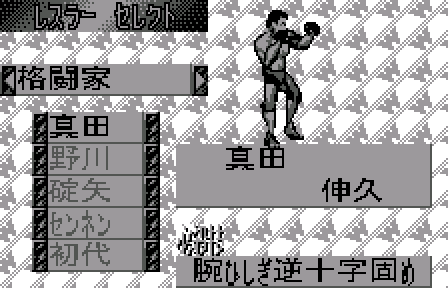
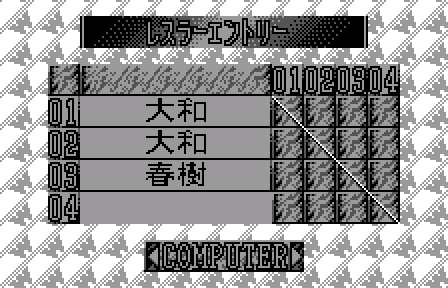
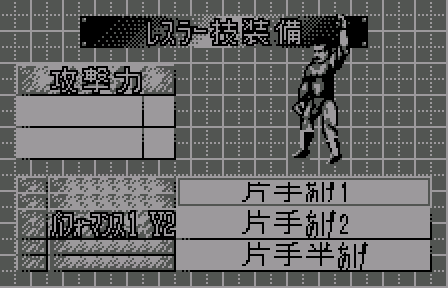
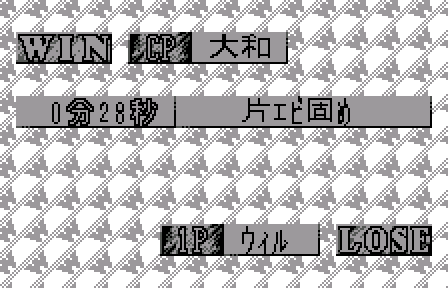
Fire Pro Wrestling for WonderSwan brings the long-running Fire Pro Wrestling series of professional wrestling games, which grew up on the PC Engine, to Bandai’s handheld. It was released on 31 August 2000 for the original black-and-white WonderSwan. The publisher was Kaga Tech, which took over the rights to the series after Human, the company behind the earlier games, went bankrupt. Because of that, it is not counted among the official entries of the series.
The game keeps the match types of the console versions, adds a new show-booking mode called Master of the Ring, and brings back the wrestler editor. Two players can wrestle each other by connecting two WonderSwan consoles with the link cable.
The story
There is no story mode. Like the rest of the series, the game is a collection of wrestlers and matches, and its cast is a roster of fighters modelled on real wrestlers but given names of their own. The roster is large for a handheld game, with 136 wrestlers and around 900 moves between them, and four referees. A few of the wrestlers appear in no other Fire Pro game.
The nearest thing to a premise is Master of the Ring, which Bandai’s preview described as a mode that fans had long asked for. In it the player is not a wrestler but the matchmaker, booking the cards for one promotion after another. Each promotion has its own style, and a show has to suit it and draw a crowd before the player is trusted with the next. This is the series’ matchmaking idea, essentially the show-booking side of running a promotion, which many players had thought appeared only in later games.
The other modes have no framing beyond the matches themselves. A tournament is fought for a trophy, a league for points, and an elimination match between two teams of five, with the player choosing the wrestlers, the opponents and the rules.
How it plays
The WonderSwan is held sideways. In the menus the X buttons move the cursor, A or START confirms and B cancels; in the screens for making a wrestler and choosing moves, the Y buttons shift the wrestler display, and on tournament and league charts Y1 skips ahead. In a match the X buttons move the wrestler in eight directions and START makes him run. Small and medium moves are on the B and A buttons, a big move takes both at once, and a special move needs all four Y buttons pressed together. Y2 and Y4 trigger two kinds of performance to the crowd, and Y1 or Y3 with START pauses. Running on START is a worry on the WonderSwan Color, where the power switch sits next to it.
Grappling works on timing, as in the console games, and some fine points of the system carry over from the Super Famicom game Super Fire Pro Wrestling X. When two wrestlers lock up, whether a move succeeds depends on the timing of the press, the wrestler’s stamina and his abilities, so a match is a matter of wearing the opponent down before the big moves will land. Because of this, few players aim for the specials at all. Wrestlers are small on the screen, and similar-looking ones are easy to confuse in black and white; mashing buttons to break out of a hold can end up releasing the player’s own hold instead, so in a two-player match it is best not to pick two wrestlers who look alike.
One Night Match is a single bout in which the opponent and rules are set freely. One Night Tournament takes from 4 to 16 wrestlers through a knockout for a trophy, and Open League puts 4 to 16 wrestlers into a round robin scored in fighting points. Elimination Match sets two teams of five against each other, and it is the only mode in which opponents can be chosen at random. Network Battle is the two-player match over the link cable.
In Master of the Ring the player builds each show’s card, and after every show the game rates the matchmaking. A good result moves the player on to the next promotion with stricter targets, and a poor one ends the run, though the player can continue and try again. The matches can be left to the computer, but its bouts turn out oddly and the ratings suffer, while playing every match by hand is tiring. Fitting the card to each promotion’s style is hard, and the last promotion is a stiff challenge to clear.
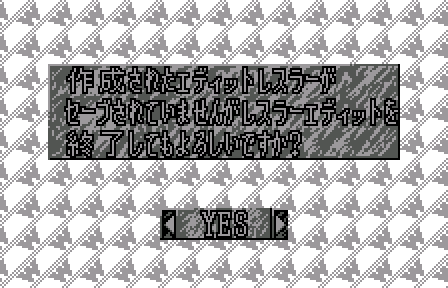
In the edit mode the player shares out 100 points to shape a new wrestler and picks the moves. For saving, the cartridge carries 256 kilobits of S-RAM. The game has no strategy guide, so the wrestlers and their moves have to be learned by playing.
Development and release
Kaga Tech, a company of the Kaga Electronics group, had earlier published games under the Naxat name. The cartridge carries a joint Human and Kaga Tech copyright line and sold for 3,980 yen before tax. Troubles on the development side had held the game back for a long while, and at the time its release came as a relief, since it could easily have been shelved. Tomoyuki Matsumoto, who had written and planned Fire Pro Wrestling G for the PlayStation and later directed Fire Pro Wrestling World, also worked on the WonderSwan version. The developer is sometimes given as Shimada Kikaku, though this has never been confirmed.
Reception
At the time it was liked for its large roster, the matchmaking in Master of the Ring and the music, but its screens were found so close to Super Fire Pro Wrestling X that the graphics might have been carried straight across. It was also faulted because similar-looking wrestlers are hard to tell apart on the black-and-white screen, that the four-button special move is awkward on the WonderSwan’s buttons, that the counts and timers use a plain system font, that the sound effects lack weight, and because neither the manual nor any guide lists the wrestlers and moves. It was judged rough but playable, and far better than the early New Japan Pro-Wrestling game on the system.
Ports and other versions
Fire Pro Wrestling for WonderSwan was made for the WonderSwan and was never ported or re-released; it is the series’ only WonderSwan game. Its relatives are the other Fire Pro games on the PC Engine, Super Famicom, PlayStation, Sega Saturn, Dreamcast and Game Boy Advance. It is not a conversion of any one of them, although it is closely related to Super Fire Pro Wrestling X on the Super Famicom, while the Master of the Ring mode was new to this cartridge.
Later history
The game fell between the end of Human and the series’ revival at Spike, which released Fire Pro Wrestling D in 2001, and the Spike-era series does not count it as one of its own. It is remembered as an obscure entry that never had a strategy guide, and a few of its wrestlers are thought to appear in no other Fire Pro game.