
Fever: Sankyo Koushiki Pachinko Simulation for WonderSwan
FEVER SANKYO公式パチンコシミュレーション for ワンダースワン
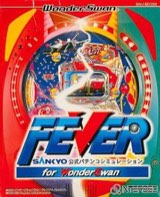
A pachinko simulation officially licensed by the machine maker Sankyo, recreating its Fever machines on the WonderSwan's monochrome screen.
Screenshots
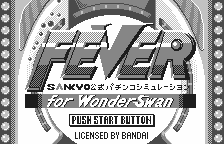
Title screen 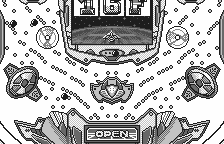
In play 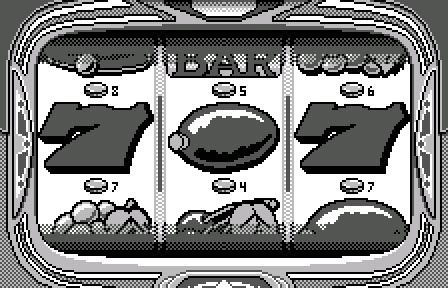
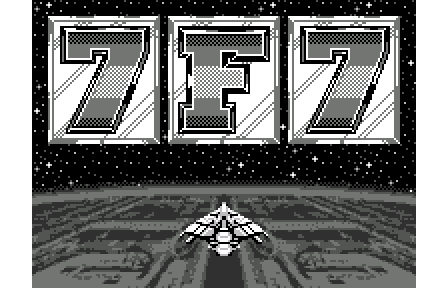

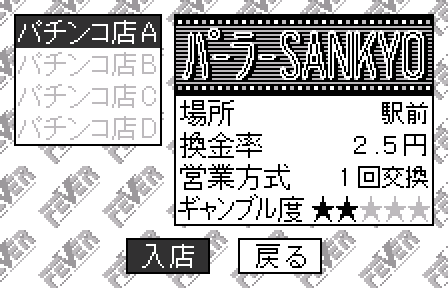
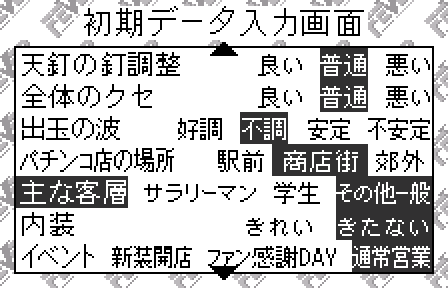
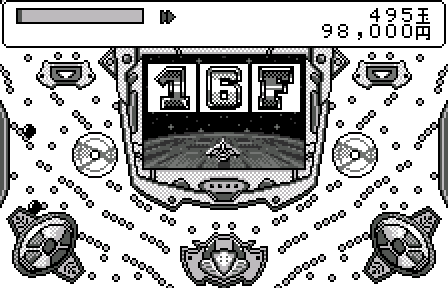
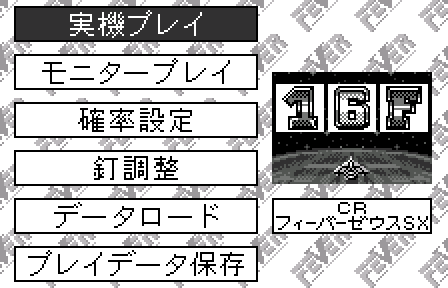
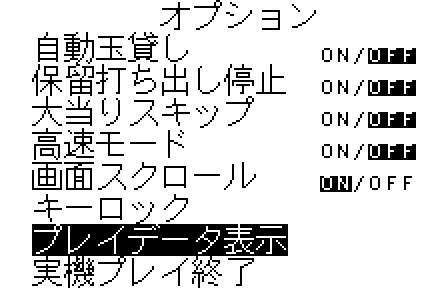
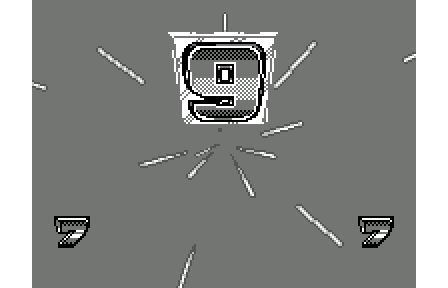
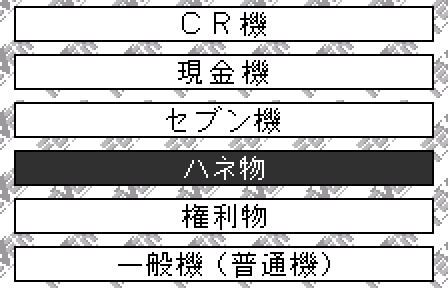
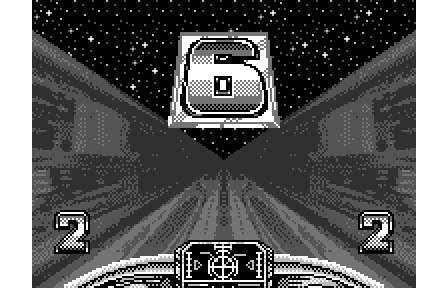
Fever: Sankyo Koushiki Pachinko Simulation for WonderSwan is a pachinko game released in Japan on 9 December 1999. “Koushiki” means official: the machines in it are licensed from the pachinko maker Sankyo, whose Fever name the game carries. It was published under the BEC name, a company whose initials stand for Bandai Entertainment Company and which worked as a developer for Bandai while the WonderSwan was being launched in 1999. A PlayStation game with the same title had been released a month earlier by ICS.
Pachinko is a Japanese gambling game that mixes ideas from pinball and the slot machine. The game holds two Sankyo machines that were in parlours at the time, CR Fever Zeus SX and CR Fever Casino RX, both introduced earlier in 1999. Around them are a strategy mode for studying each machine, a payout forecast mode, a beginner mode and a mode played day by day, and Bandai pitched the cartridge as something to carry into a parlour.
The story
The game has no story and no characters. It is a simulation of two real pachinko machines, set in a pachinko parlour and the player’s own room. Bandai’s preview placed it beside the handheld games that people took to the racetrack or the billiard hall, and described it as a companion for a visit to a pachinko parlour.
The look of the game is the look of the two machines, which Bandai promised to simulate in full. CR Fever Zeus SX is a digital machine whose reels are drawn on a liquid-crystal screen. Its reach sequences carry names such as Warp, Takeoff, Morphing and Final Attack, with Stardust and Black Hole as further stages; Final Attack at high speed, Stardust and Black Hole are the ones most likely to end in a jackpot.
CR Fever Casino RX is a drum machine, with real spinning drums in place of a screen. For a drum machine it has unusual effects: a redraw of the result, a reach that steps forward frame by frame, developed from one on the earlier Fever Ginga, drums that turn backwards, and a reach in which every drum spins together. One of its advance-notice effects suddenly switches the music to the tune of the old Fever Queen machine. On the WonderSwan both machines appear in black and white.
How it plays
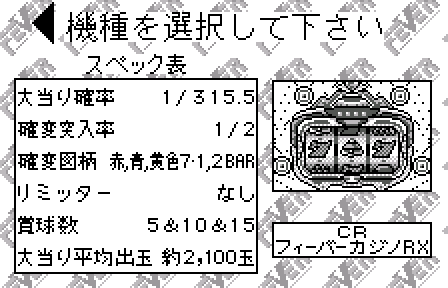
The WonderSwan is held sideways for this game, and it is for one player only, with no link-cable play. The two machines play by the rules of the real ones. Zeus SX gives a jackpot on average once in 315.5 spins, lasting up to 15 rounds and paying out about 2,100 balls. Its symbols run from 0 to 9 plus F and V, and a jackpot on 1, 3, 5, 7, 9 or F puts the machine into its high-probability state, so half of all jackpots lead on to another. Casino RX has the same base odds of 1 in 315.5, rising to 1 in 63.1 in the high-probability state, with up to 15 rounds on a ten-ball count, about 2,100 balls a jackpot, and the same one-in-two chance of a run continuing.
In the day-by-day mode the player goes from the room to the parlour, picks one of the two machines and plays it as in a real parlour. The strategy mode goes deeper and lets the player work out a plan for each machine while studying its detailed data. The beginner mode is for people who have never played pachinko and explains how the game works.
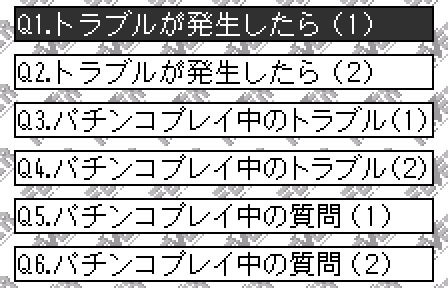
The payout forecast mode is the game’s new feature. Before any real money goes into a machine, it estimates how many balls a session is likely to produce, which is what the cartridge’s promise as a parlour companion rests on. The tutorial also explains common troubles in pachinko parlours, a touch players found considerate.
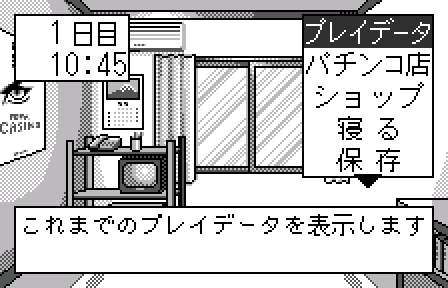
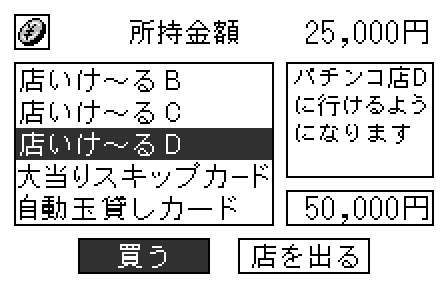
The day-by-day mode starts in the player’s room, where a clock shows the day and the hour and a menu leads to the parlour, a shop, the play data, sleep and saving. The cartridge has two of the four machines on the PlayStation disc. For saving, the cartridge carries 1 kilobit of EEPROM.
Development and release
The cartridge’s copyright line names International Card System and Sankyo alongside BEC. International Card System was the company behind the PlayStation game of the same name. The cartridge arrived nine months after the black-and-white WonderSwan went on sale, in the system’s first year. Bandai announced it at a provisional price of 3,800 yen, for one player, with stereo sound and no link-cable play. Who programmed the WonderSwan version is unknown.
Reception
The game drew little attention, and that attention was lukewarm. Its portable format and the payout forecast were welcomed, but it is remembered mainly for being the first pachinko simulation on the WonderSwan, with little else to remark on.
Ports and other versions
The cartridge is a smaller handheld version of a PlayStation game. International Card System released Fever: Sankyo Koushiki Pachinko Simulation on the PlayStation on 11 November 1999, four weeks before this one, and the WonderSwan copyright line carries the same company’s name. The two machines on the cartridge, Zeus SX and Casino RX, also appear on the PlayStation disc, which in addition has the Karate OH and Punch Out machines; the WonderSwan shows them in black and white rather than colour, and the payout forecast is its fresh feature. The PlayStation disc has a collection hall, where winnings buy machines and memorabilia, while the WonderSwan cartridge has a shop reached from the player’s room. The WonderSwan version was never released again.
The name invites confusion with other games. International Card System’s Fever series also had a PC release, though whether it holds the same machines is unknown, and a separate series, Sankyo Fever Jikki Simulation by TEN Institute, appeared on the Super Famicom, PlayStation, Sega Saturn and PC, but it is a separate line of games from another developer.
Later history
Fever Zeus was the first machine made under the relaxed pachinko rules of 1999 and the industry’s first 32-bit machine. This cartridge is the only WonderSwan entry in International Card System’s Fever simulation series, which also appeared on the PlayStation and the PC.