
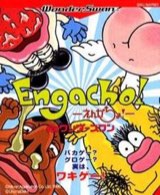
A turn-based puzzle game from Nihon Application in which a boy has to reach the exit of each room while dodging five monsters that each move by their own rule.
Screenshots
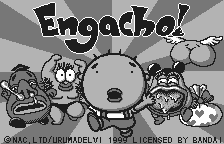
Title screen 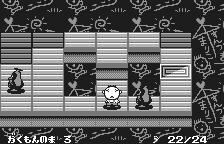
In play 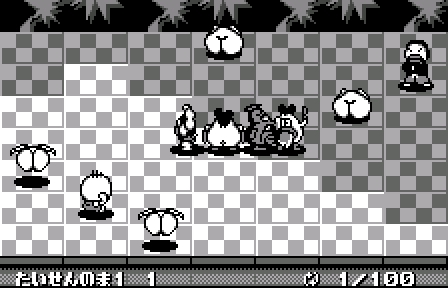
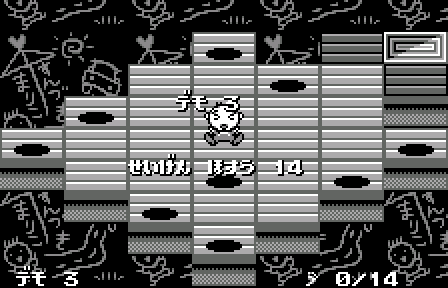
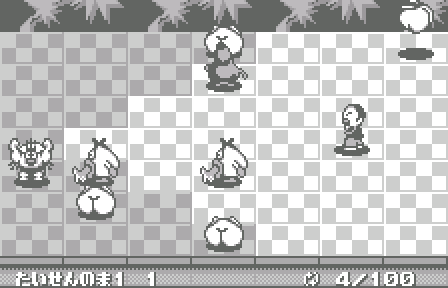
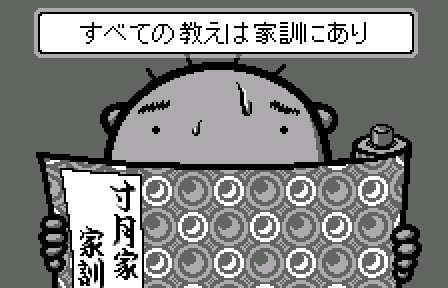
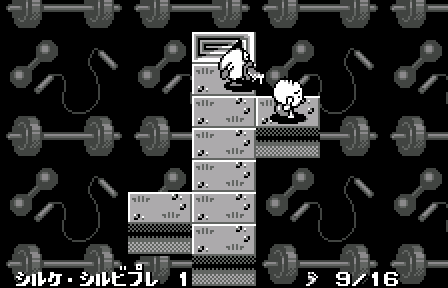
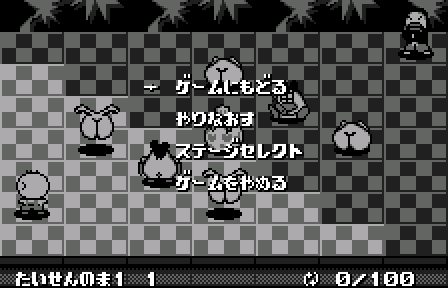
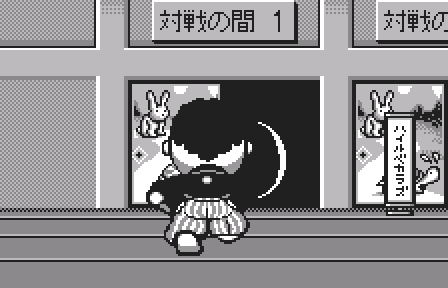
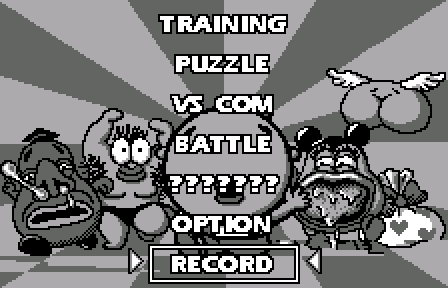

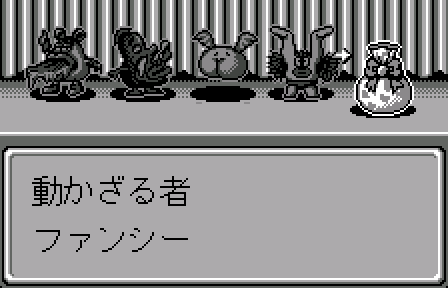
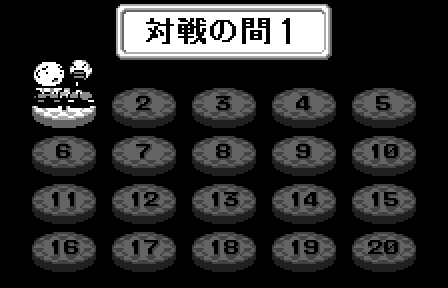
Engacho! for WonderSwan is a puzzle game published by Nihon Application on 28 October 1999, in the first year of the WonderSwan. Its name and idea come from engacho, a game played by Japanese children, and its characters were designed by the artist Uruma Delvi.
The player guides a boy across a grid to its exit while five monsters close in, and every time he takes a step each monster moves too, by its own rule. A monster’s touch passes on its disease, so each room has to be worked out a few moves ahead within a limit on the number of steps.
The game has training, puzzle and battle modes. Its puzzles are conventional, but its crude humour, such as the monsters licking a caught player until he is covered in drool, has earned it a place among the system’s joke games.
The story
The title is a word from Japanese childhood. When one child steps in something filthy, another shouts engacho, and the first makes a ring with both thumbs and forefingers that the other breaks with a chop of the hand, a little ritual that cuts off the dirt like a cooties shot. Engacho has come to mean anything foul, and the whole game is built on that schoolyard disgust.
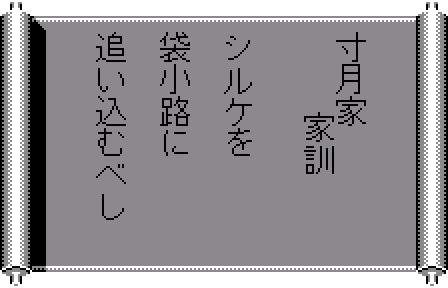
The hero is a timid schoolboy who is afraid of everything; his name is usually given in English as Sunzuki. When he comes home from school crying, his angry father decides that he has to face his fears and throws him into a dark pit. Down there the fears take shape as the Oops Five, five grotesque but harmless monsters whose touch passes on a disgusting disease, and the boy has to keep getting past them to prove that he is no coward.
The five monsters carry the game’s humour. One has a huge, dripping tongue, one is a flying backside, one has an enormous snotty nose, one has smelly hairy armpits, and the fifth is a sick bag. Uruma Delvi drew all of them, and of the boy’s misfortunes, in the pair’s usual style. The story is little more than a framing device, but it gives each world a target: at the end of each one the boy has to beat his own father.
How it plays
It is a turn-based puzzle game for one player, or two over the link cable, played with the console held horizontally. Each stage is a grid of a different shape with a blue exit square, and the boy moves one square at a time; after each step all the monsters move. There is no timer, but each stage has a step limit, and the boy has to start the stage again if a monster lands on his square, if he runs out of steps or if he is trapped in a corner. On the WonderSwan every stage fits on a single screen, so the whole board can always be seen.
What makes it a puzzle is that the monsters do not chase the boy. Each one moves in a fixed relation to his last step: the tongue copies it, the flying backside goes the opposite way, the snot monster turns 90 degrees to the right of it and the armpit monster 90 degrees to the left. The sick bag does not move at all. It appears when two monsters run into each other head on, and if another monster later lands on it, two monsters, often not the ones that went in, climb back out. A monster hit from the side is knocked one square over, which destroys it if that pushes it off the board but can also push it onto the boy. When the boy moves far enough from one edge of the board, some squares on that side go dark, and any monster standing on them falls asleep until it leaves the dark.
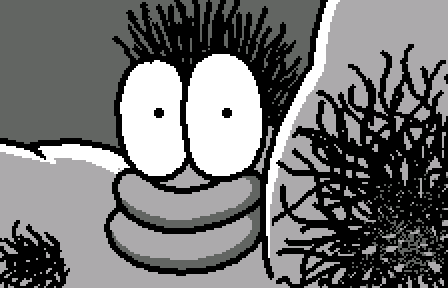
Getting caught plays a short animation of the monster’s speciality, licking the boy until he is soaked in drool, covering him in snot, burying him in filth, knocking him out with armpit stench or stuffing him into the bag, all with sound effects to match. The WonderSwan screen is black and white, and it shows the boy in close-up after each of these accidents. The boy’s cry of the title is voiced by Brother Cornn.
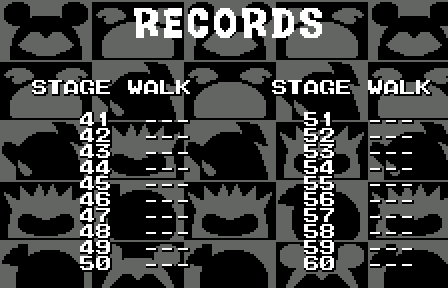
The training mode lets the player pick one monster and learn its pattern alone. The puzzle stages are divided into five worlds of 20 stages each, and the 20th stage of every world is a battle against the boy’s father, in which the two take turns on the same board and each tries to steer a monster onto the other. After that come a further hundred special stages that give exactly the number of steps the one solution needs, then a hundred more battles against the computer, and finally a few stages for two players, won by sending a monster onto the opponent or by reaching the exit first where there is one. That makes more than 300 stages in all, a count recorded for the game as a whole, as the two versions share broadly the same stages. The cartridge keeps its data on a small EEPROM.
Stages have to be cleared in order and none can be skipped, and the difficulty is uneven, so a long run of easy rooms can be followed by one that holds a player up for days. Moving without a plan quickly uses up the steps, blocks the way or walks into a monster, and the later stages call for the kind of careful reading ahead that tsume-shogi problems do. The special stages are the hardest, since each has only one answer. The battles against the father get harder from world to world, with a stronger computer opponent and a more careful starting layout of the monsters.
The shortest solution to a stage usually takes about half the steps allowed, which leaves plenty of room for mistakes and gives players something to chase if they want to clear each room in as few moves as possible.
Development and release
Nihon Application was a software company founded in 1985 that had been making and selling games since 1992, with the FM Towns title Gekirin among its earlier releases. In 1999 it released Engacho! on both the WonderSwan and the PlayStation. The WonderSwan cartridge came out on 28 October 1999. The team that programmed it is unknown, so whether the company developed it in-house is not confirmed. Uruma Delvi of the children’s show Ugo Ugo Ruga drew the characters, Brother Cornn provided the title song and the voices, including the shout of the title when the boy is caught, and the music came from Manual of Errors, the studio behind the soundtracks of Ganbare Morikawa-kun 2-go and Kileak, the Blood.
Modes and features
Two players can face each other over the link cable, each trying to steer the other into a monster, a mode often singled out as a satisfying use of the rules.
Reception
In Japan the game is regarded as a sound puzzle wrapped in a deliberately disgusting package. It counts as a joke game for its presentation alone, but its puzzle design is thought to hold up well, though the title and box put many people off. The later stages have been compared to tsume-shogi problems that demand careful planning, and players find clearing them rewarding.
Ports and other versions
Nihon Application put the game out on two systems in the same autumn. The WonderSwan cartridge was first, and a PlayStation disc under the title Engacho! followed on 18 November 1999, three weeks later. Neither version is a conversion of an earlier game, and neither was released again later.
The two versions play the same way and share broadly the same stages. The obvious difference is colour: the WonderSwan screens are black and white, while the PlayStation animations for being caught are in full colour and more elaborate, and one of them gains an extra crude touch on the PlayStation. The WonderSwan instead shows the boy in close-up after he is caught. Most menus are in Japanese on the WonderSwan and in English on the PlayStation, and a few PlayStation stages are slightly too large for the screen, so the view has to scroll and can hide a monster, which Hardcore Gaming 101 found a small nuisance in a game built on knowing where every monster stands; every WonderSwan stage fits on one screen. The PlayStation disc supports memory card saving and vibration.
Later history
The company made no later games. In 2005 Nihon Application renamed itself Creansmaerd and moved into point-management and customer-relationship software. Uruma Delvi later created the hit song character Oshiri Kajiri Mushi, and the game is often introduced with a mention of it.