
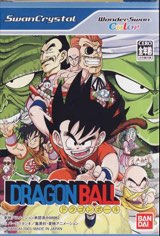
A WonderSwan Color remake of the 1989 Famicom card-battle RPG Dragon Ball 3: Gokuden, with redrawn graphics and a story brought closer to the manga.
Screenshots
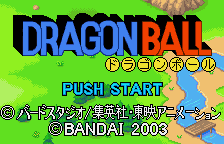
Title screen 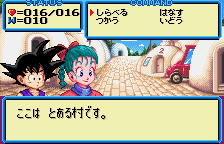
In play 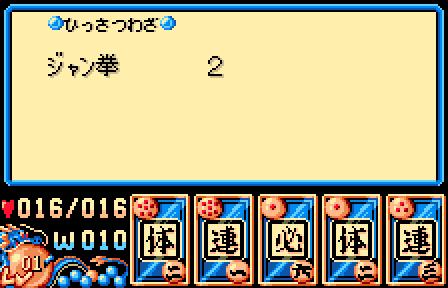
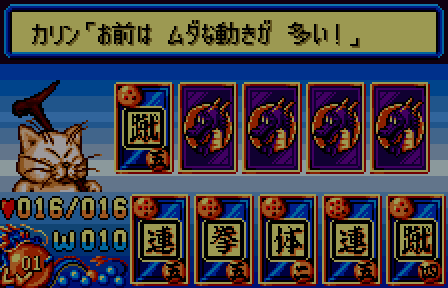
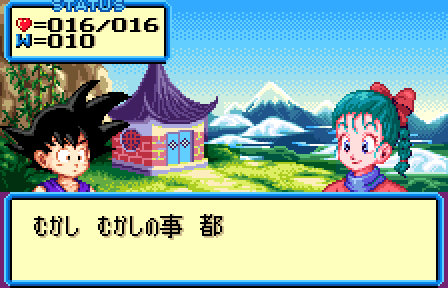
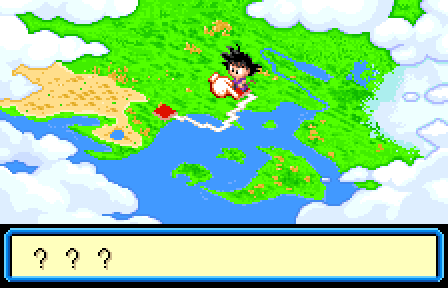
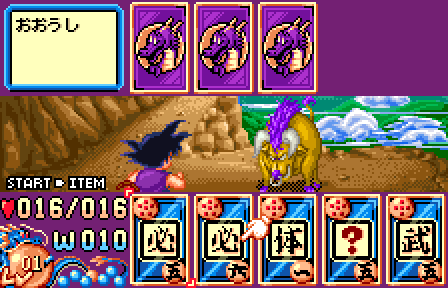
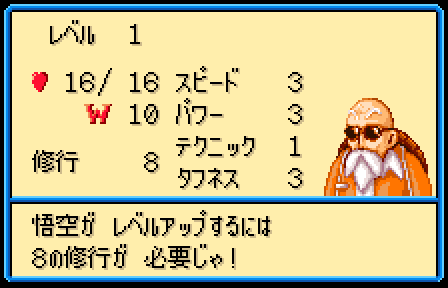
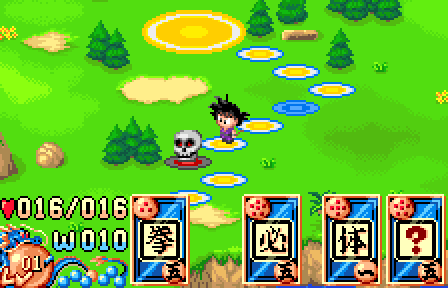
Dragon Ball is a role-playing game for the WonderSwan Color, published by Bandai on 20 November 2003. It is a remake of Dragon Ball 3: Gokuden, the third Dragon Ball game on the Famicom, which Tose developed for Bandai in 1989. The remake drops the number from its name and is simply called Dragon Ball. It follows Goku from the early chapters of the manga through the martial arts tournaments of his youth.
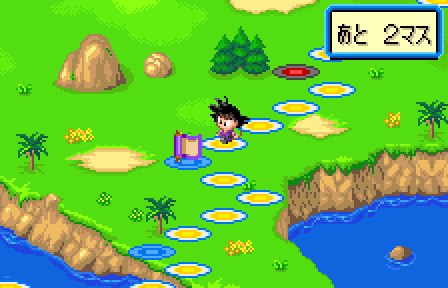
Play is built around cards, which decide both how far Goku moves on a board-game map and how hard he hits in battle. Story scenes, first-person dungeons and training with Goku’s teachers come between the map sections.
The WonderSwan Color version reworks the Famicom game rather than copying it, with new art and a story closer to the manga. It was one of the late Bandai releases for the system and needs a WonderSwan Color or SwanCrystal to run.
The story
The game retells the first part of the Dragon Ball manga, the material of the first 17 volumes of the Jump Comics edition, which stop before the Saiyans arrive. Goku starts as a small boy and grows into a young man over the course of the game, and his picture in battle changes with him.
It opens where the manga does, with Goku meeting Bulma, and the first stretch is the hunt for the Dragon Balls. On the way Goku runs into Oolong, the desert bandit Yamcha, the Ox King at Fry-pan Mountain, a sea turtle that leads him to Master Roshi, and Emperor Pilaf’s gang, whose scenes follow the manga much more closely than they did on the Famicom. The manga’s comedy comes with it: Master Roshi still asks Goku to find him a pair of panties, and in this version he pays for them with a Dragon Ball.
From there the story runs through the manga’s arcs in their original order. Goku enters the 21st martial arts tournament, takes on the Red Ribbon Army and its Muscle Tower, chases General Blue to Penguin Village, where Arale lives, climbs Korin’s tower and faces the assassin Tao Pai Pai, and fights the champions of Fortuneteller Baba’s palace together with Krillin and Yamcha. The 22nd tournament brings Tien and Chiaotzu, and the demon clan of King Piccolo leads to the 23rd.
The Famicom game had bent this plot into one of its own, with every villain working for King Piccolo and the tournament abolished. The WonderSwan Color version drops that, so that only the demon clan serves Piccolo, and the Rabbit Mob, Pilaf and the Red Ribbon Army are once more separate threats, as in the manga.
How it plays
It is a game for one player with no link-cable play. Three kinds of play take turns: a map laid out like a board game, adventure scenes in which Goku talks to people and searches places, and card battles. In some adventure scenes, such as enemy bases, Goku can walk around, and walking into a wall costs him life. A few story events also deal damage outright, as they did on the Famicom. The first-person dungeons are of the same kind, explored a step and a turn at a time; this version adds two at Pilaf’s castle and the Red Ribbon Army headquarters, and the Demon King’s castle, the largest, is easy to get lost in, so drawing a map of it helps.
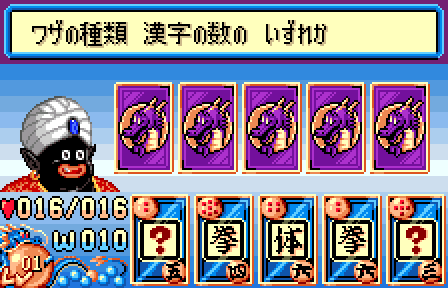
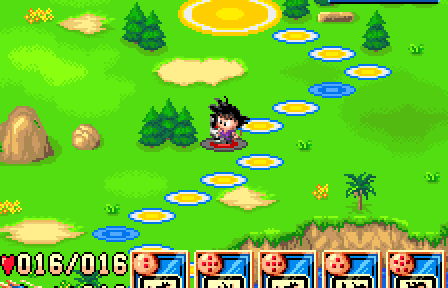
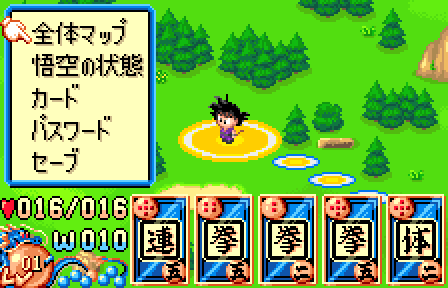
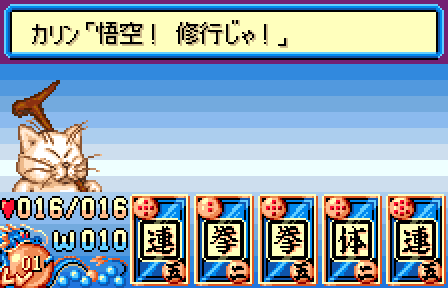
Every card carries three values: a number of stars from one to seven, a kanji in the middle that names a kind of move, and a kanji numeral from one to seven. On the map the player picks a card and Goku moves as many squares as it has stars. The square he stops on decides what happens next: a fight, a card draw for items, training or nothing at all. The overall map now marks where to go next, which the Famicom game did not. The only vehicle is the Flying Nimbus, which costs special-move points to ride.
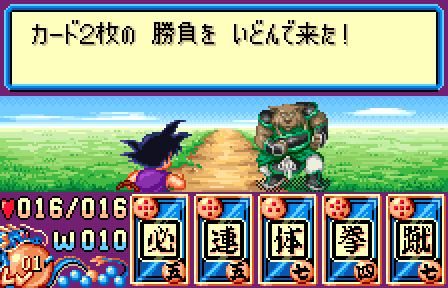
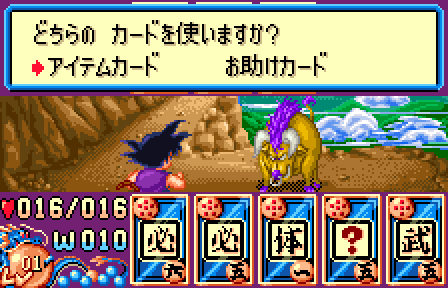
In battle, each turn either Goku or the enemy decides how many cards will be played, and both sides lay down that many. They are turned over one pair at a time, and the card with more stars wins the right to attack, though a one beats a seven. The kanji in the middle sets the attack: punch, kick, body blow, combo, a weapon attack with Goku’s Power Pole, a special move that spends special-move points, an escape, or a question mark that turns into one of the others at random. The kanji numeral is the card’s defence, and Goku can sometimes shrug off any hit with his afterimage technique. Played cards are replaced until the hand is full again, and special moves are now shown with cut-in pictures taken from the manga’s panels.
Winning fights earns training points, and enough of them raise Goku’s level, which increases his life and special-move points, sometimes teaches him a new special move, and gives points to spread over four abilities: speed, power, technique and toughness. The balance is gentler than on the Famicom, where a poor spread could make the late game very hard, and spreading the points evenly is enough here. Ordinary enemies in the field still get strong in the later part of the game, and speed is the ability that matters most against them. Goku’s teachers, Master Roshi, Korin and Mr. Popo, train him through card mini-games that also teach the rules.
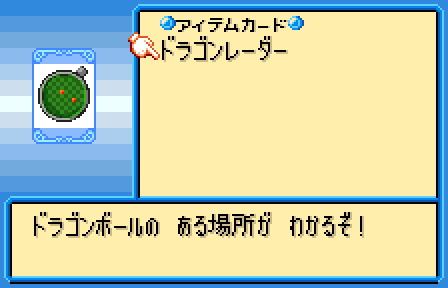
Item cards are carried between fights and include food, a feast and senzu beans to restore life and a scroll of secrets to restore special-move points; this version lets the player carry the scroll and play recovery cards during battle. Helper cards, used only in battle, show characters from the manga such as Yamcha, Oolong, Bulma, Krillin and Master Roshi, and do things like raise every ability, heal, refill special-move points, turn a card into an escape or swap the whole hand.
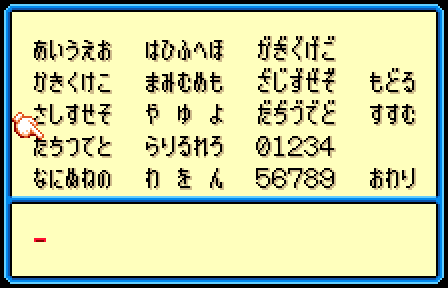
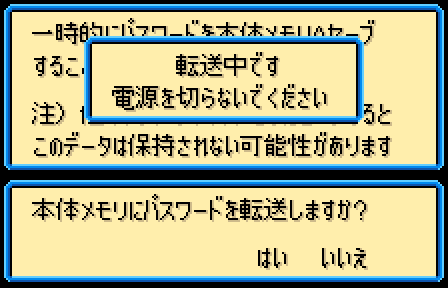
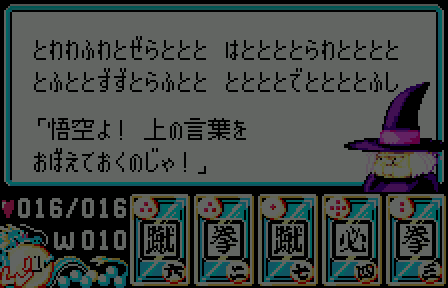
Losing a fight no longer ends the game. Goku gets up where he fell but loses every recovery item and helper card he was carrying. Progress is still kept with passwords, as on the Famicom, and the passwords grew longer. The console’s own temporary save can hold a game as well, but players advise writing the password down or photographing it, and taking care with the font, in which hiragana such as ne, wa and re, or nu and me, are easy to mix up.
The game is easier than the Famicom original, but the luck of the draw still decides a great deal, both on the map and in battle. One errand is worth knowing about: because Master Roshi now rewards the panties with a Dragon Ball rather than a vehicle, finding the right pair can mean running back and forth between Kame House and the search area until it turns up. After the ending a hidden fight with Arale waits for players who know where to look, as described below.
Development and release
Tose, which had made the Famicom original, developed the remake. The staff roll credits Satoshi Ohno and Nobuyuki Tanaka as producers and Tamuro Takasu and Kanade Yokokawa as composers, with Shueisha’s V Jump editorial team, Toei Animation and Caramel Mama listed for supervision. The game came out on 20 November 2003 at 3,980 yen. It is the last title Bandai published for the system, and the only later WonderSwan games are two mail-order releases from Qute. Because the new opening plays the anime’s theme song, Makafushigi Adventure!, the cartridge carries a JASRAC mark that the Famicom game did not need.
Modes and features
Besides the redrawn graphics and the story changes, the remake adds several things to the Famicom game: the gentler rules for losing a fight, recovery cards that can be played in battle, the destination marker on the overall map, and the two new first-person dungeons at Pilaf’s castle and the Red Ribbon Army headquarters. Krillin and Yamcha can now win their fights at Fortuneteller Baba’s palace, a short stage lets the player control Arale while chasing General Blue, and several enemies were renamed.
Secrets and extras
The Famicom game’s hidden fight against Raditz is gone. In its place, pressing the A button while the ending plays starts a battle with Arale, whose special attack does a fixed 255 points of damage, enough to finish Goku in one hit, and cannot be dodged with the afterimage technique. Players who reach her find her far harder than the final story boss.
Reception
It is generally regarded as a solid character game that fixed most of the original’s balance problems, though it is faulted for keeping passwords in 2003 and for a password font in which several hiragana are easy to confuse. Players who knew the Famicom game welcomed the smoother progress and the story’s closer match to the manga, though some found the dungeon at the Demon King’s castle easy to get lost in, and the luck of the draw is still felt to decide too much.
Ports and other versions
The game began on the Famicom as Dragon Ball 3: Gokuden, released by Bandai on 27 October 1989 and developed by Tose, and this cartridge is a remake of it rather than a new story. The Famicom original returned in 2018 as one of the games built into the gold Weekly Shonen Jump 50th anniversary edition of the Nintendo Classic Mini Famicom, released on 7 July that year. The WonderSwan Color remake itself was never released again, and neither version left Japan.
Beyond the redrawn graphics, the largest change is to the plot. On the Famicom, Pilaf’s gang, the Rabbit Mob and the Red Ribbon Army all serve King Piccolo, who has put an end to the martial arts tournament, and Goku’s first two contests are replaced by invented events. The remake drops that premise and runs the 21st, 22nd and 23rd tournaments in the manga’s order, adding the entrants Shen and Anonymous so that the last tournament’s bouts follow the manga. Some leftovers of the Famicom plot stay, such as the Demon King’s castle dungeon. There are smaller changes too: Krillin, Yamcha and others can now win fights the Famicom game made them lose, the choice between the young turtle and the Flying Nimbus as transport is gone, and some enemies have new names and colours.
Battles gained cut-in pictures for special moves, drawn from panels of the manga. The Famicom game used no music from the anime, while the remake opens with its theme song; the music during play is mostly arranged from the Famicom tracks, and the only newly written piece plays before the title screen. The difficulty was lowered and the rules made more forgiving, as described above, but saving still relies on passwords, now longer than the Famicom ones.
Later history
It is the only Dragon Ball game in the WonderSwan library. Because it arrived so late in the system’s life, it is hard to find and sells at a premium second-hand, which is sometimes put down to a small production run.