
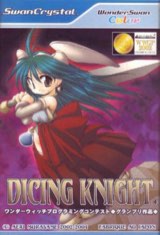
A top-down action game with randomly built dungeons and dice-rolled damage, the WonderWitch contest winner that Qute sold by mail order as the last WonderSwan release.
Screenshots
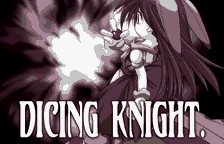
Title screen 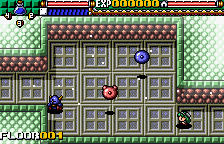
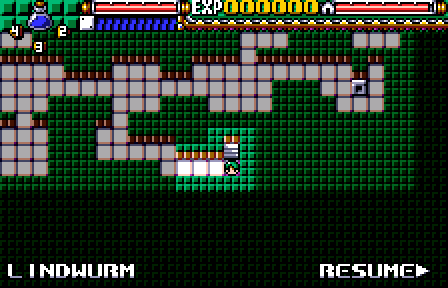
In play 
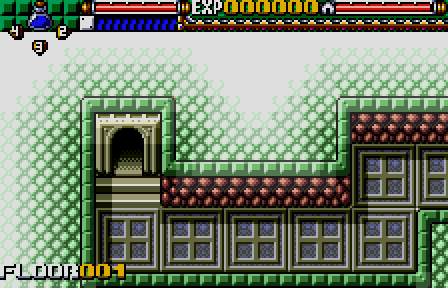
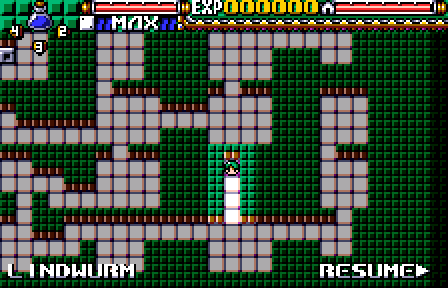
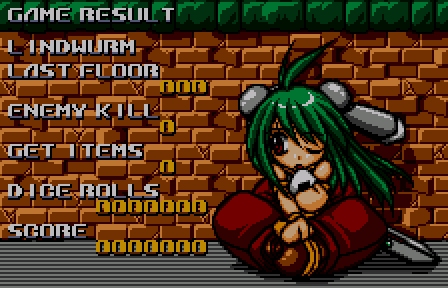
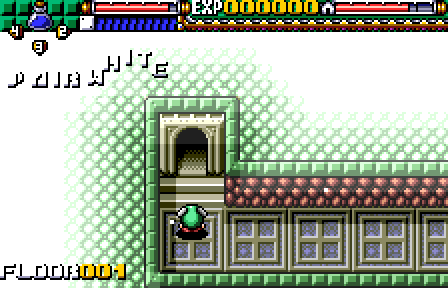
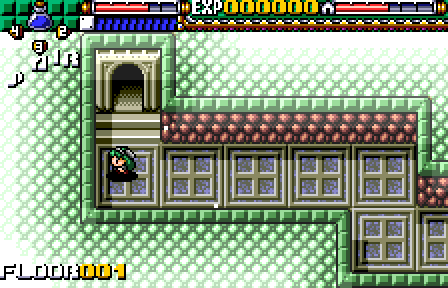
Dicing Knight. began as an amateur game. Its author, AEju Murasame, who works alone under the circle name Platine Dispositif, wrote it with WonderWitch, the programming kit that let hobbyists make software for the WonderSwan, and entered it in WWGP2002, the second WonderWitch programming contest, run by Bandai together with Qute, where it won the grand prize. The prize included help in turning the winning game into a commercial cartridge. A version was sold at the WWGP2003 contest event, and the full release followed with a period added to its name.
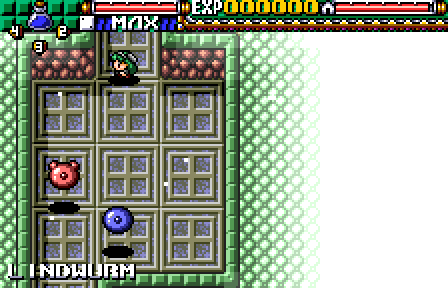
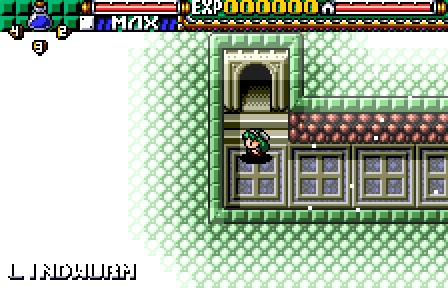
It is an action game seen from above in which a hungry knight works his way down randomly built dungeons, and dice decide the damage of every blow. Compared with the contest entry, the released game has redrawn dungeons, a new action system, a better map generator and additional monsters, items and bosses.
Qute sold the cartridge only through its online shop and made copies to order: orders were taken from 5 to 23 April 2004 and shipping began on 31 May 2004, at 4,200 yen. No WonderWitch is needed to play it, but it works only on the WonderSwan Color and SwanCrystal. It was the last WonderSwan release.
The story
The game is set in a land once made of dreams and illusions, a kingdom where dreams never ran out. Evil dragons came, killed its dreams and broke its illusions one after another, and the kingdom fell. Its princess, Jung R’lyeh, is left with nothing but grief and a wish for revenge on the dragons.
To get it, she summons a knight from another world. The knight, Peko, arrives holding the Dicing Sword and very hungry, and the princess tells him, lightly, that he will not be sent home until every dragon is dead. He stands there stunned for a while: killing the dragons will not bring the ruined kingdom back, and in any case he is starving. That is the whole set-up, and it carries the tone of the game, which treats its fallen fairy-tale kingdom with a straight face and its hero’s empty stomach as the more pressing problem.
The story is told through that opening and the places the knight goes rather than through long scenes. The journey runs through five dungeons, each a realm with its own title: Lindwurm, a pure white sky; Shooting Star, a mountain of fire where a star god fell; Jabberwock, an endless night where toys and other things that are not human hold a feast; Quetzalcoatl, a cave of bones home to souls caught between life and death; and Jormungandr, a world tree with an ancient serpent at its roots. Most of the realms take their names from dragons and serpents of myth and legend, and a strong boss waits at the bottom of each. The monsters on the way are a playful, parody-flavoured crowd that includes a potion that is really an enemy, an invisible ninja girl, a witch, a joker and a maid carrying a machine gun.
How it plays
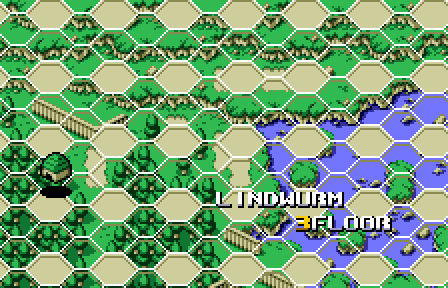
The knight moves with the X buttons. A swings the sword and B raises the shield, and holding one while pressing the other gives the special attacks. The four Y buttons are four item slots: pressing one uses the item in that slot, or picks up an item lying next to the knight. Start shows the map of the floor, and pressing right on the map suspends the game, so a run can be stopped and picked up again later. It is a single-player game.
Each dungeon is a stack of floors whose maps are generated anew every time, much like a roguelike but in real time. On every floor the knight has to find the floor key that opens the way down, and a strong boss waits on the deepest floor. Beating it within a time limit clears the dungeon and opens the next one, and each boss is tougher than the last. A hunger gauge drains as he goes, food has to be found or taken from enemies along the way, and when the gauge runs out the knight starves and the trip is over, so every trip is a race between going deeper and starving.
Dice are thrown for almost everything. The knight’s sword hits, the enemies’ hits on him and the healing from potions are all rolled, so the same blow can do very different amounts of damage. Items can interfere with the rolls, which keeps it from being pure luck. Among the items are watches that stop time for a moment.
Hitting with the sword and blocking with the shield fill a power gauge, and two special attacks spend it once it reaches its second level. Blazing Edge costs one level and strikes in every direction, wiping out enemy shots, but does little damage. Shine Slash spends the whole gauge on a cross-shaped slash meant to finish an enemy in one blow, and its strength depends heavily on how many levels were stored.
The real progression is in the orbs. Lottery tickets found in the dungeons, and one handed over by each boss, are taken to a lottery draw, one draw per ticket, and each draw gives an orb. There are seven colours: red raises the power gauge’s maximum to as many as six levels and strengthens combos and Shine Slash; yellow cuts the number of dice rolled when an enemy hits, down to a minimum of one; green makes the knight heal after a while without input, at the cost of food; blue raises the rate at which items appear; purple enlarges the hunger gauge; black speeds up experience; and white raises maximum life and the number of dice a potion rolls. Orbs are chosen before entering a dungeon. How many can be worn at once depends on a level set by adding together the best experience score from each dungeon, from 500 points for the first level and 1,000 for the second up to 30,000 for the ninth. At the start only Lindwurm is open and there is a single empty orb slot, and clearing the first dungeon is usually enough for the second level.
The dungeons change the rules as they go. Lindwurm teaches the basics, the enemies get noticeably harder in Jabberwock, so defence becomes important, and from Quetzalcoatl the knight can only see part of the floor, which makes the moment to pick up the floor key a decision of its own. There are 26 kinds of enemy with one to ten hit points, and they notice the knight in different ways: by sound, with a narrow or wide field of view, or only on contact. Some explode, some warp, and Skullgon cannot be killed and drops nothing, yet a player who always runs from it ends up trapped, and in Jormungandr dodging such enemies can cost the chance to get the key.
The game is hard, and the usual advice follows from the orbs. Black is worth wearing in the early dungeons to build up experience scores and with them more orb slots. Yellow matters late in the game, when enemies hit very hard, and blue matters because items become much rarer in the later dungeons. Purple’s larger hunger gauge is the one orb even the author jokes may not be much use.
Development and release
WWGP2002 was organised by Bandai, with Qute and Koto as co-hosts. It drew 74 valid entries from people aged 17 to 38, the results were announced on 14 June 2002, and the prizes were handed out on 23 June at the WWGP Festa, held at the Tokyo International Forum, where the winners presented their own games. Murasame’s Dicing Knight, entered as an action game with automatically generated dungeons, took the grand prize, which came with 500,000 yen, a trophy and help in bringing the game to market. A year later the WWGP2003 Festa, held on 19 July 2003 at Nakano Sun Plaza in Tokyo, had a sales corner for earlier grand-prize games, and that is where an earlier version of Dicing Knight was sold.
Qute announced the finished game in early April 2004 as a made-to-order product, with no copies in ordinary shops, no limit on quantity and a separate shipping charge, and Game Watch reported it with a list of the changes since the contest. Compared with the version sold at the 2003 Festa, the 2004 release has new packaging and printed matter, many new and changed graphics, a riskier twist when the knight is carrying the gate key, and extra gimmicks in the later dungeons. The author sums the game up as hungry action with a strategic side, and the made-to-order run has long since sold out.
Secrets and extras
Getting through the fifth dungeon unlocks a second playable character, Eryth Millfall, a guest from the author’s Gundemonium series. Eryth fights with ranged attacks, hits harder and benefits more from some items, but has weaker defence and a smaller food gauge that empties fast. Her moves are a twin-pistol shot, a fortune wheel that soaks up enemy shots, a moment of stopped time that clears shots at the cost of food, and a shockwave that goes through every obstacle. Unlocking Eryth also opens a sixth area, Uroboros, with no end to its floors. The title screen hides a sound test, reached by tapping up on the Y buttons repeatedly.
Ports and other versions
Dicing Knight. was written for the WonderSwan from the start, and every version of it stayed on it: the WWGP2002 contest entry built with WonderWitch, the edition sold at the 2003 Festa and the 2004 cartridge, whose changes are described above. It is a WonderSwan Color and SwanCrystal game, and it was never ported, remade or released as a download on any other system. Its closest relatives are the author’s own games: Platine Dispositif otherwise works mainly on Windows shooting and action games such as the Gundemonium series, from which the unlockable Eryth comes, and this dungeon game with dice-rolled damage stands apart from them as a cartridge made for Bandai’s handheld through a contest.