
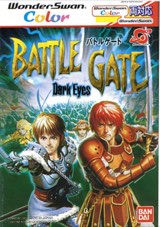
A tactical role-playing game set in the world of NexTech's PC online game Dark Eyes, in which two races of the planet Fairhope go to war.
Screenshots
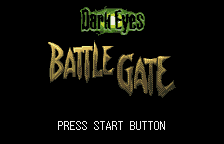
Title screen 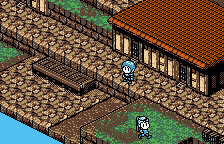
In play 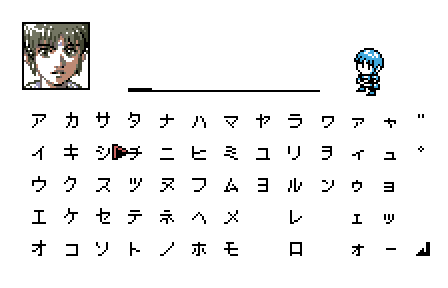
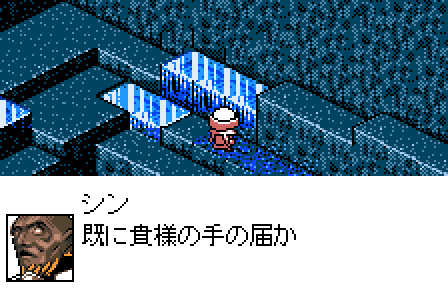
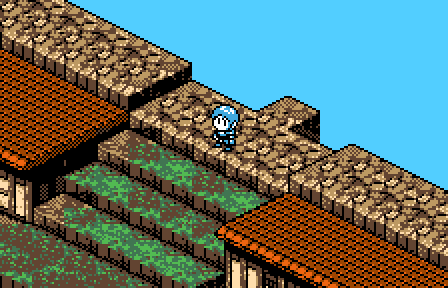
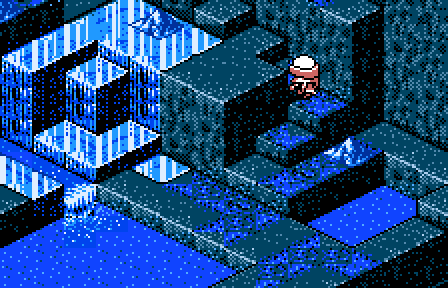
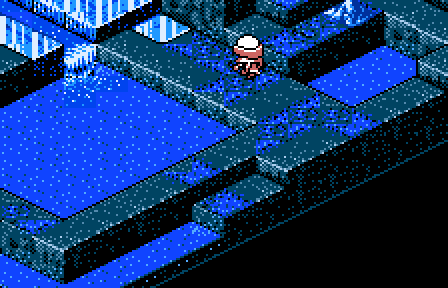
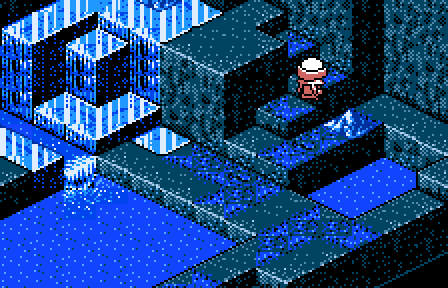
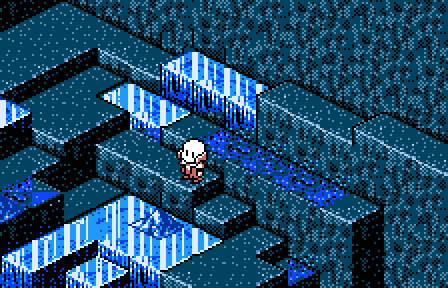
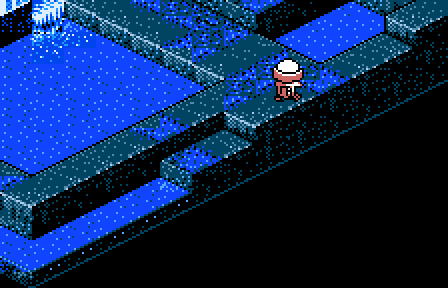
Dark Eyes: Battle Gate is a strategy role-playing game made by NexTech and published by Bandai on 15 March 2001. It borrows its world from Dark Eyes, an online game NexTech had made for personal computers, and tells a new story on the planet Fairhope. When the game was first reported in November 2000 it was planned for February 2001 at 4,500 yen.
Fairhope is home to two races who end up at war. The player picks one side, follows its hero through a story in three parts, and fights turn-based unit battles on isometric maps of the kind found in Tactics Ogre, a comparison made when the game was announced.
The cartridge is in colour but also plays on the original black-and-white WonderSwan. Through the WonderGate adapter, players could send their own characters out over the network as mercenaries, where they could change how the story played out for other players who were connected.
The story
On the planet Fairhope two races, the Orghal and the Infan, grew up on opposite sides of a vast mountain range, each building its own civilisation without knowing the other existed. The Orghal live in a land rich in nature and have learned to cultivate plants, raise monsters and draw directly on the power of nature. The Infan had a harsh land to overcome, and did it by mining its resources and crafting items. When the two peoples finally met, the contact grew into a war that spread across the whole planet. When the game begins a truce has been in place for three months, but life is still hard for many.
The player chooses one of the two races at the start, and each has its own hero and its own storyline. The story runs in three parts: a first part fought within the chosen race, a second part in which the Orghal and the Infan go to all-out war, and a third part set in the aftermath. The game is not a sequel to the PC Dark Eyes; some of its characters appear again, at times with a different background and role.
The Infan hero is Rainal, an orphan raised in a frontier village by the family of his childhood friend Rianna. For a thousand years the Infan fought the Sand Ships, blood-sucking desert monsters shaped like scorpions, up to five metres long, with hard shells and long pointed tails, which hide in the sand by day and hunt people at night. A boy of fifteen must camp alone in the desert far from town and kill one within a week, or be sent away to live among the outcasts. On the morning of his fifteenth birthday Rainal slips away without saying goodbye to face this test. In the desert he meets Lambert, a rough-tongued former gentleman thief who had been jailed and was freed in the amnesty that came with the peace, and who is on his way to the capital to find work. Lambert takes to the boy’s honest nature, the two kill a Sand Ship together, and Rainal heads home without knowing what waits for him there.
The Orghal hero is Georges Cain, a red-haired youth raised by his grandfather Dan Cain, once commander of the Orghal priest army, who left the capital to settle in Nader, a quiet country town between the sea and the mountains. Georges burns to help his people and, pushed on by his old friend Alex, sets out to join the army so that the conflict with the Infan can be ended and peace restored. Together with Kruger and Camilla he wins a tournament in the arena, joins the Orghal ranger army, and is sent by Emperor Samson to look into a strange monster in human form.
How it plays
The player leads the hero and a band of allied units against enemy squads moved by the computer, clearing one scenario after another. Between battles the game moves across three kinds of map: a world map to explore, base maps for towns, villages, temples and castles, and random maps where fights break out. The bases hold item shops, taverns and exchange counters, where the party is equipped and new members are hired. Characters met along the way join the party as allied units and are raised from there.
Battles are turn-based on isometric maps that add height to the usual grid, and the difference in elevation affects movement, attacks and defence. Moving units around these maps is fiddly, and diagonal movement in particular takes getting used to.
Each race has its own class tree of ten class lines, and each line comes in two versions with different techniques, so that there are twenty classes per race. For the Orghal the lines run from Warrior, Bandit, Priest, Farmer and Knight through Viking and Monk to Samurai, Ninja and Summoner, with versions such as Bard, Priestess and Kunoichi beside them. The Infan have their own lines, from Swordman, Ranger, Bow Priest and Smith up to Sword Master, Assassin and Sorcerer, with versions such as Aerial, Dancer and Sorceress. Each class has its own growth rates and a set of levels a unit must reach in strength, dexterity, intelligence and hit points before it can take that class, and each class learns one technique, such as a whirlwind slash, a rock drop, a holy light, healing, a sleeping song or a fireball.
Every class also has a movement value of three to five and its own way of moving, with seven kinds in all: ordinary ground, mountains and fields, ice and snow, shallow water, sand, flight, and amphibious. Equipment comes in thirteen types, from daggers, swords, axes, hammers, staves, spears, rods and bows to armour, robes, shields, helmets and hats, and each class has its own list of what it can use. Each unit carries up to four pieces of equipment.
The heroes have classes of their own that open only under special conditions, five for each race, such as Paladin and Emperor for the Orghal and Morgue Knight and Kaiser for the Infan. A few characters have a special fixed class, the Orghal White Knight and the Infan Princess, and demi-human recruits keep a fixed class too: the flying Garuda and Icarus and the amphibious Piranian. The official site’s suggested parties for the second chapter each hold eight units, and they give some characters techniques from classes other than their current one, which suggests that a technique stays with a unit after a class change.
Development and release
NexTech began life in 1992 as Emerg, a company funded by Sega and the Yomiuri group, took the NexTech name in 1994 and became a wholly owned Sega subsidiary in 1997. NexTech ran its own page for the WonderSwan game, while the cartridge went out under Bandai’s name with a 32-megabit ROM and 256 kilobits of save memory.
The official page kept the WonderGate side of the game going after launch. Shortly after release it was hit by a fault in the WonderGate pay system that, from 1 April 2001, stopped new service fees from being paid, although services already paid for still worked. During Golden Week a special event could be downloaded by players who registered or hired mercenaries over the WonderGate, and the first player to clear it had their hero’s name given to a village that appears in the event.
Modes and features
The game can be played entirely on its own. Besides the WonderGate, it supports the link cable, and it is for one or two players. The networking covers both battles against other players and lending one’s own character to someone else’s game as a mercenary, where it can change how that player’s scenario unfolds and set off new events.
Reception
It is remembered as a networked strategy game that arrived too early, and few players are thought to have ever used the online side. Players found the controls very awkward, especially the diagonal movement on the isometric maps, and felt the story ran out of steam in its later part. The two heroes give two separate storylines, and each character has a detailed face portrait.
Ports and other versions
Battle Gate was made for the WonderSwan. Bandai presented it as an original game for the system, built around the war on Fairhope from NexTech’s PC online game, and NexTech made the same point from the other side: it is not a sequel to Dark Eyes, and although it reuses the planet and some of its characters, at times in different roles, its game system has nothing in common with the PC game. That PC game, released for Windows 95 in 1999 and followed by an updated Dark Eyes 2000, is a relative of this cartridge rather than an earlier version of it.
Battle Gate was never ported, remade or re-released on another system. Where the Windows titles are online games played on a computer, this one is a turn-based tactics game on isometric maps for a handheld, with its network side limited to the WonderGate mercenary service and the link cable.