
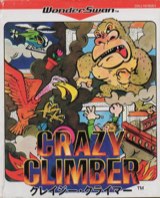
Nichibutsu's own WonderSwan version of its 1980 arcade climbing game, with the arcade game and a new arranged version played with the console held upright.
Screenshots
Title screen 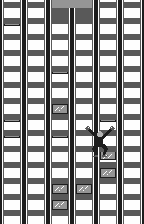
In play 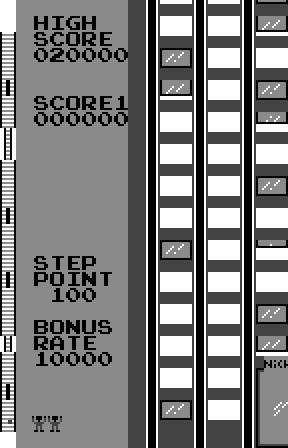
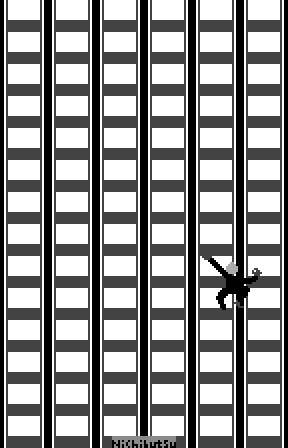
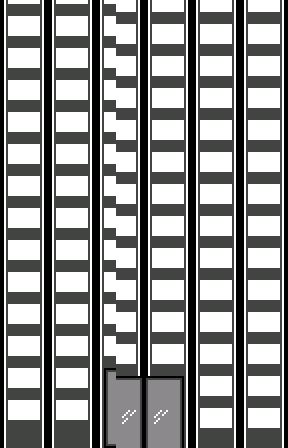
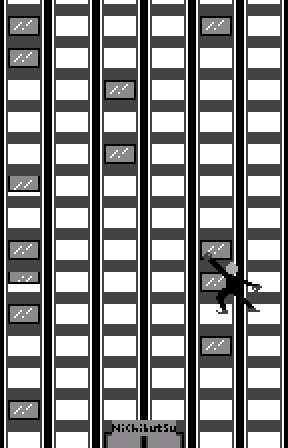
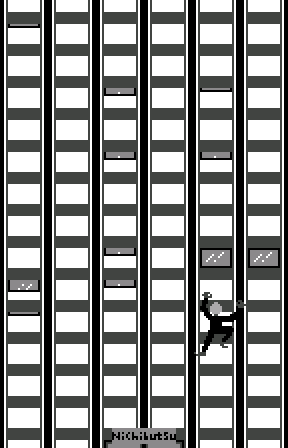
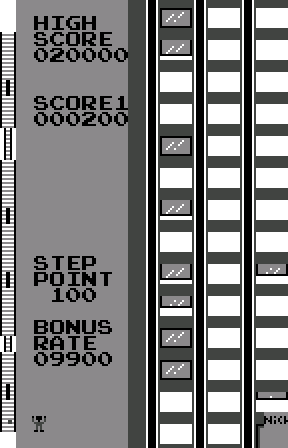
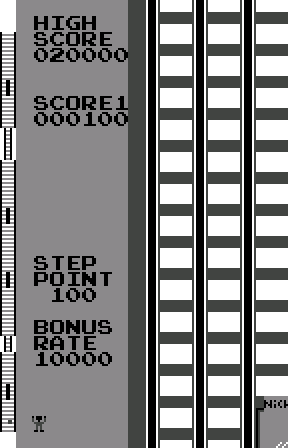
Crazy Climber for the WonderSwan is a version of the arcade game that Nichibutsu released in Japan on 10 November 1980. Nichibutsu brought it to the handheld itself and released it on 29 July 1999, in the console’s first months on sale. The cartridge holds both a version of the arcade game and a new arrangement made for the WonderSwan, and the release adds four new stages to the original’s buildings.
The player sends a climber up the outside of a skyscraper with no rope, catching hold of open window frames while windows open and shut at random and things fall from above, until he reaches the helicopter waiting on the roof. The game is played with the WonderSwan held upright, which suits a game about climbing a tall building, and it is one of the titles that made use of the console’s vertical screen. For players who want the 1980 game as it was, the arcade mode follows the original closely.
The story
Crazy Climber has no story. No reason is given for the climb: an unnamed man, called only the Climber, scales one skyscraper after another with his bare hands, and a helicopter on each roof carries him off to the next. Nothing explains the odd buildings, which are walls of windows from bottom to top, or why the people inside and a giant gorilla want him off them. Nor is there an ending. After the fourth building the game starts again at the first and goes on until the last climber falls. The manual sets the scene only with the game’s own history, as the machine that startled arcade regulars in the early days of video games with two sticks tied to the character’s two arms, brought back on the WonderSwan nearly twenty years later.
What the game has instead is a cast of comic nuisances from 1980, kept on the WonderSwan with their old sounds. Residents lean out of their windows to drop flowerpots and other things on him; the manual calls them Ojama Man, roughly Mr Nuisance. The Shirake Condor flies overhead to a few bars of a comic tune, and the King Gorilla swings punches from the side of the building. Steel girders and dumbbells tumble down, a big signboard drops with a crash, a cut power line spits sparks across a sign, and a Lucky Balloon floats by to give the climber a lift. The climber has a voice as well: he yelps when something hits him and is told to keep going if he stays put too long, in the same synthesised speech as the 1980 machine.
The WonderSwan Mode takes the climb away from the city. Its four stages are set in places such as outer space and under the sea, and the cast changes to match, with enemies such as an octopus and a UFO and a turtle in the condor’s place. Only the look changes. The sound effects, the music and the way each hazard attacks are those of the arcade stages, so the turtle arrives to the condor’s song.
How it plays
The WonderSwan is held upright, which puts a cluster of four buttons under each thumb, and each cluster stands in for one of the arcade machine’s two sticks. The Y buttons on the left move the climber’s left hand and the X buttons on the right move his right hand. Start pauses the game, the Sound button switches the volume between loud, quiet and off, and pressing A, B and Start together resets it. When the game is switched on it shows a reset screen, as the arcade machine did.
Pressing Start at the title screen opens a menu with three entries, chosen with the Y buttons and confirmed with an X button. Arcade Mode plays the four buildings ported from the arcade game, and WonderSwan Mode plays four new stages made for the handheld; in both, clearing a stage leads straight to the next, and after the fourth the climber is back at the first. The Player entry sets the number of climbers from three to six. That is the whole menu: there is no difficulty setting, and both modes are open from the start.
The climber goes up by moving his hands in turn. Pressing up on the right hand while pressing down on the left at the same moment, then the reverse, hauls him up a row of windows, and repeating the pair keeps him climbing. He can only take hold where a window is open. A window that is starting to close can still be climbed, but when the windows above are shut or something is falling in the way, he has to grip firmly with both hands, let go, and move both hands left or right together to shift to another column. If one hand ends up between two windows, or the window it holds is shut, he cannot move until he takes a firm two-handed grip again. A window that shuts on both hands throws him off the building and costs a climber.
The climber cannot fight back, so every hazard is dodged or endured. Small objects such as the flowerpots and the condor’s eggs can be withstood if he is holding on firmly with both hands. Hit while only one hand is on the wall, or hit by something large such as a girder, a dumbbell or the falling signboard, he loses his grip and a climber is lost, and the manual’s only advice for the girders and dumbbells is to get out of the way. The King Gorilla punches at him from the side, and touching the sparking wire on the electric sign gives him a shock. Catching hold of a Lucky Balloon carries him several floors up in one go and counts as a bonus.
Points come from climbing. Each row of windows climbed is worth a set number of step points, and a bonus worth thousands of points counts down over time and drops each time something hits the climber. What is left of it is added to the score when he catches hold of the helicopter. During play the screen shows nothing but the building, because the arcade game’s side panel with its map and score has been dropped to fit the upright screen. Pausing brings that information up instead: the high score and score, a map of the building with the climber’s position, the step points, the bonus and the climbers left. After a game, the top five scores take a name, picked letter by letter with the Y buttons and entered with X3, and the table is shown during the demo.
The controls are both the point of the game and its main difficulty. Each cluster is four separate small buttons rather than one joined pad, so it is easy to press two at once or to make a move that leaves the climber where he was, and he can get wedged between windows with no way to move. A tool-assisted run clears the four arcade buildings in under five minutes, but there is no ending to reach, so a game is a chase for a higher score that lasts until the last climber falls. The WonderSwan Mode plays by exactly the same rules as the arcade one, so it adds new scenery rather than new challenges.
Development and release
Bandai’s publicity made the controls the game’s main point. The arcade machine gave each of the climber’s arms its own stick, which made the game hard to bring home; the Famicom version needed the first and second controllers at the same time. Bandai argued that the WonderSwan’s buttons, with the console held upright, let the original controls be reproduced in full, as if the console had been designed for this game.
The cartridge is a small one, 4 megabits, with no save memory, and the game plays in stereo for one player, with no link-cable play. Bandai wrote the title both without the middle dot, as クレイジークライマー, and with it, as クレイジー・クライマー, the form the series usually goes by; the arcade original was advertised as クレージー・クライマー.
Reception
Weekly Famitsu’s Cross Review gave the WonderSwan version 23 points out of 40, from scores of 6, 5, 6 and 6. The reviewers found that the console’s shape suits the game and that the buttons almost seem made for it, while still judging it awkward to control. They also felt that the new stages were not changed enough from the originals, and saw the faithful arcade mode as the main reason to buy it, for players who wanted the 1980 game again.
Ports and other versions
The WonderSwan cartridge is one of a long run of home versions of the 1980 arcade game. The earliest were made abroad for the Atari 2600 and the Arcadia 2001 in the early 1980s, and Nichibutsu’s own Famicom version of 1986 reworked the game with more stages, enemies and items. Before the WonderSwan came an X68000 edition in 1993 that paired it with Crazy Climber 2, and the Nichibutsu Arcade Classics collections on the Super Famicom and PlayStation in 1995, whose music was rearranged. The PlayStation also received two remakes, Hyper Crazy Climber in 1996 and Crazy Climber 2000 in 2000, the latter with an arcade mode of its own.
What sets the WonderSwan version apart is that it is played with the console held upright, a shape widely seen as a very good match for the game, with the two levers of the arcade machine taken over by its two sets of buttons. It is an arranged port: alongside an arcade mode it has a new mode made for the handheld, with four extra stages.
Later releases include Windows editions from 2001, a Java download for mobile phones the same year, a PlayStation single-title edition in 2002 and a PlayStation 2 edition in 2005, a Virtual Console Arcade download for the Wii in 2010, a version with twin-lever touch controls for Android in 2011, and Hamster’s Arcade Archives for PlayStation 4 in 2014 and Switch in 2018; the Wii and Arcade Archives releases replace two of the arcade game’s borrowed songs. In September 2026 the Famicom version came to Switch 2 and PlayStation 5 through Console Archives, playable with the two analog sticks. The WonderSwan version was never re-released.