
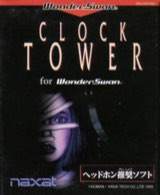
A black-and-white WonderSwan version of Human's horror adventure Clock Tower, in which the orphan Jennifer must run and hide from Scissorman in a remote mansion.
Screenshots
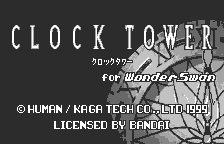
Title screen 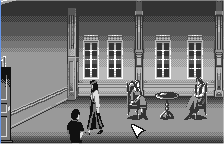
In play 

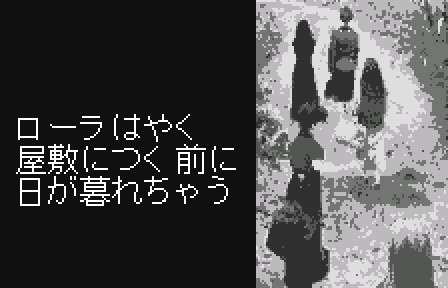
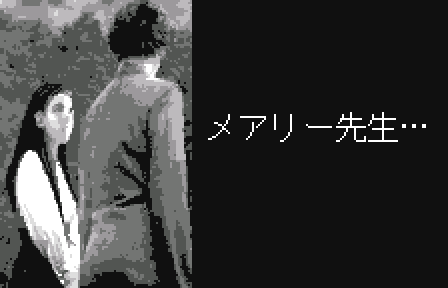
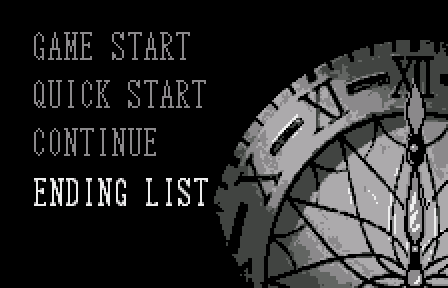
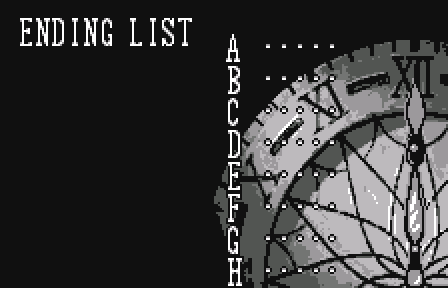
Clock Tower for WonderSwan is a handheld version of Clock Tower, the horror adventure that Human released for the Super Famicom on 14 September 1995. This black-and-white edition was published by Kaga Tech on 9 December 1999. As in the original, the player guides Jennifer Simpson through a mansion she is trying to escape from, while a killer known as Scissorman hunts her through its rooms.
Jennifer cannot fight, so the game is about pointing her at the right things, solving the mansion’s puzzles and getting away when Scissorman finds her. The game has nine possible endings.
The story
The mansion stands in the mountains of northern Europe. Its clock tower once rang a bell that gave the herders their signal, and people came to call the whole house the Clock Tower, until one day the bell stopped ringing. The house belongs to Simon Barrows, a wealthy man who lives shut away from the world.
In September 1995 four girls from the Granite Orphanage in Romsdalen, Norway, are taken in by Mr. Barrows. Jennifer Simpson is 14; her father disappeared and her mother died. With her come Laura, a gentle and shy girl of 14, Anne, at 15 the eldest and a little selfish, and Lotte, a lively 14-year-old who is Jennifer’s closest friend. Mary, their teacher at the orphanage, brings them to the mansion.
Mary leaves the girls waiting and goes to find their host. When she does not come back, Jennifer goes to look for her, hears a scream, and returns to find the lights out and her friends gone. From here she is alone in a huge house with rooms she does not know, and soon a killer with a giant pair of scissors, Scissorman, begins to follow her.
The tone is that of a horror film. Jennifer has no weapon and no way to strike back, so every encounter is about running, hiding or finding a trick that buys time. What she finds and does in the rooms decides which of the nine endings the story reaches.
How it plays
The WonderSwan is held horizontally. The player moves a cursor around the screen, and its shape changes over anything that can be examined, opened or used. Clicking empty floor sends Jennifer walking that way. She can also run to the left and right, but running costs stamina, and she gets it back only by sitting down to rest.
Most of the time the mansion is quiet, with little or no music. Scissorman does not turn up on a timer. He appears when Jennifer examines certain spots or reaches certain events, and in a few rooms he may appear at random when she walks in.
Once he appears the game switches to an escape state. Only the points that can help her get away or fight him off can be clicked, and Jennifer always runs. Some areas are places he never enters, but reaching one does not end the chase. When he catches her, the player has to mash a button to get free; in open spaces this becomes a struggle, and losing it means a heavy blow that takes much of her stamina. Caught in a small room or near the edge of the map, she gets no struggle at all and is killed outright. When her stamina runs out the game is over.
The way out of a chase is to use a repel point. Some of these are hiding places, and some need an item or a trap in the room. Not all of them always work, and some work only once. There is no portrait of Jennifer on screen; her stamina is shown by three dots at the side of the screen, and the inventory is browsed one item at a time with a button.
Progress is kept in the cartridge’s battery-backed memory. A death brings up a DEAD END screen, and the player can continue from just before it. A quick start option skips the prologue.
Each playthrough is a little different. Some items, the positions of some characters and even some of the connections between rooms are chosen at random, so a route learnt on one run may not work on the next. The nine endings depend on what Jennifer finds and does. The WonderSwan version takes its scenario from the PlayStation release: the item placement is changed, there are extra items, some of the newer graphics are used, and a mummy in the mansion comes to life.
The game is in Japanese. An English fan patch by BobSchneeder45 came out in August 2025, based on Aeon Genesis’s translation of the Super Famicom game with names changed to match Clock Tower: Rewind. The WonderSwan draws its messages with a small number of sprites, so in the patch some messages are very short or stay on a single line.
Development and release
The credits are split: Human is named for planning and development supervision, and Kaga Tech for publishing and sales. Whether Human also did the programming, or supervised another studio, is unknown. The cartridge holds 16 megabits with S-RAM for saving, is held horizontally and is for one player, and it has no link-cable play.
The announcement stressed the stereo sound through headphones, as a way to bring the effects and voices of a horror film to a handheld. The game was released in time for the winter of 1999, more than four years after the Super Famicom original.
Reception
Weekly Famitsu’s Cross Review gave the WonderSwan version 22 points out of 40, an average score. The Super Famicom original had scored 31 and the PlayStation release 27, so the handheld version scored lowest of the three.
Ports and other versions
The WonderSwan game is one of many editions of the first Clock Tower, which Human released on the Super Famicom in September 1995 and offered again through the Nintendo Power rewritable cartridge service in 1997. A Windows 95 edition followed in March 1997, with fixes for bugs, more music, new images and events, and rooms that could not be entered before; the PlayStation edition of July 1997, subtitled The First Fear, builds on that version and adds further scenes, among them a new room, a dagger and video sequences. Bandai’s announcement described the WonderSwan cartridge as holding the full PlayStation scenario, scenes added in that version included.
On the handheld the game is monochrome, and its pictures and sound are generally thought weaker than on the Super Famicom. Only the essential information stays on screen, messages appear in the upper left corner over the picture, and the character portraits are gone, Jennifer’s among them. What it keeps from the PlayStation release are some of that version’s new graphics, its changed item placement and extra items, and the mummy that comes to life, details that hint at Clock Tower 2. The music and effects play in stereo through headphones.
The WonderSwan version was never re-released, but the other editions came back. The Super Famicom game came to the Wii’s Virtual Console in 2010, to the Wii U’s in 2013 and to Windows through Project EGG in 2017, while the PlayStation edition was sold as a download for PlayStation 3 and PSP in 2011 and for PS Vita in 2012. Clock Tower: Rewind, released on 31 October 2024 for Switch, PlayStation 4, PlayStation 5, Xbox Series X/S and Windows, is built on the Super Famicom game; it offers an original mode true to that version and a Rewind mode that mixes in PlayStation features and new ideas such as random appearances by Scissorman, along with a function for winding play back a little, and it was the first edition sold outside Japan.