
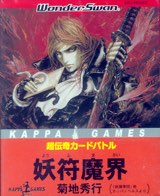
A story-driven card battle game set in Hideyuki Kikuchi's demon-haunted city, in which a lone bodyguard fights with talisman cards to rescue a lost boy.
Screenshots
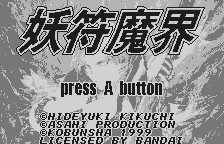
Title screen 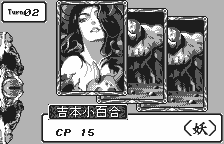
In play 
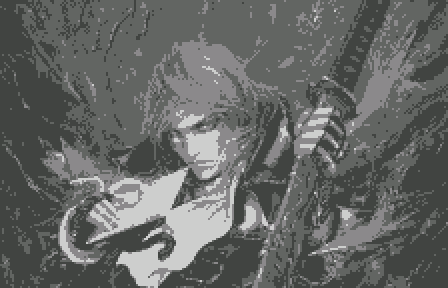
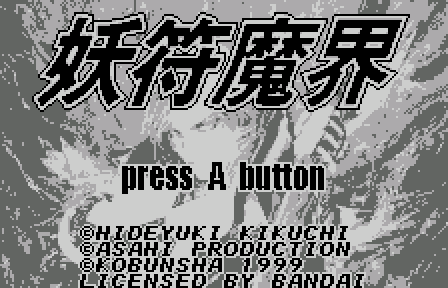
Chou Denki Card Battle: Youfu Makai is a card battle game for the original WonderSwan, published in Japan on 16 December 1999 by Kobunsha, the publishing house behind the Kappa Novels book line. The game came out under the Kappa Games name, and the full title also carries the name of the novelist Hideyuki Kikuchi, who wrote and supervised its scenario. Kikuchi made his debut in 1982 with Demon City Shinjuku, and this is the only video game among his works.
The setting is Kikuchi’s own fantasy world, and the scenario was written to match his stories. The game joins a novel to a card game: the story is read as text, and its fights are played out as card battles, whose results can send the story in different directions.
The game was released at the end of the WonderSwan’s first year on sale, and it was sold only in Japan.
The story
The game takes place in a city that was once orderly and peaceful until a catastrophe called the Demon Quake shook it to pieces in a single day. Its streets filled with strange spirits and monsters, and the district became a demon realm. This is the world of Kikuchi’s Demon City Shinjuku novels, and characters from several of his books turn up in it, as allies, as opponents and as cards.
The player is the hero, a lone hired bodyguard known only by that title, who walks into the ruined city holding the demon talismans that give the game its name. He has come for one reason: a boy named Masami has strayed into the lair of the demons, and the bodyguard has to find him and bring him out.
The story is told as a novel. Text runs down the screen in vertical Japanese lines, page after page, and is broken up by encounters with the people and creatures of the city; one of the opponents is a figure the game calls the Gate Keeper. Each encounter ends in a card battle, and the outcome of the battle decides where the story goes next. Not every defeat ends the game, and some characters can only be met by losing to the right opponent, so the path through the city differs from one play to the next.
How it plays
The WonderSwan is held horizontally. The X buttons move the cursor and turn the pages of the story, A confirms, B cancels, and the Y buttons are used on the deck screen to read about the cards. The title menu has five entries: the scenario, a battle mode against the computer, link-cable battles, the deck editor, and an option that wipes the save and starts from nothing. The game saves on its own, in the story before and after each battle, and continuing loads that save; the manual asks for the save to be cleared once before the first game.
In the scenario the text scrolls by itself. A moves to the next page, B shows a page in full at once, and the game keeps a backlog, so X2 and X4 page back and forward through passages that were skipped or are worth a second read. When an event leads to a fight, a versus screen shows the opponent and the game moves to the card table.
A battle is fought on a field of four spaces around a central marker. The player and the opponent take turns, each turn going through the same steps: look at the field, choose a card from the hand, place it, and fight. The aim is to fill all four spaces with one’s own cards, a rule the manual likens to a game of claiming territory; whoever does so first wins. If a deck runs out the game is a draw, which in the scenario counts as a loss. Losing a story battle usually means starting again from the last save, though some losses let the story go on.
Every card belongs to one of three attributes, Chou, You and Nen, and the centre of the field takes on the attribute of whichever kind is most common among the cards on the table, the earlier one winning a tie. Character cards are placed on an empty space or on top of one of the player’s own cards, and they can only attack when their attribute matches the field. Each carries a number of card points that serves both as its attack strength and as its life; an attack deals damage equal to the attacker’s points, and a card reduced to zero leaves the field. Allied cards are shown on black, enemy cards on white.
The centre of the field holds a needle that turns all the time, and character cards attack in the direction it turns. Special cards change the situation instead of holding a space: they can be played whatever the state of the field, take effect at once if their attribute matches it, and are gone after use. They come in two broad types. Reverse cards turn the needle the other way, so that attacks run backwards, and flip cards turn cards on the field face down or face up. Every card has a second side, and a card that is weak on one side can be strong on the other, so the manual advises checking the back of each card in the hand with B before playing it. Flip cards can weaken an opponent’s strong card or restore one of the player’s own damaged ones, and many have conditions, such as touching only the player’s cards or only Nen cards. The manual suggests relying mainly on character cards at first.
A deck holds exactly 30 cards, with at most three copies of any one card, and the editor will not let the player leave until the deck is complete. Beaten opponents give cards, and the card won varies from fight to fight. Every opponent defeated in the scenario can be fought again at any time in the computer battle mode, where the ones not yet beaten appear as blank white cards, and the manual urges the player to keep fighting until every card is collected. Link-cable battles need two cartridges; the winner takes a card, and the loser gives none up.
The card screens also hold a large amount of reading. Each card has a description of its character and an episode about it, written to bring Kikuchi’s world to the page, and the Y buttons switch between the two sides. The card rules are unusual and hard to read from the menus alone, and the game is very difficult without them: the first battles can be lost almost before they start.
Development and release
The package art is by Ayami Kojima, the illustrator best known for Kikuchi’s novels. The copyright line credits Hideyuki Kikuchi, Asahi Production and Kobunsha, and the manual names Asahi Production as the developer, the company to contact about the game’s content. The cartridge holds 16 megabits with S-RAM for saving and is held horizontally, and Bandai promoted link-cable battles between two friends as one of its draws.
Modes and features
The game is a mix of novel and card game, set in the world of Kikuchi’s Demon City Shinjuku series, with characters from several of his novels appearing together. Each menu entry carries a name from that world: the scenario is called To the Demon Card Realm, the computer battles Those Who Stand in the Way, the link battles Worthy Rival, the deck editor Demon Talisman Formation, and the reset Return to Nothing. The game has stereo sound.
Reception
Weekly Famitsu classes the game as a board game and gave it no review score. Players who wrote about it later are lukewarm: the artwork is liked, but the card system is found frustrating, enough for some to give up without finishing, and some wished the battles had been fought with something more direct than cards.
Ports and other versions
Youfu Makai was made for the WonderSwan and was never ported or re-released on another system. It is not part of a game series, and Kikuchi wrote no other video game scenario. The nearest relative is a different work: in 2005 his novel Alien Hihougai was turned into a three-part game for mobile phones, drawn from that one book, whereas Youfu Makai is a card game that brings together characters from several of his series.
Notes
The title is written in several ways. Famitsu gives it as KAPPA GAMES 伝奇カードバトル「妖符魔界」菊地秀行, while Bandai’s own text uses 超伝奇 in place of 伝奇, and lists of Kikuchi’s works give it simply as 妖符魔界.