
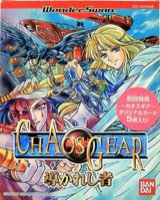
A 1999 WonderSwan strategy game set in the world of Bandai's Chaos Gear trading card game, sold with cards of five original heroes made for this version.
Screenshots
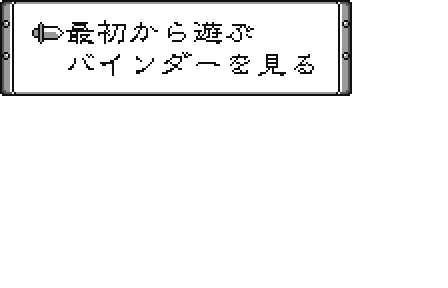
Title screen 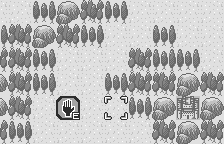
In play 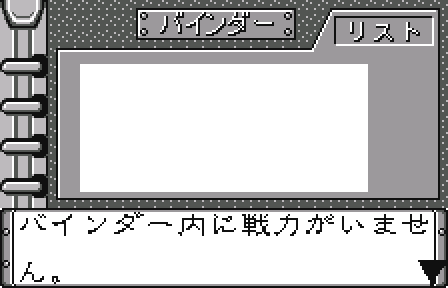
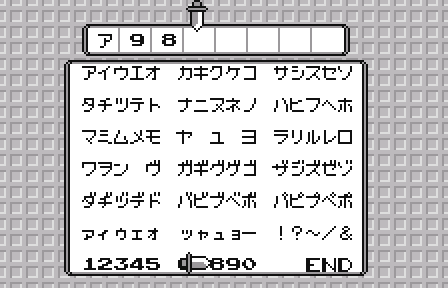
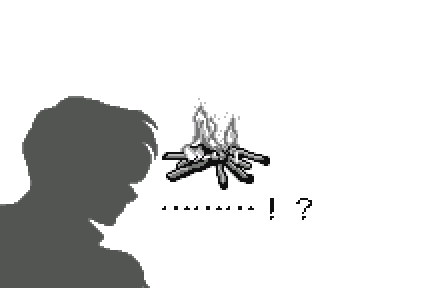
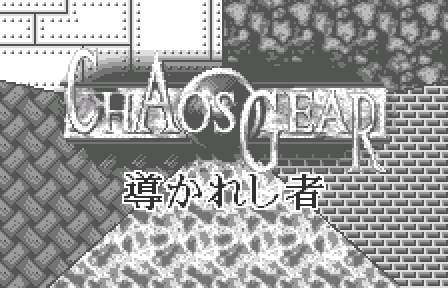
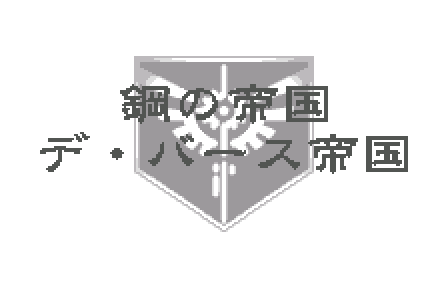
Chaos Gear: Michibikareshi Mono is a strategy game for the original black-and-white WonderSwan. Bandai published it in Japan on 10 June 1999, a little over three months after the console went on sale, and the studio Lay-Up developed it. The subtitle can be read as “the one who was led” or “the guided one”.
The game is based on Chaos Gear, a trading card game of the same name. Rather than using the license for an unrelated story, it sets out to recreate the world of the card game on the handheld, and it is a strategy game.
The WonderSwan version adds five heroes who exist only in this release. A special card for each of them was packed in the box with first-run copies, so the game came with real cards of its own as well as the digital ones on screen.
The story
The game is set on the continent of Chaos Gear, a world in which chaos is the force that runs everything. The oldest of its powers is the De Birth Empire, whose machines run on chaos and whose armies once ruled the central plains at the heart of the continent. Its rule did not last. Beast people who wanted a return to nature, and gifted people who could command spirits, rose one after the other and grew, through the power of chaos, into the Gaia tribes and the Mana Kingdom. Then the springs that supplied all three with chaos dried up at once. The empire, which burned chaos in huge amounts, lost its place as the strongest power, and the other two were too busy surviving to take over, so wide empty lands opened up between them.
Into those lands came the First Gainers, who could turn chaos that had vanished into the air back into solid matter, and for a while the central plains came back to life. Then one day the First Gainers all disappeared. The fighting over what chaos was left grew worse, the empire’s legions broke away from their homeland’s orders and became private armies, and the arrival of a band called the Eleal Brigade made things worse still. People began waiting for the one who would come after, as a prophecy left by the First Gainers had promised. That is the point at which the Chaos Gainers appear.
The player is one of them: a Chaos Gainer, a person from the surface world who can create chaos, summoned into this world and taken in as a new ruler with a castle of their own, sent to put an end to the turmoil. The four powers each have their own character. De Birth is an empire under an absolute emperor with giant machine armies, its strength crumbling so that some of its border lands now follow other powers. Mana is home to the four great spirits of earth, water, fire and wind and the mages who command them, terrifying in attack but weak in defence. The Gaia are beast people, each tribe with the shape of a different animal; they are poor at fighting alongside other tribes but fiercely loyal within their own and physically very strong. The Eleal Brigade are strange beings from the lands of chaos who travel in small caravans, each with odd powers that suit its shape and no great weakness. Outside all four are the Chaos Formers, fighters with no allegiance who live through the wars by their own strength, for the sake of gear.
There is no single hero with a fixed story. The campaign is a series of missions, each played on its own stage map, and the named heroes of the card game turn up stage by stage, some of them with events of their own. The art comes from the card game, which was drawn by more than 40 illustrators. The WonderSwan version’s five original heroes are one for each power: Prince Cedric of De Birth, Lanchel the knight of the lake for Mana, the shrine maiden Shelsia the Snow White for the Gaia, Ruthven for the Eleal Brigade, and a gentleman thief known as the Black Swan among the Chaos Formers.
How it plays
The game is held horizontally and played in turns on a map, and each turn is split into a political phase and an action phase. The aim on every stage is to strengthen the home castle by building on it, send out armies, and bring down the enemy’s main castle. The manual explains the controls, but the game does not tell a new player much about what to do first, and the player begins as a commander with no troops at all.
Everything costs gear, the money that castles produce each turn. However much gear was earned before, every session begins with only 10. Income rises by placing castle pieces on the walls and in the town around the castle, and building materials cost 5 gear each and take some turns to finish. Taking the empty castles on the map adds more income, but the bigger reason to take them is that it makes it harder for the enemy to surround the player or pour its armies in from one side. An empty castle goes to whoever reaches it first with a unit that is not a hero.
At the start only the Chaos Formers, who have no allegiance, can be hired. Troops of the four powers become available only after building materials of that power have been bought and finished, and recruits tend to gather at castles that share their power. Units are made up of a commander and the troops under them. Three things matter most: the commander’s special abilities, the number of troops the commander can lead, and the power the unit belongs to. A commander and troops of different powers cannot use their full strength, so the two should always match. The most useful abilities are shooting, which wears an enemy down without being drawn into close combat where it can hit back, and flying, which ignores the movement cost of terrain and is the fastest way to reach empty castles across water or rocky ground.
The usual advice is not to hire soldiers straight away. The enemy does not attack for the first few turns, and even when it sends out units from the second turn they need at least four turns to reach the main castle, so the first gear is better spent on income, with town pieces for De Birth and Mana a common first purchase because they open two strong kinds of troops. De Birth’s Riesen orbital gun has the longest reach and strongest shots of any troop, and enough of them can wipe out an enemy before it comes close; Mana has a fast flying commander suited to rushing troops into empty castles, though its low defence makes it a poor choice once the enemy strikes first. The enemy is slow to attack in general, so a stage can take a long time.
Between sessions only five units can be carried over, and the History screen records every card the player has collected, whether it was used or not, along with the highest level each castle reached. Collecting is the other half of the game: there are 181 kinds of troop card, and building castles of a single power raises the chance that the troops wanted will appear. Some heroes have their own events and some appear only on a second playthrough. Units still alive when a stage is cleared become cards that can be traded with a friend by linking two WonderSwans, and progress is kept in the cartridge’s battery-backed memory.
Development and release
Bandai launched the Chaos Gear card game in March 1998, and described the handheld version as a faithful recreation of that card game’s world, aimed squarely at people who already played the cards. The game was announced with the five original cards as a limited first-run bonus. The box held a 46-page manual, two flyers and the five cards. SB Creative published a 111-page Perfect Guide in its WonderSwan books line in June 1999. The game is credited to Lay-Up, though this has never been confirmed. Layup is a Tokyo design and planning firm known for SD Gundam and other character work, and it began planning and releasing its own game software in 1997.
Modes and features
The campaign is played as a series of stage maps, the factions have their own recommended unit formations, and there are hidden events. The game holds data on subordinates, tactics and schemes, and formations and special abilities, which the Perfect Guide from SB Creative set out in full along with the statistics of every unit. It is for one or two players with link-cable support, and progress is kept in battery-backed memory.
Ports and other versions
Chaos Gear: Michibikareshi Mono was made for the WonderSwan, and it was never ported or re-released. It is not a conversion of an earlier video game: its starting point is Bandai’s paper trading card game, and Bandai presented the cartridge as a turn-based strategy game set in that card game’s world, with original heroes of its own that the cards did not have. No other Chaos Gear video game was made on any system, so the WonderSwan game is the license’s only appearance on a screen.