
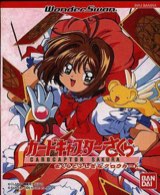
A raising game based on the Clow Card arc of Cardcaptor Sakura: a school year of lessons, friendships and card battles, with six endings and a linked card battle for two.
Screenshots
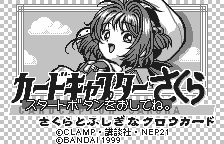
Title screen 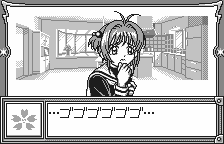
In play 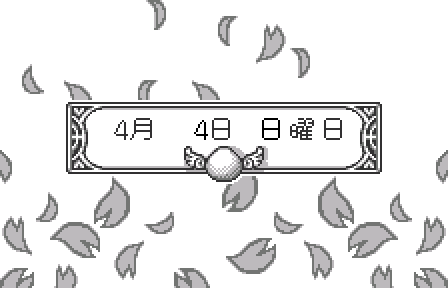
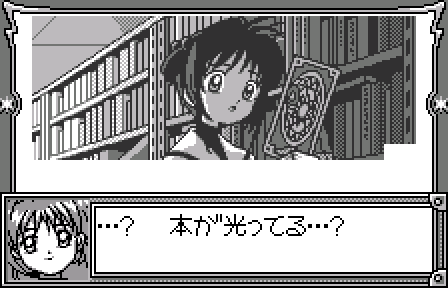

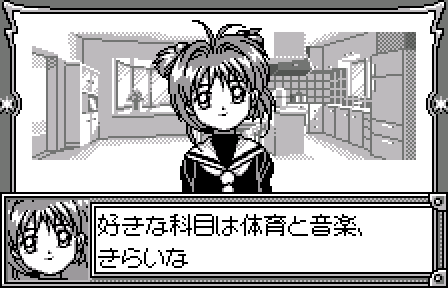
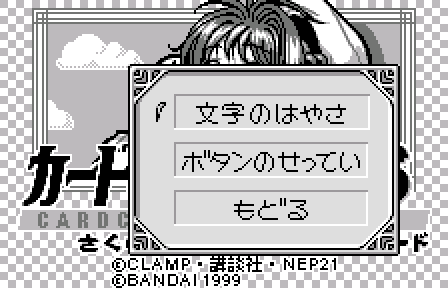
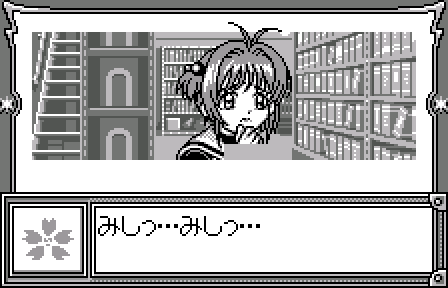
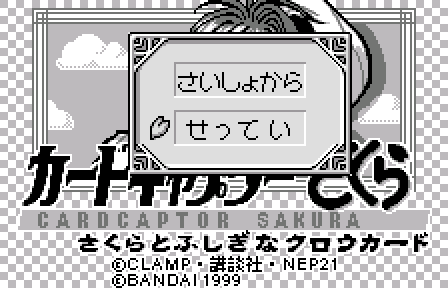
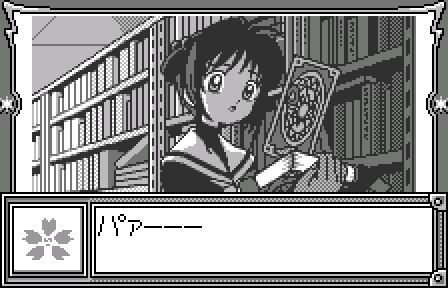

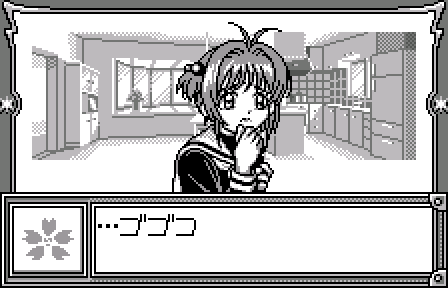
Cardcaptor Sakura: Sakura to Fushigi na Clow Card is an adventure game for the WonderSwan, released by Bandai on 2 December 1999. It is based on Cardcaptor Sakura, the manga by CLAMP serialised in Nakayoshi, and on its television anime, and it follows the first part of the story, in which Sakura Kinomoto sets out to gather the magic Clow Cards. It is credited to SIMS, though that has never been confirmed.
The game combines the anime’s Clow Card arc with stories written for it. Sakura spends a school year studying, making friends and capturing cards, and a friendship value decides which characters she meets and which of the many events take place. There are several endings, and which one the player sees depends on what happened along the way.
The cards gathered during the story can also be used outside it. In the Clow Card battle mode, players build a deck from the cards they have collected and fight a friend, with two WonderSwans joined by the link cable. It is often named among the console’s main titles.
The story
Sakura Kinomoto is a fourth-year pupil at Tomoeda Elementary School in the town of Tomoeda, where she lives with her father Fujitaka and her older brother Toya. In her father’s study she finds a strange book, and out of it comes its guardian, Kero. The book was meant to hold the Clow Cards, magic cards made by the sorcerer Clow Reed, but the cards have scattered across the town, and if they are left unsealed disaster will follow. Kero makes Sakura a Cardcaptor, and with his help she sets out to win the cards back.
The game opens on 4 April, the day Sakura becomes a Cardcaptor. The wind card is hers at once, and her first real fight follows the same day against the Fly. The first month covers the cards of the anime’s first episodes, the Shadow, the Watery and the Jump among them, and the rest of the year follows the arc card by card, with original episodes mixed in.
Around Sakura are the people she sees every day. Her best friend Tomoyo Daidouji makes her costumes. Syaoran Li is a transfer pupil from Hong Kong whose family is related to Clow. Yukito is her brother’s friend, and her classmates Chiharu, Rika and Naoko round out the school scenes; a girl named Meiling joins the class in September. Much of the story is small, everyday business, such as a date with Yukito, a trip to the Twin Bell shop for a stuffed toy, or Sakura remembering that Mother’s Day is near, and the magic arrives in the middle of it.
How it plays
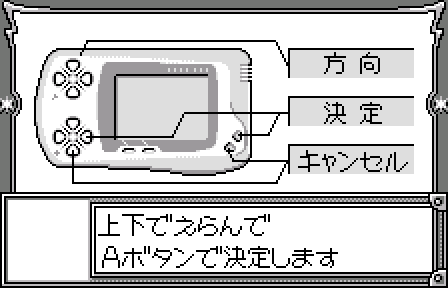
The game is played with the WonderSwan held horizontally, and it runs on a calendar from April to the following March. At the start of each school week the player picks up to two subjects from Japanese, maths, music, home economics, physical education and club activities. Each one raises some of Sakura’s statistics (HP, MP, knowledge, sensitivity, strength and speed) and adds to her fatigue. Some pairs give a bonus: physical education with club raises HP by 16 and strength and speed by 4 each. Sakura is bad at maths, so it tires her the most. Picking one subject lowers fatigue by 1, and picking none lowers it by 5 but costs a point in two random statistics. Fatigue runs from 0 to 20, each point drains a point of HP and MP, and at 20 she can take no lessons until she rests. Each statistic stops at 99.
Sundays and holidays are free days, unless a story event fills them. Only on these days can the game be saved, and the first chance comes on 18 April. On a free day Sakura can rest, which lowers fatigue by 5, go shopping, or go out to places such as Yukito’s house, Tomoyo’s house, the shrine, the promenade, the school or Penguin Park, or help with the housework at home. Meeting a friend raises that friend’s friendship level. Who is found where follows four rotating patterns, and a place joins the pattern only after Sakura has met someone there once. Many events and some card captures need a certain friendship level, so the free days are the heart of the planning.
The Twin Bell shop sells items for Sakura’s pocket money. A study book, a music CD and a skipping rope each cost 600 yen and raise knowledge, sensitivity, or strength or speed by a random 1 to 5 points, which the game does not display. Seasonal gifts appear for a few days or weeks each, a ribbon for Chiharu or a handkerchief for Rika for example, and raise that person’s friendship by 2. Others are needed to trigger an event, like the carnation sold only from 29 April to 5 May, or the chocolate ingredients of 6 February, which turn into handmade chocolate by Valentine’s Day. Sakura can hold only one of each item.
Captures are fought as one-on-one command battles. On her turn Sakura casts one of her cards, defends or dodges. A spell deals the card’s base power plus her knowledge and sensitivity, with a small random spread, it is cut to a fifth if the enemy is guarding, and it gains half again against a weakness. Damage taken is the enemy’s attack minus her strength and speed, and never less than 1. Defending cuts the damage further and restores 30 percent of her maximum MP, while a successful dodge restores 40 percent of her maximum HP and a failed one still costs a third of a normal hit. The enemy’s HP is not shown. The first fights teach the basics: the Fly has 100 HP, and the wind card is all Sakura has. The Jump in late April is a common early wall, and raising strength and speed is the usual remedy.
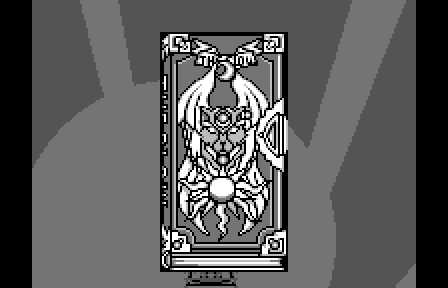
Every card captured becomes a spell with its own base power and MP cost. The attacking cards run from the wind card at 20 to the Earthy at 200, and the rest are tools: some raise Sakura’s speed for a few turns, the shield halves damage for five turns, the Time stops the enemy for five turns at a heavy MP cost, the flower restores half her HP, one card rewinds a turn, and the Thunder stuns the enemy for a turn. Only about 20 of the 47 cards are won in battle. The others come through events, some through a choice between two answers, and some only if Sakura’s friendship with a certain person is high enough or she already holds another card.
There are six endings. Losing to the last card or to Yue leads to the two weaker ones. Beating Yue without all 47 cards gives a third, and with all 47 the ending depends on whether Yukito, Tomoyo or Syaoran has the highest friendship, with no one else counting. Yue is much stronger than the last card and turns back about one spell in three, though not the Thunder, and a second attempt is allowed after a first loss. The game is not hard overall. Building HP and speed is the simplest way through the fights, and from late November friendships matter less than statistics, because the cards grow stronger.
Development and release
Bandai pitched the game to the anime’s whole audience, from schoolgirls to older fans, and described it as a game in which the player raises Sakura into a full-fledged Cardcaptor. It was billed as a raising role-playing game. First-run copies came with an original B2-size poster, and Bandai advised fans who wanted one to reserve the game.
Modes and features
More than 120 events are spread across the branching story, and the structure is close to a dating-sim schedule, with Sakura’s parameters raised between events. Sakura’s spoken lines come as voice clips, and how clear they sound for the hardware is a matter of taste. The cartridge keeps progress in battery-backed memory, and the Clow Card battle mode lets two players fight with decks of the cards they collected.
Ports and other versions
The game was made for the WonderSwan, and it was never ported or re-released; it is the series’ only WonderSwan title. Its relatives are the other licensed games of the same years, among them two Game Boy Color titles by MTO and three PlayStation titles by Arika, but none of them is a version of this one, which differs in mixing the Clow Card story with a friendship meter, branching events and a linked card battle. A 2012 Mobage game by Arika has a very similar Japanese name, yet it is a separate game, not a re-release of the WonderSwan cartridge.