
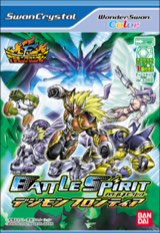
A Digimon Frontier fighting game by Dimps: knock spirits out of the opponent and hold the most when time runs out, with beast forms and Ancient super moves.
Screenshots
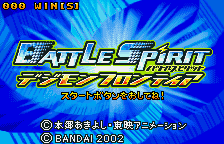
Title screen 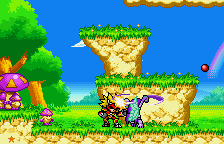
In play
Battle Spirit: Digimon Frontier is the second Digimon fighting game that Dimps made for Bandai on the WonderSwan Color, following Digimon Tamers: Battle Spirit from October 2001 and its revised Ver. 1.5 from April 2002. It is based on Digimon Frontier, the fourth Digimon television series, and came out in Japan on 7 December 2002, while the show was still on the air.
As in the earlier game, a fight is not decided by a health bar. Each hit makes the opponent drop spirits, and whoever has gathered the most when time runs out wins the round. This game adds spirits worth two and three points, a beast form that a fighter can switch into for a short time once a gauge is full, and an Ancient form for a super special move, and some attacks summon the ten warriors of the anime to strike. The cast is smaller than in the previous game, and a player who falls behind has fewer chances to turn a round around. Two players can fight each other by joining their consoles with the link cable.
The cartridge is made for the Color and does not run on the black-and-white WonderSwan. A Game Boy Advance version was later sold outside Japan.
The story
The game is built on Digimon Frontier, the fourth Digimon television series. Children receive messages on their mobile phones asking whether they want their lives to change, and the six who accept are taken to the Digital World, which Cherubimon rules through fear. There the spirits of the Ten Legendary Warriors, Digimon who saved that world long ago, let the children turn into Digimon themselves, and they set out to end Cherubimon’s reign.
The cast is those six children in their warrior forms. Takuya Kanbara becomes Agnimon, the warrior of flame; Kouji Minamoto becomes Wolfmon, the warrior of light; Tomoki Himi becomes Chackmon, of ice; Izumi Orimoto becomes Fairimon, of wind; and Junpei Shibayama becomes Blitzmon, of thunder. The sixth, Kouichi Kimura, fights as Löwemon, the warrior of darkness, and is a hidden fighter. Each warrior also has a beast form, and the stages are drawn from places in the show, among them the fire town of the first episode, the Candmon town of the third and an underground station where Trailmon run.
Beyond that set-up there is little story to follow. The single-player game is a run of one-on-one fights against the other warriors, with Cherubimon waiting once they are all beaten. Dimps aimed this game at looking cool rather than at the cute, comic feel of the earlier Battle Spirit games, with livelier fighters, faster music and far more spirits flying about, though the fighters are still drawn as small, big-headed figures; an early design with tall fighters in anime proportions was dropped. The special moves carry long, flamboyant names, and some attacks call the Ten Warriors onto the screen.
How it plays
The controls are simple and follow the earlier games. The X buttons walk the fighter left and right, with a quick double tap for a dash, and their up and down directions combine with B for special moves. A jumps, and the fighter can be steered in the air. B attacks, with reach and power that differ from fighter to fighter: each has a chain of B presses, a dash attack, upward and downward specials and versions of them in the air, and some moves grow stronger or keep going while B is held. Fairimon and Shutumon can double jump and dive with A in the air, and Blitzmon and Bolgmon can hover. Guarding at the exact moment a hit lands is a Just Defense: the display turns yellow, the evolution gauge fills, and the guard leaves no recovery time, so a counterattack comes quickly.
A battle is a contest for spirits against the clock. Every hit knocks spirits out of the opponent, and whoever has gathered more when time runs out wins. Ordinary D-Spirits are worth one point, Double Spirits two and Triple Spirits three, and each move has a set yield, from one or two for a light blow up to eleven for the heaviest attacks of Blizzarmon. Now and then Ancient Spirits, yellow diamonds, appear among the others. With five of them the fighter can press up, A and B together to evolve into its Ancient form for a super special move; a cut-in plays and the hit scatters seven Triple Spirits, twenty-one points at once.
The gauge in the middle of the screen fills as the fighter’s own attacks land. When it is full, A and B together trigger a slide evolution into the beast form, which raises attack and movement and makes Ancient Spirits drop more often until the gauge runs dry and the fighter changes back. Agnimon is an all-rounder whose attacks carry it forward and the fighter suggested for beginners, and its beast Vritramon hits harder, has a strong projectile and stays aloft on its wings. Wolfmon is quick, with a long beam blade and a Licht Kugel shot that grows when charged, and Garummon dashes on four legs. Chackmon reshapes its body by melting or freezing it, and Blizzarmon is a close-range fighter with two tomahawks. Fairimon dodges and strikes back and is strongest in the air, and Shutumon jumps high and dives on its opponent. Blitzmon is slow but the most powerful, with long reach and charges that plough through attacks, and Bolgmon is a heavily armoured tank. Löwemon has reach, attacks that change when the button is held and an Entrich Meteor shot that upsets the opponent, and Kaiser Leomon is fast with a rapid-fire shot.
Five fighters can be chosen at the start, and Löwemon and EX versions of Agnimon and Wolfmon are hidden, for eight in all; the EX fighters take Kaiser Greymon and Magna Garurumon as their beast forms. Each of the six main fighters has a home stage with its own hazards. In Agnimon’s Heat Pipe Town, the fire town of the first episode, Toy Agumon and fireballs drop from above. Wolfmon’s Factory of Light is a symmetrical room lit from the ceiling, easy to fight in apart from the Goburimon who roam it. Chackmon’s Sparkling Ice Park is the Candmon town of the third episode, with a slippery floor that the Candmon melt away as time passes. Fairimon’s Breeze Highland is a meadow in the forest with differences in height and mushroom springboards. Blitzmon’s Lightning Rock Dome is a stepped cave where Minomon pop up from below the footholds, and Löwemon’s Terminal of Darkness is an underground station where Trailmon run and spirits can drop through the rails.
Each clear of the single-player game awards a tag for the total spirits gathered, and a continue sets the total back to zero, so the higher tags need a run without one. There are ten ranks, In-Training, three Rookie grades, three Champion grades, Ultimate, Mega and Master, and the thresholds drop as the difficulty rises: Master needs 1,200 spirits on easy, 1,000 on normal and 700 on hard. Clearing the game with two of the five starting fighters, continues allowed, brings out Löwemon. After a clear with each of the six, a further clear with 800 or more spirits brings out EX Agnimon if it was made with Agnimon, Chackmon or Fairimon and EX Wolfmon if it was made with Wolfmon, Blitzmon or Löwemon, whatever the difficulty and time limit.
Two players can fight over the link cable, and tags can be won from a friend as well as earned alone. The game also links with the Digimon Pendulum virtual pets, and it recognises each WonderSwan it is linked to by the console’s serial number; Ophanimon marks at the bottom of the options screen show how many different people the player has fought. A clear after a link battle with one person or after one Pendulum battle brings out Löwemon, and a clear after link battles with five people brings out the EX fighter that matches the fighter used. Digimon Shoot, the minigame that opens after the first clear, is a kind of marble game played with Digimon: seven rounds against growing groups of warriors, some of which change with the player’s fighter, with an Ancient Spirit appearing on the fourth turn. It is very hard.
Cherubimon is fought in a different way from the warriors. It appears in turn at the upper right, lower right, centre, upper left and lower left, leaving orbs behind, more of them on higher difficulties; then it appears in the centre and sinks down, drawing in shards of rock, rises and vanishes, and calls down five bolts of lightning, which stop if its clouds are struck. The cycle then repeats, and the more damage it takes the more orbs it makes, its body turning yellow as the damage mounts. Waiting in the centre and striking when it appears low on either side is a safe approach, and the slide evolution is best saved until it reappears in the centre at the end of a cycle. Landing hits in beast form is the key to beating it on hard, and an Ancient attack that connects can finish it in one blow.
Development and release
Bandai counted the game as the third entry in the Battle Spirit line, with Ver. 1.5 included in that count, and pitched it as the version built around the cast of the Digimon Frontier anime. Agnimon, Wolfmon, Chackmon, Fairimon and Blitzmon are among the selectable fighters, and Bandai promised that a new lead character and new Digimon, still to be introduced on television that December, would also be playable. Bandai also announced a dedicated website for high-score rankings and news of events. Two strategy books were published: a complete guide from DigiCube that also covers the Pendulum Progress ver. 1.2 virtual pet, and a V Jump Books guide from Shueisha that deals with this game together with Ver. 1.5.
Modes and features
Choosing the right moment to switch between the human and beast types is part of the strategy, and Bandai pointed to the stages, a slippery ice floor among them, as differing in more than looks. Besides battles between two WonderSwans over the link cable, Bandai advertised linked play with the Digimon Pendulum virtual pets. The cartridge has battery-backed save memory.
Reception
The fighting is thought ordinary for a licensed game, but the sprite work and the elaborate names of the special moves stand out, and the game is recommended chiefly to fans of the show’s heroes.
Ports and other versions
The WonderSwan Color cartridge is the original release of the game. Bandai later brought it to the Game Boy Advance for players outside Japan under the name Digimon Battle Spirit 2, released in North America in September 2003 and in Europe in August 2004. That version has English, German, Spanish, French and Italian text, and it was not released in Japan.
IGN’s review of the Game Boy Advance release, published in October 2003, described it as essentially the same game Bandai had issued on the WonderSwan Color a year earlier, with the same technical limits as the first Battle Spirit conversion: a border around the play area because the WonderSwan screen has a lower resolution, fighters drawn with fewer colours, and music the reviewer found dated. The reviewer still found it fun and gave it 7 out of 10, and Metacritic averages the Game Boy Advance version at 63.