
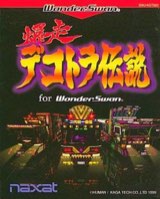
A handheld Bakusou Dekotora Densetsu in which the player hauls cargo across Japan, races rival truckers for their parts and spends the winnings on decorating the truck.
Screenshots
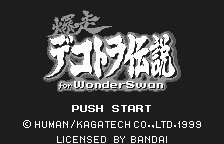
Title screen 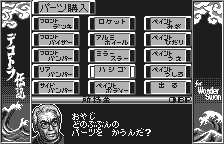
In play 
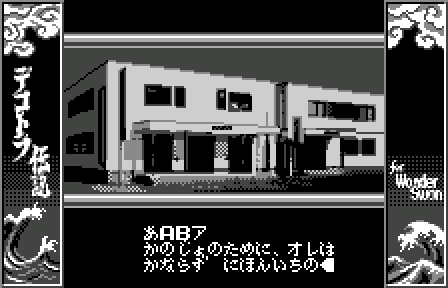
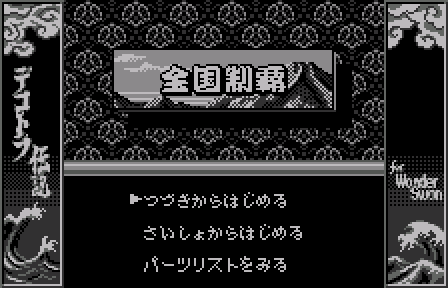
Bakusou Dekotora Densetsu for WonderSwan is a truck racing game for the original WonderSwan, released in Japan on 29 December 1999 by Kaga Tech, the company also known as Naxat. It belongs to the Bakusou Dekotora Densetsu series, which began on the PlayStation in June 1998 with a game from Human, and it is a reworked handheld version of that first game, released about a year and a half after it, during the WonderSwan’s first year on sale. “Dekotora” is short for “decorated truck”, and dressing up the player’s own truck is a large part of the game.
The player hauls cargo across a map of Japan and races rival truckers on the highway, seen from behind the truck, staking the delivery fee against the rival’s truck parts. The money and parts won are spent on decorating and tuning the truck, and two players can race each other over the link cable.
The story
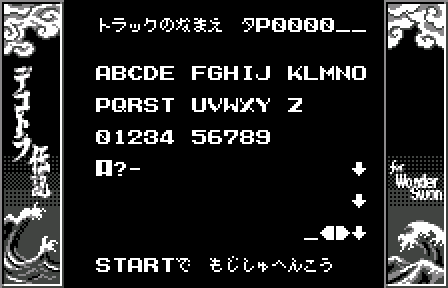
The hero is a trucker who sets out to beat the rival truckers of the whole of Japan and become the country’s best. At the start of a new game the player names both the hero and his truck.
He begins as a driver for a transport company, taking delivery jobs from town to town. Once he has saved enough money he can go independent, keeping every fee for himself and taking on higher-ranked truckers. Two ratings track his rise: attention, which grows as the truck is decorated, and legend, which grows as rivals are beaten. As they climb, stronger truckers come out to race him and rarer parts come within reach, and the road leads in the end to a race against the strongest trucker of all to decide who is the best in Japan.
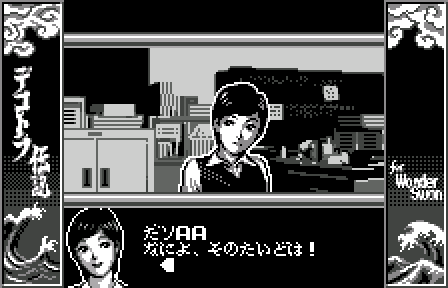
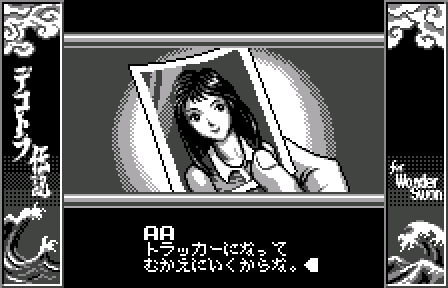
The story is told through events along the way. Rival truckers turn up on the road and pick fights, and the hero meets girls on his travels, at his destinations and at service areas. These scenes play out through two-way choices of reply, so the player’s answers change how an event goes. The PlayStation original told its story in a separate mode; on the WonderSwan the story is part of the nationwide conquest mode, which gives it more of a role-playing feel.
How it plays
The WonderSwan is held sideways and the Y buttons are not used. In the menus the X buttons choose and A and B confirm and cancel. In a race A is the accelerator and B the brake, and both the top speed and the braking power improve with tuning. X1 sounds the horn, which can make the ordinary car ahead speed up, and X3 is a shout, which can make it move out of the lane. X2 and X4 change lanes: one press puts on the turn signal and a second press in the same direction moves the truck over. Start pauses the race.
The race screen shows the road from behind the player’s truck, with its rear and roof decorations in view, and the rival’s truck on the road with it. Around the view are the elapsed time, a course map running from the start on the left to the goal on the right, the turn signal, the speedometer, a radar showing the cars and the rival ahead and behind, and a cargo meter of five pieces, one of which is lost each time some of the load is broken. Running into the back of an ordinary car slows the truck sharply, and following close behind the rival gives a slipstream that raises the speed, shown by a blinking lamp. If the goal is not reached before the time limit runs out, the race is lost.
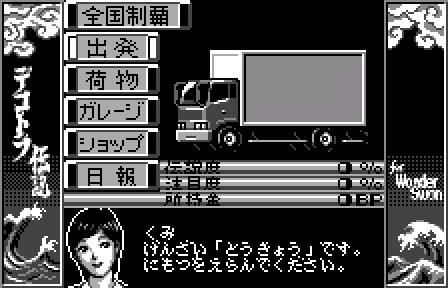
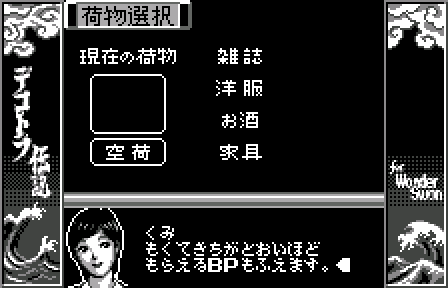
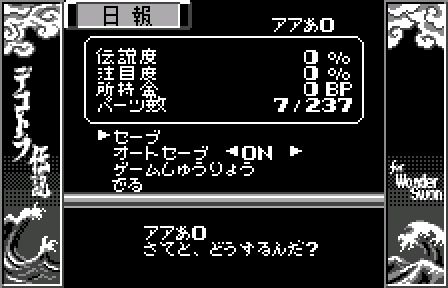
The main mode is the nationwide conquest. Its main screen offers departure, cargo, the garage, the shop and the daily report, which holds the save, an autosave switch that is on by default, and a count of the parts collected. The player cannot set out without cargo. Loads come in heavy and light kinds, such as steel plate, marble, timber and beer, the fee depends on the destination, and more kinds of cargo appear as the game goes on. Departing opens a map of Japan, and events can happen on the way, at the destination and at service areas.
A race against a rival is a wager: the player stakes the delivery fee and the rival stakes parts from his truck. Reaching the goal within the time limit wins both the fee and the rival’s parts, while a loss forfeits the fee. Rough driving breaks the cargo and cuts the fee, so a clean run pays more than a reckless one. In the girl events each reply raises or lowers her intimacy rating, and a high rating can lead to something good; fights with rival truckers are also settled by choosing replies.
The garage changes parts and trucks. A truck is dressed up part by part, with a front deck, front visor, mirror stay, front, side and rear bumpers, a ladder, a rocket, aluminium wheels and paintwork for the body and for the left, right, top and back, and other vehicles can be won through events and driven instead. Besides the parts on sale, rare parts can only be won from particular truckers, which makes collecting a goal of its own. Decorating raises the attention rating, and together with the legend rating it decides which truckers and parts the player can reach.
The shop sells parts and tunes the truck in four areas: low-speed torque, mid-speed torque, top speed and brakes. Each has ten levels, every step costs money, and only the first five can be bought until the player has gone independent, which makes saving up for independence the first big goal.
The link battle needs two WonderSwans, each with the game, joined by cable and set to the link option on the menu. The players first choose whether to stake nothing or to stake parts; parts can only be staked when each side owns parts the other lacks, and the winner takes the loser’s staked parts. The course is chosen by moving two cursors on the map of Japan. The shout cannot be used in a link race, and if the cable comes loose the race carries on against a computer driver.
Development and release
The credits are split: Human, maker of the PlayStation original, is credited with planning and development supervision, and Kaga Tech with release and sales. The game was announced at a planned price of 3,980 yen before tax, on a 16-megabit cartridge with 256 kilobits of battery-backed save memory, played with the console held sideways, and was billed as combining three elements, racing, role-playing and collecting. The WonderSwan version is the work of Human and Kaga Tech, which also traded as Naxat.
Modes and features
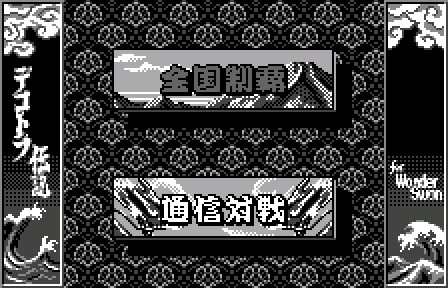
There are two modes, the nationwide conquest for one player and the link battle for two. The game has stereo sound and saves to battery-backed memory, and enka music plays during the races, as in the rest of the series.
Reception
Players’ reviews are mostly warm. Players enjoy the atmosphere and the decorating. The most common complaint is that the black-and-white screen makes the trucks hard to make out, along with thin horn and voice sounds, and players have also wished the decorated trucks could have been seen in colour.
Ports and other versions
The WonderSwan game is an adaptation of the first game in the series, Bakusou Dekotora Densetsu: Otoko Ippiki Yume Kaidou, which Human released for the PlayStation in June 1998 and reissued as a budget edition in November 1999. Bandai presented it as that game arriving on the WonderSwan, and it is an arrangement of it for the handheld. The WonderSwan version was never ported or re-released.
The two are not identical. The PlayStation game’s separate story mode was merged into the nationwide conquest mode to give the WonderSwan version more of a role-playing feel, collecting was given more weight through rare parts that only certain truckers hand over, and the handheld version has a link-cable mode in which two players stake parts on a race. On the WonderSwan the trucks are also shown in black and white.
Players feel that the playing feel and spirit of the series came across well, though the graphics are judged plainly weaker than the PlayStation game’s, and the hard-to-read monochrome trucks and thin horn and voice sounds are singled out. The Game Boy Color game of 2000 is a separate related title rather than a version of this one.
Later history
Human followed it in July 2000 with a Game Boy Color game in the series, released by KID, which likewise offers a nationwide conquest story and link-cable battles. Human later went out of business, and further games in the series came from other companies, Spike among them.
Notes
The developer is not settled. The game is usually credited to Human but sometimes to KID; KID published the Game Boy Color game rather than this one, which may explain the mix-up. Human, though, is credited with planning and development supervision rather than the whole of development, which leaves open whether another studio did the programming. The Japanese title is written with WonderSwan both in English letters and in katakana.