
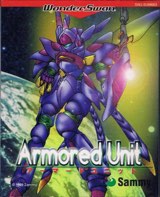
A science-fiction strategy game from Sammy in which the player's armoured robot hunts an unseen enemy on a small grid by radar, with link-cable duels for two players.
Screenshots
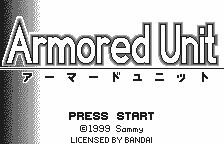
Title screen 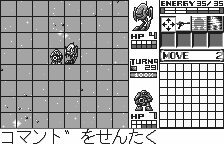
In play 
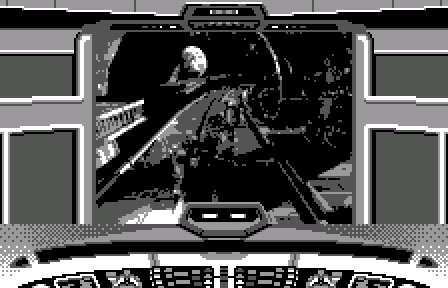
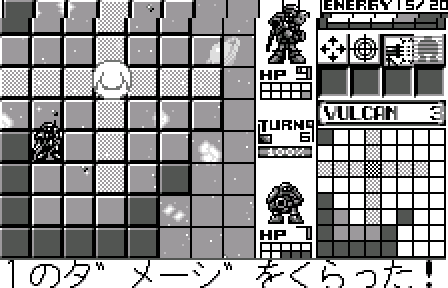
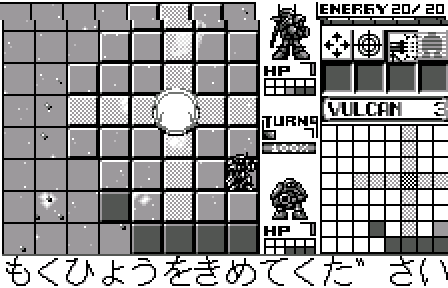
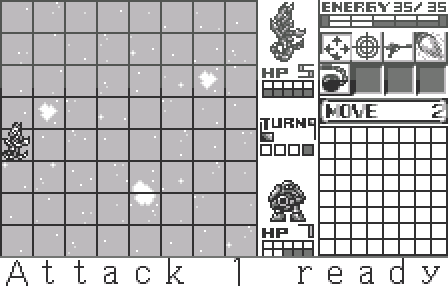
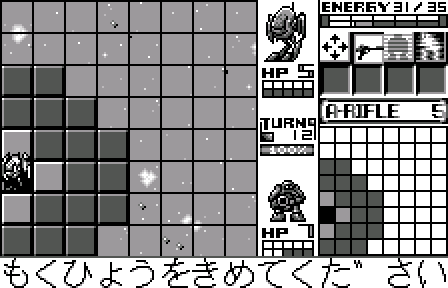
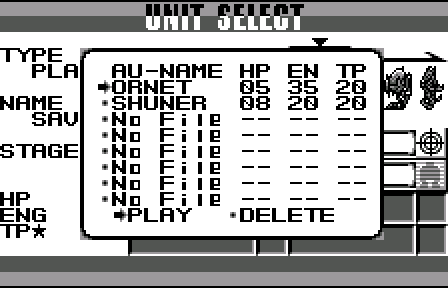
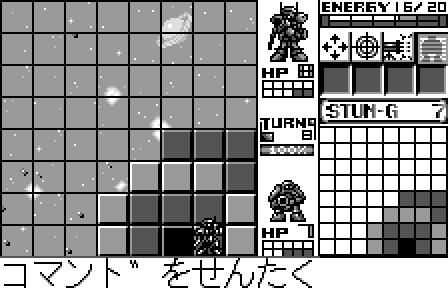
Armored Unit is a science-fiction strategy game made and published by Sammy for the original WonderSwan. It was released in Japan on 18 November 1999, on a 4-megabit cartridge, and was sold only in Japan. The title is printed in English on the package.
The player pilots one of the fighting robots of the title against a rebel army. Each battle is a duel on a small grid against an enemy unit that usually cannot be seen, so it has to be found with sonar and radar before it can be hit, which makes a fight closer to a game of hide-and-seek than to a standard tactics battle. Points won in battle are spent on tuning the robot between fights, and two players can fight each other over the link cable.
The story
The game is set in the far future, in a world where combat robots called Armored Units, AU for short, have become the main weapons of war. A rebellion breaks out inside the army, and the rebels seize bases all over the land. The player is the pilot sent out to beat them and bring back peace, and the manual tells the player that nobody else can do it. Bandai’s announcement gives the aim of the story more sharply: to stop the enemy from finishing its ultimate weapon.
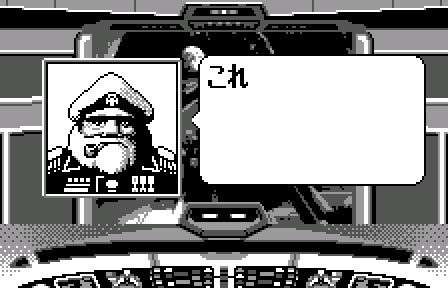
The story is light, a frame for the battles rather than a drama. It is told in short scenes of dialogue between battles, in which a commanding officer who looks much like Captain Okita of Space Battleship Yamato sends the player into the next area with little more than an order to go, and remarks as the enemy’s attacks grow fiercer. The player is represented by the chosen robot. Each of the ten units in the game has its own name and type, such as Welg and Shuner, the two Knights.
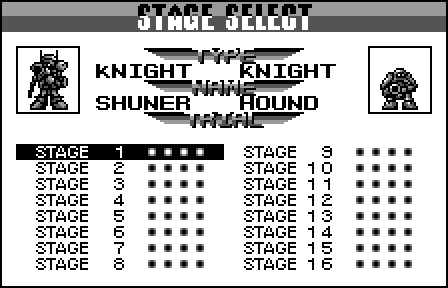
The story mode runs through a series of maps in a fixed order, each a battle against rebel units, and clearing the last map leads to the ending. Along the way the player’s robot grows stronger with each victory, and the story mode is the only place where new units can be gained.
How it plays
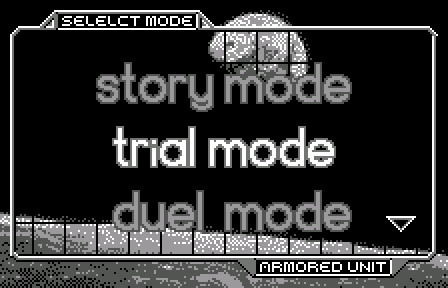
The WonderSwan is held sideways. The X buttons move the cursor and the robot, A confirms a command or an attack and B cancels; the Y buttons are not used. Start pauses the game, except in a link battle. The title screen leads to a mode select with the story mode, the trial mode, the duel mode and an option screen, which turns the music and the sound effects on or off.
A battle is fought on a field of eight by eight squares, which the manual calls hexes. Two robots cannot see each other on the main screen once they are two or more squares apart, so the enemy normally stays hidden and only shows itself when it comes right next to the player’s robot. Beside the field, the screen shows both robots’ health and energy, the turn count, the command icons, a wait gauge and a small radar screen. Every command costs energy (EN), and after each action the robot has to wait for the wait gauge to fill before it can act again, even with energy to spare. The gauge fills in real time and the enemy acts on its own clock, so a wasted command leaves an opening. Bringing the enemy’s health to zero earns one victory point, and two victory points win the battle.
Finding the enemy comes first, since nothing can be attacked without knowing where it is. Moving costs 2 energy for every robot. There are three ways to search: the sonar is the standard one at 2 energy, the heat sensor costs only 1 but is less reliable, and the radar costs 3 and covers a wide area. Whatever a search or an attack turns up is marked on the radar screen as a number counting turns: 0 where the enemy is now, 1 where it was a turn ago, and so on, with a small digit for the tens. A turn in which the enemy was not found leaves no number, and the marks disappear after a while, much as numbers do in Minesweeper. The manual’s advice is to search wide early, because the sooner the enemy is found the smoother the battle goes.
To attack, the player picks a weapon and a target square. Each weapon has its own power, energy cost, range and area of effect, and an attack is impossible when the target is out of range or the energy runs short. Longer-ranged weapons hit for less and wide-area weapons use more energy; some weapons also search the squares they hit. The special commands bend the rules of the hunt: the booster doubles the distance the robot can move, the jammer wipes the information on the opponent’s radar, the flasher shows the enemy’s position on the radar for one turn, the decoy puts a fake robot on the map, the paint shot keeps the enemy visible on the map for five turns, the energy field raises the energy limit by 10 and the warp unit jumps instantly to any square within range at the price of 25 energy. The manual lists 23 parts in all, from the basic Vulcan gun to a heavy Gatling, missiles, a railgun and a hammer for close combat.
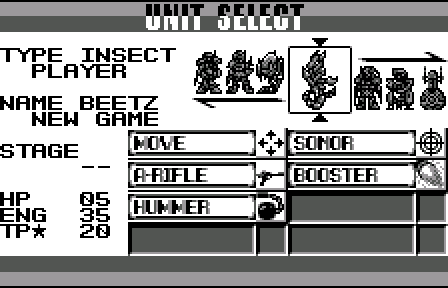
The robots come in five types. Knights have plenty of health but run short of energy, Insects have the most energy and are good at acting several times in a row, Rooks are made for long-range attack and also have a lot of energy, Seekers are best at searching and win by striking first, and Rangers combine high health with a balanced set of equipment. Ten units are listed in all, two Knights, three Insects, a Rook, two Seekers and two Rangers, each with its own starting equipment and between 5 and 8 health and 20 and 35 energy. Only some are available at first, and more can be chosen as the story mode goes on.
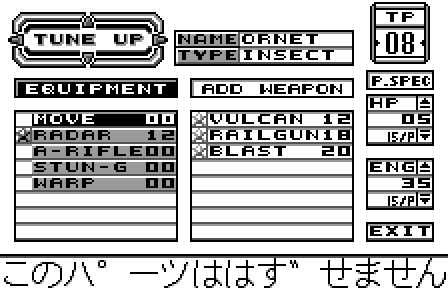
After each battle in the story mode the player receives tuning points (TP), and a faster, more precise win earns more of them. They are spent on raising the robot’s maximum health, raising its energy limit, or changing its parts. A robot can carry up to five kinds of parts, but its basic equipment cannot be taken off, and stronger parts cost more points and more energy to use, so the build has to stay in balance with the energy supply. Progress is saved to up to eight files, automatically when a robot is chosen and when a stage is cleared, and the same robot cannot be kept in two files.
The trial mode takes the robot from the story mode into practice battles for trying out weapon combinations and tactics, but it gives no tuning points; the manual recommends it as training for winning faster in the story. In the duel mode two players link their WonderSwans, each with a copy of the game, and the player who chose the mode becomes player one. The normal duel lets each pick any of the ten robots with its starting equipment, so that only skill counts, and the advanced duel brings in the robots each player has built up in the story mode. Because the enemy keeps acting in real time, pressing the attack once it has been found usually works better than careful planning.
Development and release
The game was announced at a planned price of 3,800 yen before tax, on a cartridge with 64 kilobits of save memory, played with the console held sideways. It was presented as a robot simulation built around the title’s armoured units, in which the player relies on radar to find and destroy enemies that cannot be seen, and the aim of the story is to stop the enemy from completing its ultimate weapon. Sammy listed the game under its name in katakana in its own catalogue of 1999 home releases, as a science-fiction robot simulation with two-player battles. The game carries only a Sammy copyright.
Modes and features
The game has stereo sound and battery-backed saving, and its duel mode needs two consoles, two cartridges and a link cable. The manual advertises a link cable of Sammy’s own, sold at 1,450 yen plus tax.
Reception
Players liken the game to well-known submarine-hunting games and find it fun, especially as a head-to-head game on a handheld. The real-time design, though, is felt to leave little room for thought, and the game has been seen as quickly made and likely to have been better with one action per turn.
Ports and other versions
Armored Unit was made by Sammy for the WonderSwan, and it was never ported, remade or re-released on another system. It belongs to no series. Its closest relatives are the classic hidden-submarine guessing games it is compared to, but here the search runs in real time against an enemy that keeps moving, and it is wrapped in a mech story with units that can be re-equipped and carried into a duel.
Notes
The game is credited only to Sammy, though it may in fact have been made by an unnamed subcontractor. It is sometimes classed as turn-based strategy, but it plays as a real-time simulation.