

A WonderSwan Color spin-off of the Atelier alchemy series in which Marie and Elie share one workshop and can work on recipes separately or together.
Screenshots
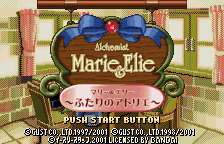
Title screen 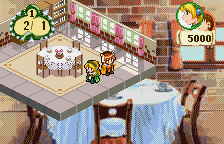
In play 
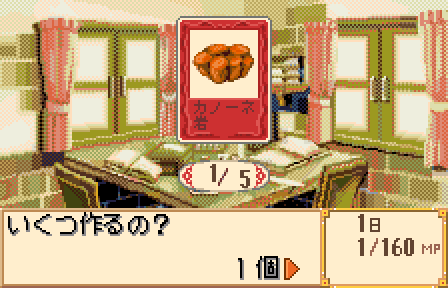
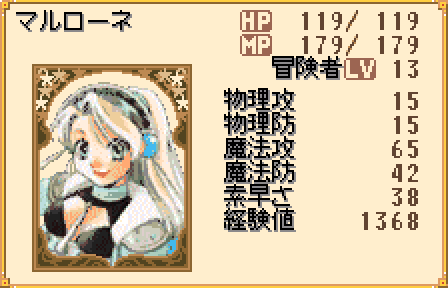
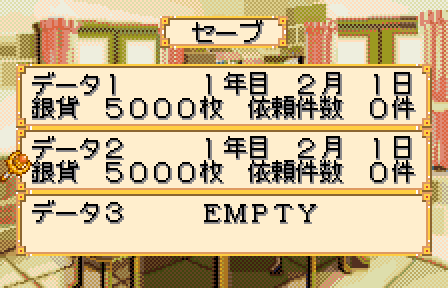
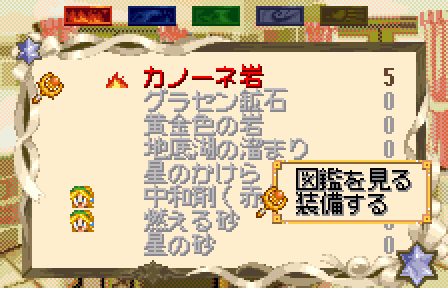
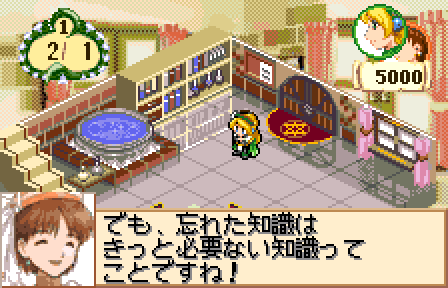
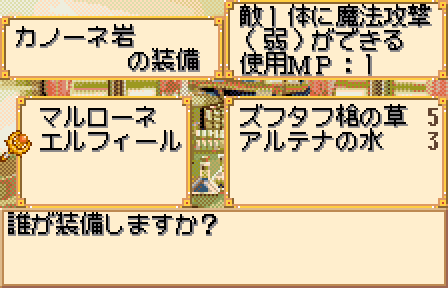
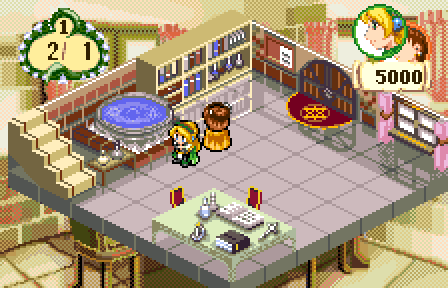
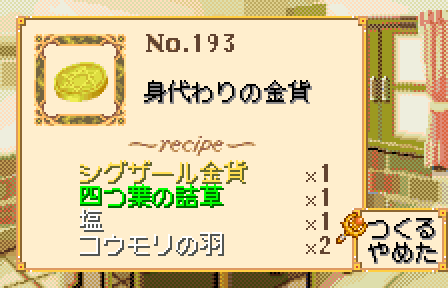
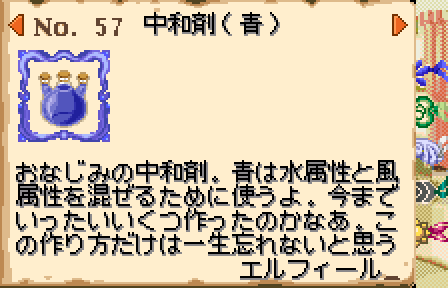
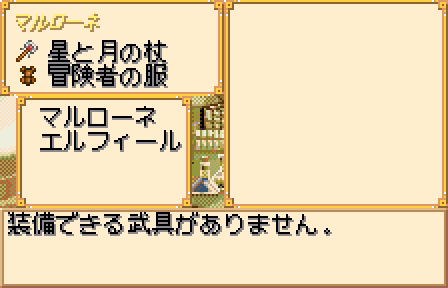
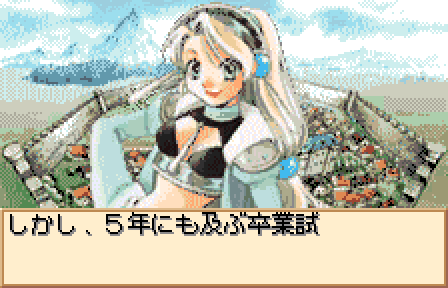
Alchemist Marie & Elie: Futari no Atelier is a spin-off of Atelier Elie, the second game in the Atelier series of alchemy role-playing games. It brings together the heroines of the first two games, Marie and Elie, and was released only in Japan, for the WonderSwan Color, on 25 October 2001. It was published by E3 Staff, a company that later became part of Happinet.
The story branches off from Elie’s own game: Elie and Marie share one workshop in Salburg and have three years to make a legendary item, the Origin Flame. Play follows the series’ cycle of gathering ingredients, combining them into items and spending days on each task, but here the player directs two alchemists at once and can have them work apart or together.
The cartridge is made for the Color and does not run on the original black-and-white WonderSwan. Its two-person synthesis carried over into the next handheld game, Atelier Marie, Elie & Anis, on the Game Boy Advance.
The story
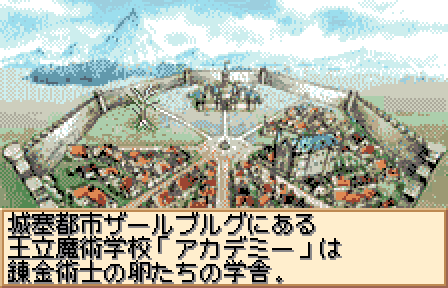
The game is set in Salburg, the city of the first two Atelier games, and it splits off from the end of the fourth year of Atelier Elie into a timeline of its own. Elie has graduated from the Academy, the royal school of magic, as a fully trained alchemist. Instead of staying on for the Academy’s higher Meister rank, she wants to use alchemy to help people in their everyday lives, and she travels to the scholars’ city of Kenntnis to study where alchemy came from. There she meets Marie again, the alchemist she has always looked up to. The two get on at once, promise each other to take their alchemy further, and travel back to Salburg together.
Elie was meant to open her own workshop on her return, but she finds it stripped bare by thieves, with everything she owned gone. Fuhlen, a young man from the Kenntnis Academy who now works at the Academy in Salburg, offers a way out: the Academy will pay her costs for the time being if she takes on one commission, to create the Origin Flame within three years. Nobody has ever seen the Origin Flame, and what it actually is remains the open question of the game. Marie cannot bear to watch her friend struggle and offers to run a workshop with her, so the two set up together, both already qualified alchemists aiming higher.
Marie and Elie are both heroines, and the story is told from both sides. More than 40 characters appear across over 400 events. Familiar faces from Salburg such as Kreis, Nordis, Millcassee, Dagllas and Enderk return, and there are a number of new arrivals. Chris Varnous entered the Academy younger than anyone before her and, with her twin brother Luca, runs the workshop Marie once used for her graduation exam instead of living in the dormitory. Ludwig is an alchemist and doctor who has been struck off by the Academy, a man in a black cloak about whom little is known, and he is assisted by a quiet girl with no name. Kaleido is a fortune-teller and alchemist who did poorly at the Academy, and Matthias is an old alchemist devoted to the search for truth, who employs Popple, a fairy who drops and breaks equipment and forgets what she was sent out to buy. Rolf is a skilled warrior who wants to become a holy knight and sees Dagllas as his rival, and Franchera, known as Flatz, is a capable adventurer who remembers Marie from her own childhood in Salburg.
The tone is that of a busy, cheerful town where the workshop’s neighbours and rivals keep dropping in. The story moves forward through the events the two run into as they visit people, take on work and travel outside the city over the three years. Its themes are the trust between the two heroines and the help of everyone around them, both of which are needed to finish the Origin Flame. How the pair spend those years decides which of several endings they reach.
How it plays
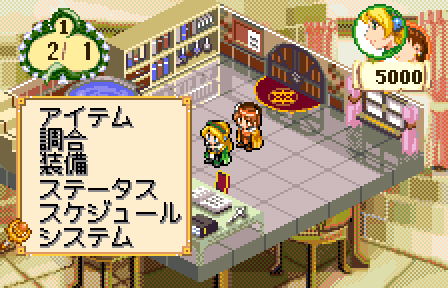
The game is for one player and is played in days. Every task, from a trip outside town to a single synthesis, uses up a number of days from the three-year limit. The basic loop is to take commissions for money, buy books, tools and ingredients, gather materials outside Salburg, and combine them in the workshop. Repeated synthesis raises each alchemist’s master level, which improves the success rate and lets her read more reference books, and so make more items.
Marie and Elie are controlled at the same time and given separate jobs. One can go out gathering while the other stays at the cauldron, both can gather in different areas, or each can work on a different item at once, and scheduling the two well is the quickest way to the goal. Going out into town together can also lead to events that one alone would not see. Two-person synthesis has to be learned before it can be used. Working on one recipe together raises the success rate and shortens the time it takes, and later in the game some items can only be made this way. About 200 items can be made, and some can only be made by Marie, some only by Elie and some only by the pair, so filling the item encyclopedia takes planning.
Recipes come from reference books. The official site listed 14 of them, each split into four chapters that open one by one as the reader’s knowledge or skill rating rises, at certain master levels, or after particular events. Six, including a confectionery book whose recipes are tied to the tea parties, are sold at the Academy shop for between 1,000 and 1,600 silver coins; four more are kept in the Academy library, three in the principal’s office, and one is found in ruins. The Academy shop also sells tools that help with synthesis, and the first one worth buying is a bigger basket, which raises the number of items picked up on each gathering trip. The general store sells ingredients, some of which cannot be found anywhere else, and its stock changes with the season, so it is worth checking often without buying more than is needed.
Money comes mainly from commissions taken at the Hishoutei tavern from Dio or Kugel at the counter. Bringing the requested item by the deadline earns the reward, while arriving late hurts the workshop’s reputation. Some requests ask for items the two have never heard of, so it pays to take work that matches their ability, and Dio’s warnings are a good guide. Money is needed for books, tools and ingredients, and for hiring escorts.
Ingredients have to be gathered outside the city, where monsters roam, and alchemists are poor fighters, so the usual answer is to hire adventurers as guards at the Hishoutei or the weapon shop. Strong adventurers charge high wages, so early on it is better to hire cheap ones to make up the numbers, and later to buy them weapons and armour. Battles are not fought command by command: the player chooses a plan for the party and the computer handles each member’s actions. Only Marie and Elie carry usable items into battle; the other members bring their own items, which act more like skills and grow in number as their alchemy or adventurer level rises. A bar shows how full the gathering basket is, and some items enlarge it for a while.
Friendship with the people of Salburg matters as much as skill at the cauldron. Going on trips with someone or buying from them brings the two closer, which leads to new knowledge and new places to gather. Once the story has moved on a little, the pair can hold tea parties in the workshop. A party needs something to serve, and the finer the food, the more likely friends are to come; each guest has their own tastes in food and talk, a closer friend gives a better result, and guests sometimes pass on important information or a recipe. Tea parties also relieve the heroines’ fatigue. Unlike earlier games there are many other alchemy workshops in town. Their alchemists sell finished items, mostly everyday supplies, they close on certain days, and some of them can join the party, with alchemy levels of their own.
The official ending is reached by starting the synthesis of the Origin Flame, and there is also a bad ending and several normal endings with conditions of their own: one, for example, needs both heroines at adventurer level 50 and every boss beaten, and another needs one of every tea-time food and drink in stock. The balance is gentle and leaves room to enjoy the events, though the story waits for the player to set its events off, and finishing the encyclopedia on a first run is hard.
Development and release
The game was sold under the E3 Staff name, with the company Hearty Robin given in brackets after it, and it carries Gust’s copyright for the original games alongside E3 Staff’s own. The price was 4,800 yen before tax. E3 Staff ran an official site for the game, which advertised a first-print extra: a drawstring pouch made to hold a WonderSwan Color. The game was placed in Weekly Famitsu’s Hall of Fame in the issue dated 2 November 2001, which went on sale on 19 October, a week before release. The site also offered a small fairy mini-game in the browser and linked to Gust’s own Atelier pages.
Modes and features
There is a single story mode, played over the three in-game years, with no link-cable play. Besides the main goal, the item encyclopedia and the several endings give reasons to play again, and the sound is in stereo.
Ports and other versions
Marie & Elie was made for the WonderSwan Color and was never ported, remade or re-released on another system. The main Salburg games began on the PlayStation and the Sega Saturn and later reached Windows, the Dreamcast, the PlayStation 2 and download services, while Marie’s and Elie’s own adventures also had separate Game Boy Color versions; this game is none of those, but a new story in which the two heroines share one workshop. A 2012 social game on GREE with a similar name, Marie Elie no Atelier, was a different game.
Later history
The game led directly to the Game Boy Advance title Atelier Marie, Elie & Anis, which Gust made with Banpresto in 2003 and which kept two-person synthesis. Gust lists the WonderSwan Color game among its own Atelier titles. Its premise of Marie and Elie opening a new workshop together in Salburg also became the starting point of a manga adaptation published by Enterbrain.
Notes
The developer is uncertain: the game is credited both to E3 Staff alone and to Gust together with E3 Staff. The game uses a 32-megabit cartridge with 256 kilobits of battery-backed save memory, and it is for one player, with no link-cable play.